
Profile Perfect Level 132 Answer
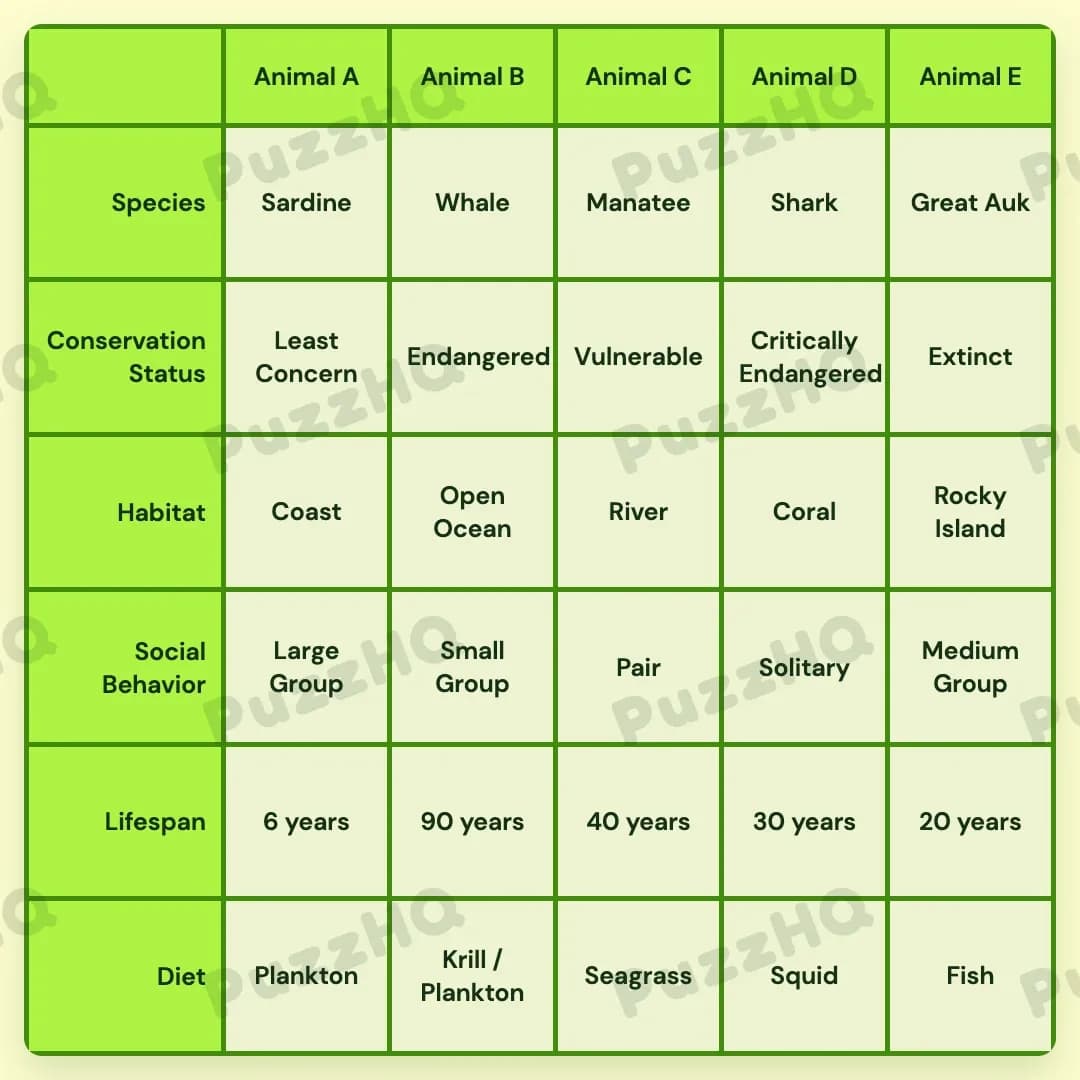
Spoiler warning: the complete five-animal profile breakdown for this marine and coastal conservation lineup is detailed below.
| Trait | Animal A | Animal B | Animal C | Animal D | Animal E |
|---|---|---|---|---|---|
| Species | Sardine | Whale | Manatee | Shark | Great Auk |
| Conservation Status | Least Concern | Endangered | Vulnerable | Critically Endangered | Extinct |
| Habitat | Coast | Open Ocean | River | Coral | Rocky Island |
| Social Behavior | Large Group | Small Group | Pair | Solitary | Medium Group |
| Lifespan | 6 years | 90 years | 40 years | 30 years | 20 years |
| Diet | Plankton | Krill / Plankton | Seagrass | Squid | Fish |
The Logic Behind Profile Perfect Level 132
Level 132 revolves around positional anchoring across the board, using spatial relationships and conservation rankings to lock the outer edges into place before filling in the dietary and social habits of each creature.
Finding The Outer Edges And Anchoring The Habitats
The board begins to take shape once we look at how the physical locations line up from left to right. Animal A is immediately identified as the Least Concern subject due to its rapid breeding, and a companion clue names the Sardine as this very same Least Concern animal. That gives Animal A both its species and status right away.
Habitat placements follow swiftly from spatial geometry. We are told that the extinct Pinguinus impennis, known historically as the Great Auk, once lived farthest from the Coast. Since Animal A belongs to the Least Concern status, a separate clue tells us that the animal to the left of the River's neighbor lives in the Coast. This phrasing means the Coast sits at the far left edge on Animal A, which immediately forces the Great Auk and its Extinct status over to Animal E on the far right.
With the Coast established at Animal A, the River animal must be Animal C so that its left-hand neighbor sits adjacent to the Coast. We also know the Vulnerable animal is beside the Open Ocean, while the Solitary animal lives directly next to the now Extinct animal at Animal E. This leaves the Open Ocean for Animal B, Coral for Animal D, and Rocky Island as the natural home for the Great Auk at Animal E.
Matching Species And Lifespans Across The Columns
Once the habitats and statuses are in place, the species fall into line through conservation categories and behavior clues. The Great Hammerhead Shark is identified as Critically Endangered, which places it squarely under Animal D. Meanwhile, Manatees are noted as strict herbivores living in Pairs, which perfectly aligns with the River habitat at Animal C.
With Sardine, Manatee, Shark, and Great Auk accounted for, the Whale takes its spot as Animal B, listed under Endangered status.
Lifespans provide the next interlocking layer. The River animal holds the second longest lifespan at 40 years, placing that figure under Animal C. A comparative rule states that the animal to the left of the longest-living animal is the shortest-living one. Since Animal A is at the far left edge, placing the shortest lifespan of 6 years on Animal A requires the longest lifespan of 90 years to sit directly to its right under Animal B.
From there, the remaining lifespans click into place. The Coral resident outlives the Rocky Island animal by exactly 10 years. Looking at the remaining values of 30 years and 20 years, Animal D receives 30 years and Animal E takes 20 years.
Social Circles And Diets Complete The Board
The social dynamics quickly clean up the remaining columns. The Small Group animal sits right next to the Least Concern animal, making Animal B the Small Group. The Shark is positioned two columns away from this Small Group, which verifies Animal D as the Solitary animal. Because the Large Group cannot be adjacent to the Solitary creature, the Large Group must belong to Animal A. That leaves the Pair for Animal C and the Medium Group for Animal E.
Dietary habits tie up the remaining open cells. The Manatee is a strict herbivore, claiming Seagrass at Animal C. The clue that the Krill eater sits three columns away from the second shortest lifespan of 20 years points straight to Animal B, giving the Whale a diet of Krill and Plankton. Because the Whale shares a similar diet with the Large Group animal, the Sardine at Animal A takes Plankton.
For the last two animals, the Coral resident avoids Plankton and Fish, leaving Squid for the Shark at Animal D. The remaining food source, Fish, goes naturally to the Great Auk at Animal E.
The Clue I Would Read Twice
The clue mentioning that the animal on the left of River’s neighbor lives in the Coast requires careful parsing. It is very easy to confuse whether the clue describes two steps to the left or a single step relative to an adjacent cell.
When read precisely, the neighbor of the River at Animal C is Animal B, and the animal to the left of Animal B is Animal A. This confirms Coast on Animal A and prevents players from accidentally shifting the entire habitat chain one column too far to the right.
Final Thoughts
What makes Level 132 memorable is the way environmental and biological traits weave seamlessly through the geography of the board. Solving it feels less like pure calculation and more like restoring a complete ecological index across five distinct habitats.
Comments