
Profile Perfect Level 326 Answer
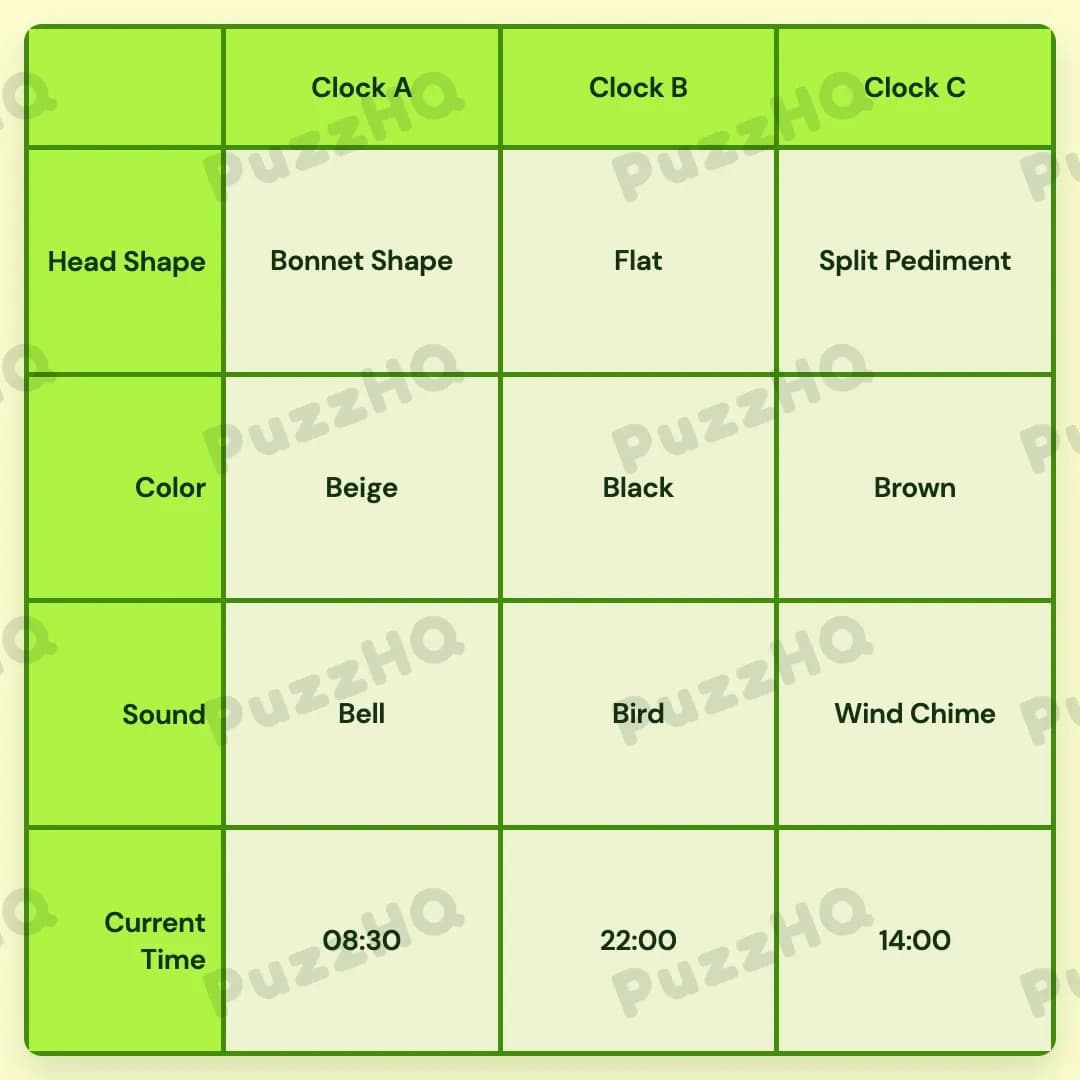
Clock A is the Beige Bonnet Shape clock with a Bell sound set to 08:30, Clock B is the Black Flat clock with a Bird sound set to 22:00, and Clock C is the Brown Split Pediment clock with a Wind Chime sound set to 14:00.
| Trait | Clock A | Clock B | Clock C |
|---|---|---|---|
| Head Shape | Bonnet Shape | Flat | Split Pediment |
| Color | Beige | Black | Brown |
| Sound | Bell | Bird | Wind Chime |
| Current Time | 08:30 | 22:00 | 14:00 |
How To Think Through Profile Perfect Level 326
The key habit for solving this puzzle is anchoring fixed identities before interpreting relative positioning and descriptive restrictions. When you secure direct assignments first, you immediately narrow down where the remaining traits can fit.
Start With Direct Identity: Clock B Plays Bird Sounds
Direct matching clues should always be your opening move because they give you concrete facts with zero guesswork.
The clue stating that Clock B echoes rare Bird sounds directly assigns the Bird sound to Clock B.
- Clock B sound is Bird.
This leaves only two sound options open: Bell and Wind Chime. By locking in Clock B's sound immediately, you simplify all future deductions involving sounds.
Use Descriptive Contrast: Flat Belongs To Clock B
Some clues describe visual attributes by comparison rather than naming an exact subject label.
The clue mentions that Clock B has a head shape simpler than the others. Comparing the three available head shapes (Flat, Bonnet Shape, and Split Pediment), Flat is plainly the simplest structural design.
- Clock B head shape is Flat.
Now Clock B has both its sound and head shape confirmed. The remaining head shapes to distribute between Clock A and Clock C are Bonnet Shape and Split Pediment.
Use Positional Separation: Placing Beige, Brown, And Black
When a clue states that two items cannot be neighbors in a linear row of three subjects, those two items must occupy the outer ends.
The clue notes that the Beige clock is not next to the Brown one. In a three subject lineup of Clock A, Clock B, and Clock C, the only way two items are not neighbors is if they occupy Clock A and Clock C, with Clock B positioned between them.
- Clock B color is Black because it is the only remaining color trait for the center slot.
- Beige and Brown belong to Clock A and Clock C in some order.
This is a powerful pattern. You do not need to know which outer end is Beige and which is Brown to lock in the middle subject color right away.
Link Linked Traits Across Categories: Split Pediment And The Afternoon Time
Multi trait clues combine traits from different categories without naming the subject directly. You resolve them by looking at which subjects can still accept both linked traits.
The clue states that the Split Pediment clock is stuck at an afternoon time. Looking at the three times (08:30, 14:00, and 22:00), 14:00 is the afternoon time. Therefore, the Split Pediment head shape and the 14:00 time must belong to the exact same clock.
We already know that Clock B has the Flat head shape. That means Split Pediment and 14:00 must belong to either Clock A or Clock C.
Now look at the clue stating that Clock C shows a time outside breakfast hours. The morning breakfast time is 08:30. Clock C cannot have 08:30, so Clock C must have either 14:00 or 22:00.
Another clue says that clocks not showing night time are not neighbors. The night time is 22:00. If daytime clocks cannot sit next to each other, the night time clock must sit in the middle at Clock B to separate the morning and afternoon clocks.
- Clock B time is 22:00.
- Clock A and Clock C must hold 08:30 and 14:00.
Because Clock C cannot be the breakfast time (08:30), Clock C must be 14:00.
- Clock C time is 14:00.
- Clock A time is 08:30.
Since 14:00 is linked directly to the Split Pediment head shape, Clock C also takes Split Pediment.
- Clock C head shape is Split Pediment.
- Clock A head shape is Bonnet Shape by elimination.
Resolve Outer Colors: Reading Visual Hints And Eliminating Options
Once Clock C is identified with specific traits, you can resolve the remaining outer color pair.
The clue tells you that Clock C is varnished, highlighting its beautiful colors. Since the two possible colors for Clock C were Beige and Brown, the rich Brown finish pairs naturally with Clock C.
- Clock C color is Brown.
- Clock A color is Beige.
Every subject now has an established head shape, color, and time.
Filter By Negative Restrictions: Wedding Sounds Separate The Final Pair
Negative clues tell you what something is not. They are ideal for breaking ties between the last two remaining values in a trait category.
The two sounds left to place are Bell and Wind Chime for Clock A and Clock C.
The clue mentions that the Brown clock does not play a sound usually heard in weddings. Bells are traditionally associated with weddings, so the Brown clock (Clock C) cannot have the Bell sound.
- Clock C sound is Wind Chime.
- Clock A sound is Bell.
The entire grid is now fully solved with every deduction supported by a specific clue.
What This Level Teaches You
Non Neighbor Clues Lock The Center Subject
Whenever three subjects stand in a row and a clue states that two items cannot be adjacent, those two items must sit on the outer flanks. You can immediately assign the third unused trait to the middle subject even before you know which outer subject gets which specific trait.
Time Descriptors Require Contextual Grouping
Clues that use everyday labels like breakfast, afternoon, and night time require you to categorize 24 hour times into standard periods. Grouping 08:30 as breakfast/morning, 14:00 as afternoon, and 22:00 as night time makes structural clues about neighbors and schedules immediately solvable.
Negative Clues Are Best Used At The End
Clues that state what a subject does not have, such as the Brown clock not playing a wedding sound, become vastly more powerful once one subject is already fixed. Instead of tracking multiple possibilities across all clocks, the negative clue cleanly decides the final pair.
Final Thoughts
The most crucial solving habit in this level was using positional layout to secure the middle subject. Recognizing that non adjacent items in a three item grid must bookend the center allows you to eliminate possibilities quickly and keep the deduction process clean.
Comments