
Profile Perfect Level 363 Answer
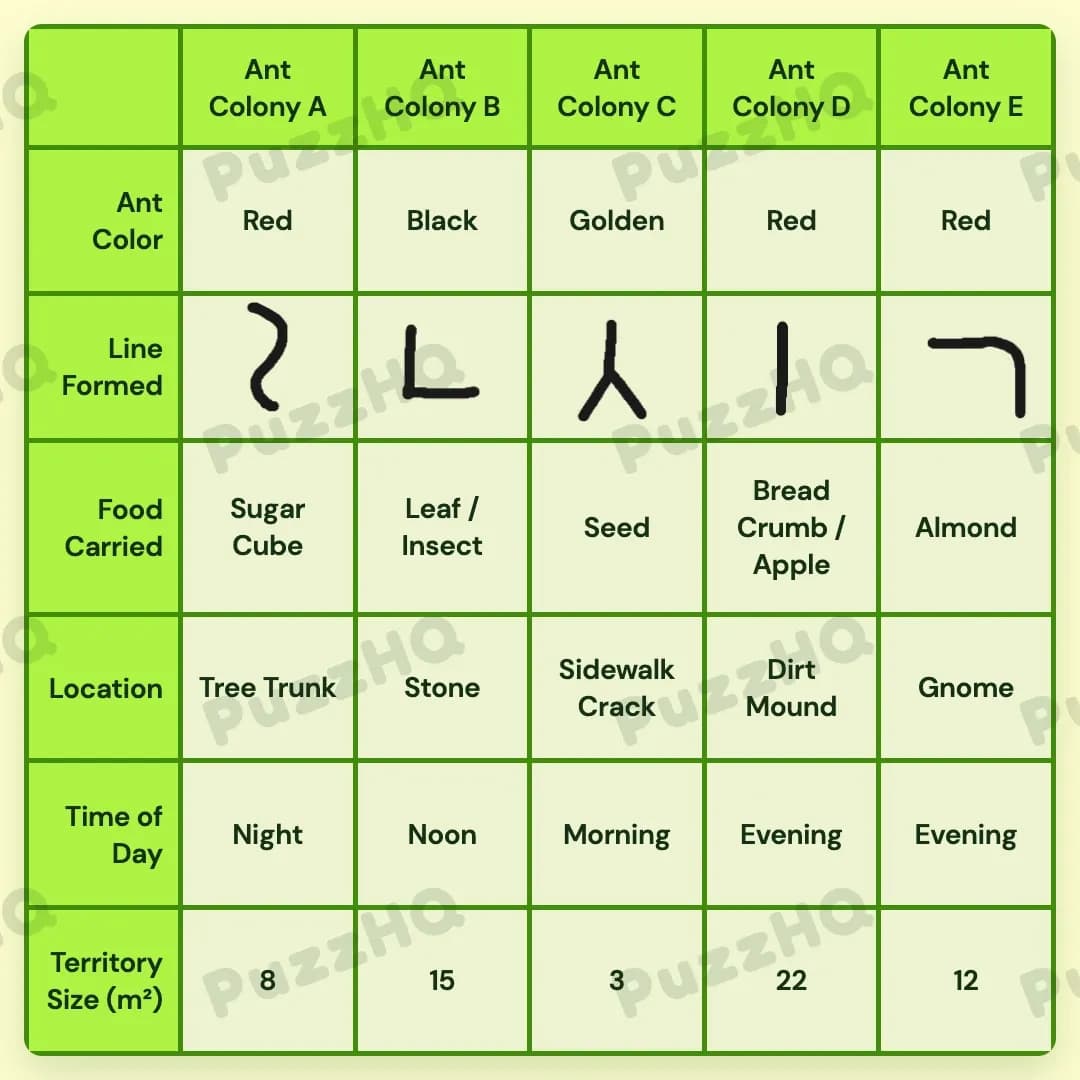
Here is the complete solution grid for the puzzle, followed by the step-by-step walkthrough.
| Trait | Ant Colony A | Ant Colony B | Ant Colony C | Ant Colony D | Ant Colony E |
|---|---|---|---|---|---|
| Ant Color | Red | Black | Golden | Red | Red |
| Line Formed | ShapeRotated | ShapeL | Shape^ | ShapeI | ShapeReversed L |
| Food Carried | Sugar Cube | Leaf / Insect | Seed | Bread Crumb / Apple | Almond |
| Location | Tree Trunk | Stone | Sidewalk Crack | Dirt Mound | Gnome |
| Time of Day | Night | Noon | Morning | Evening | Evening |
| Territory Size (m²) | 8 | 15 | 3 | 22 | 12 |
Clues of Profile Perfect Level 363
- Looks like the leftmost colony has a sweet tooth
- Ants in a formation are bringing gifts to the Gnome
- The middle colony makes a formation with the most branches
- Colony next to the Sugar Cube is working hard at Noon
- Sugar rush makes the ants move in a wavy trail
- A huge Stone blocks the colony that works at Noon
- The formation of Colony B is not merely a straight line
- Both Colony B and C control territories with odd sizes
- Wavy colony's territory size is not 12 m²
- The largest territory is owned by the ants in a formation
- Both ants carrying various food are not carrying Seeds
- Leaves are the favorite of the -shaped colony
- Insect and Almond are not seen in the largest colony territory
- Black ants colony is not beside the food containing yeast
- Almond does not neighbor Black or Golden ants
- Combined territory of Colony A and B exceeds Colony D’s
- Colony A’s home was once covered in shade, but not anymore
- Red ants do not follow the “early bird gets the worm” proverb
- More ants work during the Evening than during the Night
How To Solve Profile Perfect Level 363
This puzzle revolves around five ant colonies spread from left to right, each with its own ant color, marching formation, carried food items, nesting location, active time of day, and territory size. Positional hints anchor the left and middle colonies immediately, which unlocks direct deductions for foods, formations, and territory calculations.
Step 1: Anchor the leftmost colony and its neighbor
Clue 1 states that the leftmost colony has a sweet tooth. Ant Colony A is the leftmost column, so it receives the Sugar Cube.
Clue 5 reveals that a sugar rush makes these ants move in a wavy trail, assigning the wavy ShapeRotated formation to Ant Colony A.
Clue 4 notes that the colony next to the Sugar Cube works at Noon. Since Ant Colony A is the leftmost spot, its only neighbor is Ant Colony B, which takes Noon as its active time.
Clue 6 immediately connects the Noon schedule to a location, telling you that a huge Stone blocks the colony that works at Noon. Place Stone in Ant Colony B's location row.
Step 2: Place the middle formation, Gnome, and Tree Trunk
Clue 3 points to the middle column, Ant Colony C, stating it makes the formation with the most branches. Assign Shape^ to Ant Colony C.
Clue 17 notes that Ant Colony A's home was once covered in shade, but is not anymore. Out of the available locations, Tree Trunk matches a tree that has lost its canopy shade, locking Tree Trunk into Ant Colony A.
Clue 2 connects an angled formation to the Gnome location. Ant Colony E claims the Gnome location along with the ShapeReversed L formation.
This leaves two formations left to assign: ShapeL and ShapeI. Clue 7 states that Ant Colony B's formation is not merely a straight line. That gives ShapeL to Ant Colony B and ShapeI to Ant Colony D.
Step 3: Match the ant colors and remaining food types
Clue 15 states that Almond does not neighbor Black or Golden ants. Ant Colony E is at the far right end, making its only neighbor Ant Colony D. Placing Almond at Ant Colony E means Ant Colony D cannot be Black or Golden.
Clue 14 states that the Black ant colony is not beside food containing yeast (Bread Crumb). Since Ant Colony B neighbors Colony A and Colony C, Colony D carries Bread Crumb / Apple.
Because Colony D cannot be Black or Golden, the Black ants must be Ant Colony B, and the Golden ants must be Ant Colony C. That leaves Red for Ant Colony A, Ant Colony D, and Ant Colony E.
Clue 11 and Clue 12 confirm that colonies carrying mixed food do not carry Seeds, and leaves belong to the L-shaped group. Ant Colony B takes Leaf / Insect, while Ant Colony C takes Seed.
Step 4: Calculate territory sizes
Clue 8 notes that both Ant Colony B and Ant Colony C control territories with odd sizes. The odd sizes in the puzzle are 3 m² and 15 m². Ant Colony C takes 3 m² and Ant Colony B takes 15 m².
Clue 10 explains that the largest territory belongs to the straight line formation (ShapeI), giving the 22 m² territory to Ant Colony D.
Clue 16 confirms that the combined territory of Colony A and Colony B exceeds Colony D's size of 22 m². With Colony B at 15 m², Colony A must be 8 m² because 8 plus 15 equals 23, which is greater than 22.
Clue 9 notes that the wavy colony's territory is not 12 m², which further supports Colony A having 8 m². This leaves 12 m² for Ant Colony E.
Step 5: Assign the remaining locations and times of day
The two remaining locations are Dirt Mound and Sidewalk Crack. Clue 13 notes that insects are not found in the largest colony territory, which aligns with Colony D being at the Dirt Mound and Colony C taking the Sidewalk Crack.
For the schedule, Clue 18 states that Red ants do not follow the morning proverb. Colony C has Golden ants, so Morning belongs to Ant Colony C.
Clue 19 states that more ants work during the Evening than during the Night. With Morning and Noon already taken, Evening is assigned to both Ant Colony D and Ant Colony E, while Night goes to Ant Colony A.
Solution: Finish the remaining matches
Every category is now fully resolved across all five subjects:
Ant Colony A has Red ants, the ShapeRotated formation, Sugar Cube, Tree Trunk, Night, and 8 m² territory.
Ant Colony B has Black ants, the ShapeL formation, Leaf / Insect, Stone, Noon, and 15 m² territory.
Ant Colony C has Golden ants, the Shape^ formation, Seed, Sidewalk Crack, Morning, and 3 m² territory.
Ant Colony D has Red ants, the ShapeI formation, Bread Crumb / Apple, Dirt Mound, Evening, and 22 m² territory.
Ant Colony E has Red ants, the ShapeReversed L formation, Almond, Gnome, Evening, and 12 m² territory.
Key Clues Explained In Profile Perfect Level 363
Clue 1: "Looks like the leftmost colony has a sweet tooth"
This clue establishes the exact starting subject on the board. Because the puzzle subjects are arranged horizontally from Colony A to Colony E, Colony A is the leftmost colony. A sweet tooth directly links this spot to the Sugar Cube.
Clue 15: "Almond does not neighbor Black or Golden ants"
Position constraints make this clue powerful. Ant Colony E is on the far right edge of the grid, meaning it only borders Ant Colony D. By placing Almond at Colony E, Ant Colony D is barred from being Black or Golden, forcing those colors leftward into colonies B and C.
Clue 16: "Combined territory of Colony A and B exceeds Colony D’s"
This clue provides the exact arithmetic check needed to lock down the even territory values. Colony D has the maximum value of 22 m², and Colony B has the odd value of 15 m². Colony A must take 8 m² so that their sum reaches 23 m², edging out Colony D.
Final Thoughts
Solving this puzzle relies on converting early positional clues about the leftmost and middle colonies into fixed traits. Once Colony A and Colony B established their food and schedule, the color constraints and territory math fell into place naturally.
Comments