
Profile Perfect Level 54 Answer
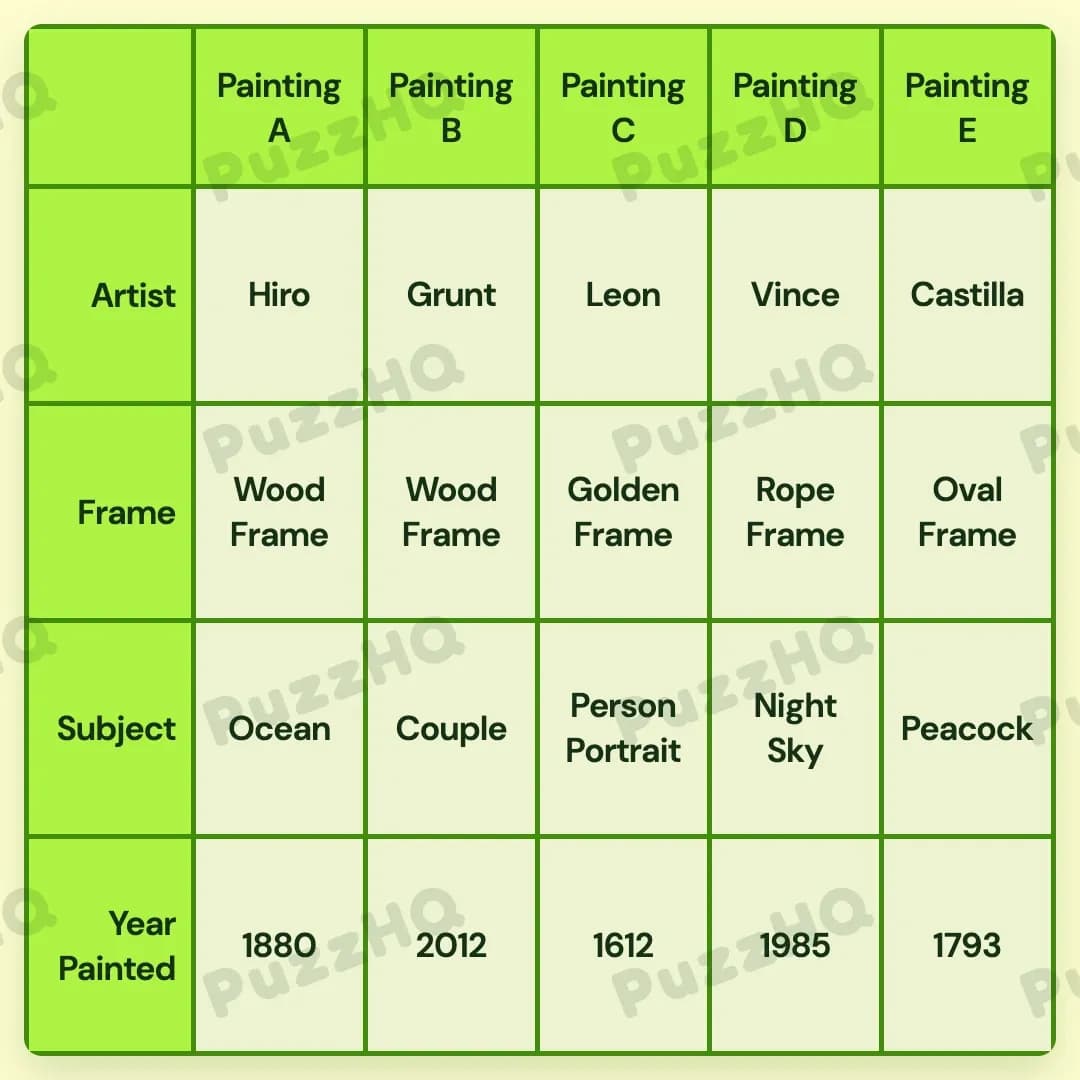
Here is the complete solution for this gallery layout puzzle.
| Trait | Painting A | Painting B | Painting C | Painting D | Painting E |
|---|---|---|---|---|---|
| Artist | Hiro | Grunt | Leon | Vince | Castilla |
| Frame | Wood Frame | Wood Frame | Golden Frame | Rope Frame | Oval Frame |
| Subject | Ocean | Couple | Person Portrait | Night Sky | Peacock |
| Year Painted | 1880 | 2012 | 1612 | 1985 | 1793 |
The Logic Behind Profile Perfect Level 54
Every good gallery puzzle has a natural anchor, and here everything unfolds from Painting C. Once the central portrait establishes its timeline and identity, the relationships between neighbors, human figures, and specific framing styles steadily bring the rest of the collection into focus.
The Portrait Locks Down The Center
The fastest way into this grid begins squarely at Painting C. We are told directly that Painting C is the work of Leon. That single fact links immediately to two other observations: Leon's piece is a portrait of a person, and the portrait was painted in 1612. In just a few lines, Painting C gains its artist, its subject, and its year.
From that 1612 creation date, math takes over. The clue noting that the portrait was drawn exactly 400 years before the couple gives us the second date without any ambiguity. The couple must have been painted in 2012.
Because we also know that paintings featuring humans hang directly next to each other, the couple has to sit right beside Leon's portrait. Since Painting C is in the middle slot, the couple belongs in either Painting B or Painting D.
Following The Timeline Across The Frames
Looking at the remaining dates helps untangle which side is which. The oval frame was crafted a few years before 1800, which points to 1793. Hiro worked in the 1800s, claiming 1880. That leaves 1985 as the only remaining year to pair with the remaining slots.
The clue stating that the peacock painting hangs adjacent to the piece from 1985 gives us a crucial spatial constraint. When we combine this with the pairing of the night sky and the rope frame, the pieces fall into place. Painting D takes the night sky, the rope frame, and the year 1985. Painting E becomes the home of the peacock, framed in the oval frame and dated to 1793.
With Painting D established as the night sky from 1985, the couple cannot be in Painting D. That forces the human neighbor, the couple dated 2012, into Painting B.
Matching The Final Artists And Wood Frames
With Painting B identified as the couple from 2012, Painting A naturally receives the 1880 date. Since Hiro painted in the 1800s, Hiro belongs in Painting A.
Two clues point toward wooden frames. Grunt's painting is preserved in wood, and the ocean painting is also inside wood. Since Painting A is Hiro's 1880 work, it claims the ocean subject and one of the wood frames. That leaves Painting B for Grunt, who also uses a wood frame for the couple.
The remaining details resolve cleanly. Castilla did not create the 1985 painting, which places Castilla in Painting E alongside the peacock and oval frame. That leaves Vince to take credit for the night sky in Painting D. To complete the frames, the golden frame slots into Painting C around Leon's portrait.
The Clue I Would Read Twice
"Paintings with human in them are next to each other" is the statement that quietly governs the entire middle portion of the board.
It is easy to treat this note as a minor flavor detail, but it acts as a strict geometric bridge. Leon's person portrait is locked at Painting C, meaning the only other human subject, the couple, is constrained to slot B or slot D. Without identifying that adjacency early, you might float the 2012 date across the edges of the grid and stall your progress on the remaining subjects.
Final Thoughts
What makes this grid enjoyable is the way the timeline acts as a bridge between separate traits. You do not just match dates to artists; you use date arithmetic to resolve spatial positioning between the two figurative paintings before tackling the landscapes and wildlife.
Comments