
Profile Perfect Level 128 Answer
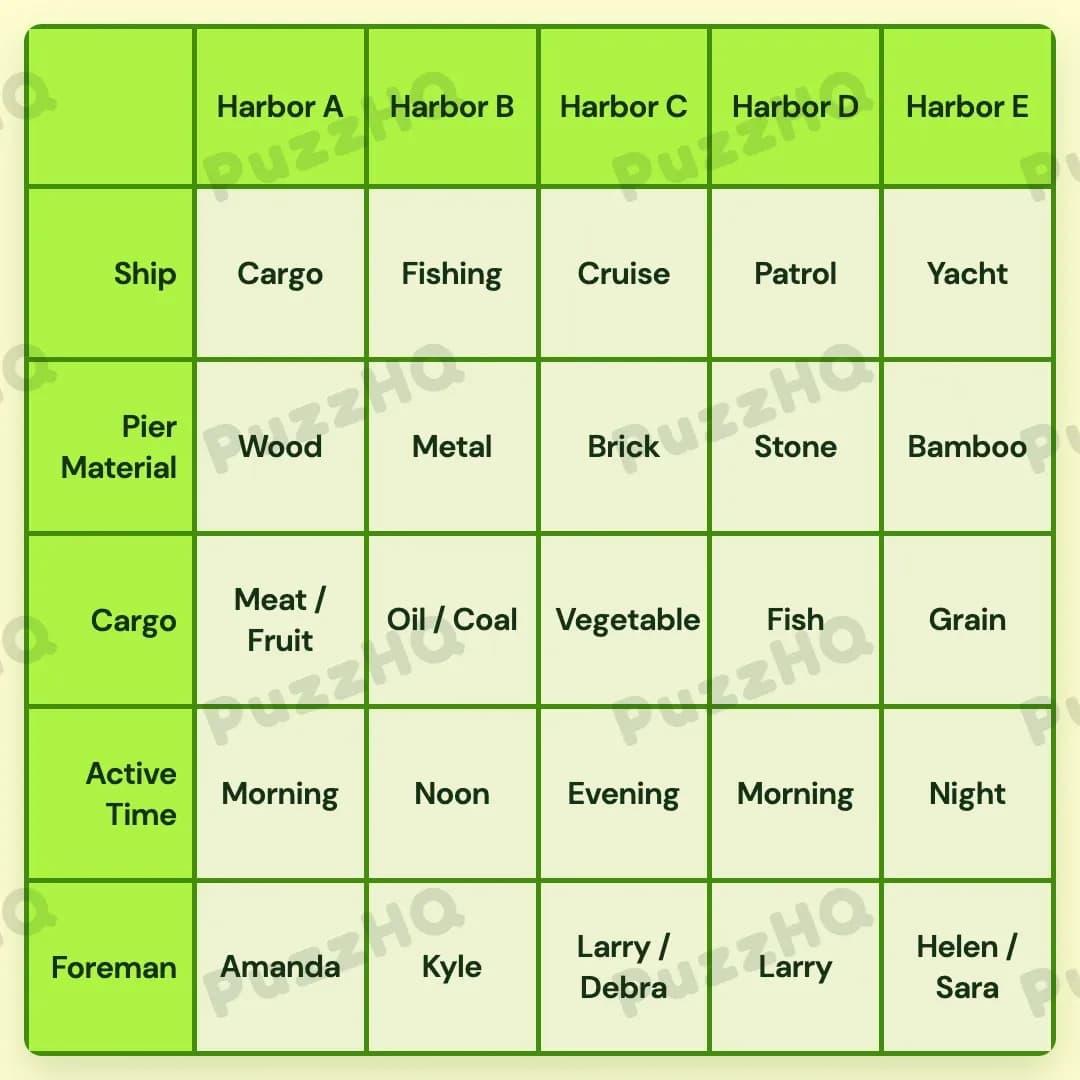
Harbor A through Harbor E host unique combinations of ships, pier materials, cargoes, operating times, and foremen across the coastline.
| Trait | Harbor A | Harbor B | Harbor C | Harbor D | Harbor E |
|---|---|---|---|---|---|
| Ship | Cargo | Fishing | Cruise | Patrol | Yacht |
| Pier Material | Wood | Metal | Brick | Stone | Bamboo |
| Cargo | Meat / Fruit | Oil / Coal | Vegetable | Fish | Grain |
| Active Time | Morning | Noon | Evening | Morning | Night |
| Foreman | Amanda | Kyle | Larry / Debra | Larry | Helen / Sara |
How To Think Through Profile Perfect Level 128
The most useful solving habit for this puzzle is using spatial layout clues to anchor the outer ends of the grid before resolving paired traits. By understanding how non-adjacent restrictions and directional relationships lock materials into specific columns, you can quickly eliminate uncertainty across the entire board.
Use Direct Multi-Trait Bundles: Kyle, Fishing Ship, And Metal Pier
Direct identity clues that combine two or three categories in one statement are the cleanest way to begin. Clue 15 states that Kyle stands on a Metal pier alongside the Fishing ship. This instantly binds the foreman Kyle, the pier material Metal, and the Fishing ship into a single movable block.
Similarly, Clue 5 tells you that Debra stands on a Brick pier. You do not know the exact harbor column for either group immediately, but grouping these traits right away prevents scattered notes and reduces several separate categories into unified packages.
Anchor Outer Edges Using Directional Clues: The Bamboo Pier And Fish Cargo
Positional statements that mention boundaries or direct neighbors narrow the horizontal placement of piers. Clue 11 specifies that the Fish cargo sits directly to the left of the Bamboo pier. This tells you two things: Bamboo cannot be Harbor A, and Fish cargo cannot be Harbor E.
Next, look at Clue 7, which states that Wooden and Bamboo piers are not next to Brick. If Debra is on a Brick pier (Clue 5), Brick must be insulated from both Wood and Bamboo. Placing Brick in Harbor C keeps it separated from Harbor A and Harbor E.
With Brick locked at Harbor C, the Bamboo pier must go to Harbor E so that it does not touch Harbor C. Because Fish cargo is directly to the left of Bamboo (Clue 11), Fish cargo must belong to Harbor D. That leaves Wood for Harbor A, Metal for Harbor B, and Stone for Harbor D. Since Metal is locked at Harbor B, the entire Kyle, Fishing ship, and Metal pier bundle naturally settles into Harbor B.
Solve Extremes With Distance Rules: Cargo Ship And Night Harbor
Clue 2 states that the Night harbor is the furthest from the Cargo ship. On a five-harbor grid spanning Harbor A to Harbor E, the maximum possible separation is between the two end harbors, Harbor A and Harbor E. Therefore, one of these outer harbors must be the Cargo ship and the other must be the Night active time.
Clue 3 notes that the Yacht docks at either Harbor D or Harbor E. If Harbor E hosts the Yacht, then Harbor A must host the Cargo ship. That forces Harbor E to be the Night harbor to satisfy the maximum distance requirement from Harbor A.
With Cargo at Harbor A, Fishing at Harbor B, and Yacht at Harbor E, you have Harbor C and Harbor D remaining for Cruise and Patrol. Clue 14 states that the Patrol ship does not have a Morning harbor neighbor. Placing Patrol at Harbor D puts its neighbors at Harbor C and Harbor E. To satisfy this rule, neither Harbor C nor Harbor E can be Morning.
Match Singular Traits To Active Times: Noon Oil And Evening Vegetable
Clue 12 states that Vegetable is the only cargo for the Evening harbor. Clue 13 states that a Noon harbor has Oil as one of its cargoes.
Because Harbor E is already designated as Night with the Yacht, and Harbor D holds Fish cargo, Harbor C is the only available slot left for the single cargo of Vegetable. This simultaneously makes Harbor C an Evening harbor.
Harbor B is the only slot left that can accept Oil, meaning Harbor B is active at Noon. Since Clue 13 mentions Oil as one of its cargoes, Harbor B takes the Oil and Coal combination. The remaining active times for Harbor A and Harbor D must both be Morning. Notice that this fits Clue 14 perfectly, as Patrol at Harbor D neighbors Evening at Harbor C and Night at Harbor E, avoiding any Morning neighbors.
With Oil and Coal at Harbor B, Vegetable at Harbor C, and Fish at Harbor D, Harbor A takes Meat and Fruit, while Harbor E takes Grain. This respects Clue 8 (Coal has more neighbors than Fruit) and Clue 4 (Meat and Fruit are not between Coal and Grain).
Untangle Multi-Person Foremen: Amanda, Larry, Debra, Helen, And Sara
Foreman assignments require close attention to gender and partner rules. Clue 1 explains that Debra's partner works in two harbors. Clue 5 places Debra at Harbor C on the Brick pier. The partner sharing Harbor C with Debra must also appear by himself in another harbor.
Looking at the remaining foremen slots, Harbor D needs a single worker. Assigning Larry to Harbor C alongside Debra and placing Larry alone at Harbor D satisfies the condition that Debra's partner works across two harbors.
Clue 16 states that foremen working at Morning are not of the same gender. The two Morning harbors are Harbor A and Harbor D. Harbor D has Larry, who is male. Therefore, Harbor A must have a female foreman. Amanda fits into Harbor A.
Finally, Clue 6 states that only one harbor has two female foremen, and Clue 17 notes that Helen has a foreman partner who is not Amanda. Harbor E is the only harbor left with space for two foremen. Placing Helen and Sara together at Harbor E fulfills all partner conditions and completes the grid.
What This Level Teaches You
- Combine layout restrictions to find boundary anchors. Clues that forbid adjacency, such as keeping Wood and Bamboo away from Brick, work best when combined with left-or-right clues to lock down the outer edges of the board.
- Use extreme distance clues to pinpoint opposite ends. When a clue specifies that two traits are the furthest apart, test the maximum board span first. In a five-column layout, this immediately links column one and column five.
- Track shared subjects across multiple cells. When a person or trait appears in more than one location, treat that recurring entity as a bridge to resolve active times and neighbor conditions.
Final Thoughts
Patience with spatial restrictions was the key to unlocking this puzzle. Rather than guessing foreman partnerships early, building a secure foundation with pier materials and ship positions made every subsequent trait fall into place without friction.
Comments