
Profile Perfect Level 173 Answer
Spoiler warning: the complete solution to this coastal lineup is laid out below.
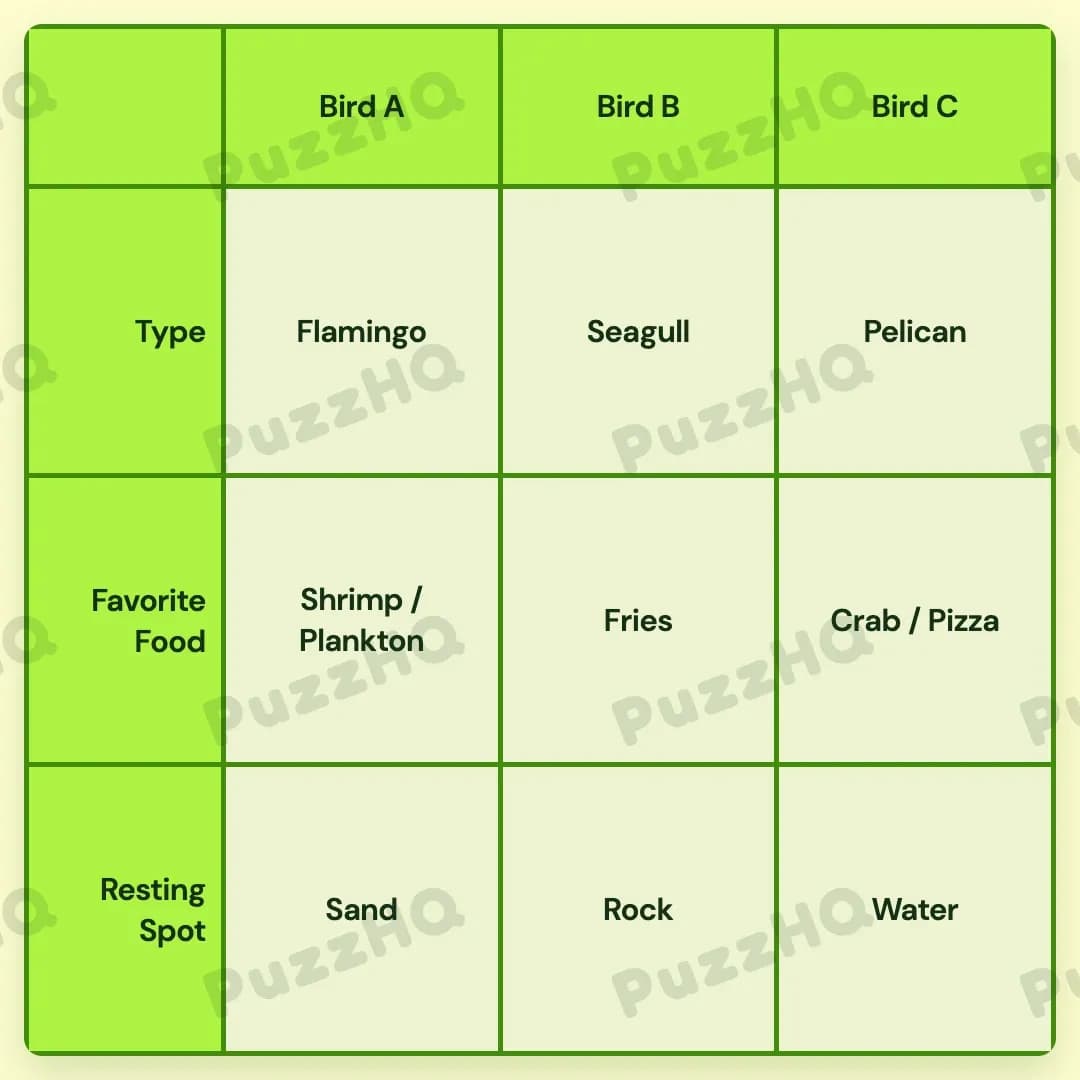
| Trait | Bird A | Bird B | Bird C |
|---|---|---|---|
| Type | Flamingo | Seagull | Pelican |
| Favorite Food | Shrimp / Plankton | Fries | Crab / Pizza |
| Resting Spot | Sand | Rock | Water |
The Logic Behind Profile Perfect Level 173
This grid turns almost entirely on how physical terrain and dietary habits map across three adjacent perches. With only three subjects arranged in a clear sequence from left to right, every spatial statement carries immediate weight. The moment you place one resting spot or identify who sits beside whom, the neighboring slots quickly fall into alignment.
Mapping The Shoreline
The first task is establishing the resting spots across the three positions. We are explicitly told that Bird C is resting on the sea surface, which immediately assigns Water to the third slot. That leaves only Sand and Rock to divide between Bird A and Bird B.
To resolve where the remaining spots belong, we have to look at the positioning statement regarding the Pelican. We know the Pelican rests closer to the Rock than to the Sand. If Bird A were on the Rock and Bird B were on the Sand, or vice versa, the relative distances to each terrain type would dictate where the birds sit. Placing Sand at Bird A and Rock at Bird B creates a clean spatial layout where Bird C is directly adjacent to the Rock and farther from the Sand. That sets our terrain row firmly in place: Sand on the left, Rock in the center, and Water on the right.
With the terrain anchored, the identities begin pairing up with their physical locations. Bird B is directly named as a Seagull. Because Bird C rests on Water and is adjacent to the Rock while positioned away from the Sand, Bird C naturally claims the Pelican identity. That leaves the Flamingo for Bird A, standing on the Sand.
Linking Diets To Perches
Once the bird types and their resting spots are established, their dietary traits unlock through several related clues. The clues provide a mix of specific foods tied directly to types, locations, and neighboring positions.
We are told that the Flamingo turns pink because of its Shrimp diet, while the bird resting on Sand consumes Plankton. Since Bird A is both the Flamingo and the resident of the Sand, Bird A combines both Shrimp and Plankton into its diet.
Next, we look at the bird resting on Water. The clue states that the bird on Water loves Pizza. Since Bird C occupies the Water resting spot, Pizza belongs to Bird C. At the same time, Bird C is the Pelican, and its full coastal diet includes Crab alongside Pizza.
Junk Food Neighbors
The final dietary piece ties back to the central position occupied by Bird B. We have a clue indicating that birds eating junk food are neighbors.
Bird C loves Pizza, which represents one half of this junk food partnership. For the neighborhood clue to hold true, Bird C's immediate neighbor, Bird B, must also partake in junk food. Bird B is the Seagull sitting on the Rock, and its favorite food turns out to be Fries. The Seagull eating Fries sitting directly next to the Pizza-loving Pelican on the Water completes the entire neighborhood relationship across the board.
Every bird now has its type, its resting spot, and its favorite foods cleanly locked down without any contradiction remaining in the grid.
The Clue I Would Read Twice
The most interesting clue to parse carefully is the statement that the Pelican rests closer to the Rock than the Sand.
In a compact three-subject puzzle, distance comparisons can sometimes feel slightly abstract until you visualize the physical order of the slots. Because Bird C is already fixed to the sea surface at one end of the line, the relationship between the central position and the far end determines the whole layout. If you misplace which bird occupies the Pelican role or invert the Rock and Sand assignments, the entire neighborhood logic collapses later on. Reading that relative distance statement as an anchor for the whole board is what keeps the rest of the solve moving smoothly forward.
Final Thoughts
What makes Level 173 memorable is the way it blends typical wildlife diets with playful boardwalk snacks. Seeing a Flamingo balance Shrimp and Plankton on the Sand while a Seagull and Pelican share neighboring junk food cravings adds a delightful bit of charm to a tidy spatial deduction.
Comments