
Profile Perfect Level 206 Answer
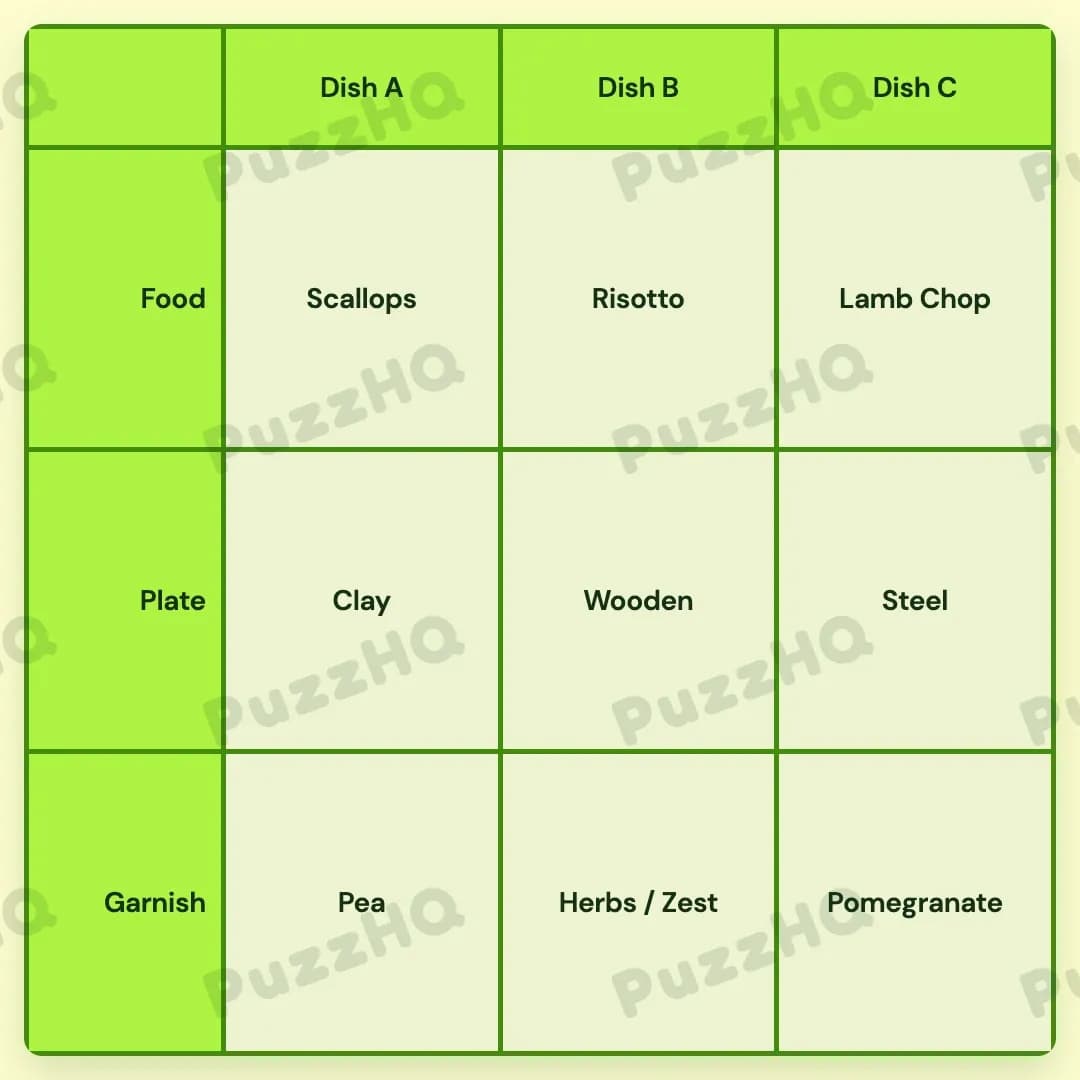
Dish A holds Scallops on a Clay plate with Pea garnish, Dish B holds Risotto on a Wooden plate with Herbs and Zest garnishes, and Dish C holds Lamb Chop on a Steel plate with Pomegranate garnish.
| Trait | Dish A | Dish B | Dish C |
|---|---|---|---|
| Food | Scallops | Risotto | Lamb Chop |
| Plate | Clay | Wooden | Steel |
| Garnish | Pea | Herbs / Zest | Pomegranate |
How To Think Through Profile Perfect Level 206
Solving this puzzle efficiently depends on spotting how positional clues connect to compound traits. When a clue specifies multiple items in a single category, it immediately narrows down the possible homes for those items. Combining that restriction with left-to-right positional clues allows you to anchor the subjects across the board without making unsupported guesses.
Recognize Multi-Item Traits: Risotto Takes Multiple Garnishes
Begin by examining the available traits and looking for unique structural requirements. In this puzzle, one of the food dishes receives more than one garnish.
Clue 2 states that Risotto is presented with multiple garnishes. Looking at the garnish options, only one entry contains two combined garnishes: Herbs and Zest.
This establishes a firm trait link right at the start. Risotto must be paired with Herbs and Zest. You do not know which dish column Risotto occupies yet, but you know that whenever you place Risotto, Herbs and Zest must travel with it.
Direct trait connections like this reduce the number of moving parts in the puzzle. Instead of tracking Risotto, Herbs, and Zest as three separate variables, you now treat them as a single combined block.
Anchor Relative Positions: Zest Sits Left Of Lamb Chop
Once you know that Zest is part of the Risotto package, you can connect it to relative spatial clues.
Clue 6 tells you that Zest is on the left of Lamb Chop.
Think through what this means across the three ordered columns of Dish A, Dish B, and Dish C:
- Zest cannot be in Dish C because there is no dish to the right of Dish C for Lamb Chop to occupy.
- Lamb Chop cannot be in Dish A because there is no dish to the left of Dish A for Zest to occupy.
- Because Zest is paired with Risotto, Zest is either at Dish A or Dish B.
Now consider what happens if Zest and Risotto are in Dish B. If Zest is in Dish B, Lamb Chop must be to its right in Dish C.
Can Zest be in Dish A? If Zest were in Dish A, Risotto would also be in Dish A. However, Clue 1 states that Zest is being used next to the Clay plate. If Zest were in Dish A, the Clay plate would have to be in Dish B. Furthermore, Clue 3 states that Lamb Chop is beside the Wooden plate. If Lamb Chop were in Dish B, the Wooden plate would have to be in Dish A or Dish C.
Let us test the exact layout using Clue 3, Clue 4, and Clue 6 together.
Clue 6 demands that Zest is to the left of Lamb Chop. Clue 3 states that Lamb Chop is beside the Wooden plate. If Lamb Chop is in Dish C, the adjacent plate at Dish B must be the Wooden plate. Since Dish B holds the Wooden plate, Dish B can simultaneously hold the Risotto with Herbs and Zest.
Let us check Dish B as Zest: Zest is in Dish B, which is directly to the left of Lamb Chop in Dish C. Dish B has the Wooden plate, which is beside Lamb Chop. Everything aligns cleanly.
Therefore, you can firmly assign:
- Dish B contains Risotto with Herbs and Zest.
- Dish C contains Lamb Chop.
- Dish A contains the remaining food, which is Scallops.
Use Adjacent Relationships: Finding The Neighboring Plates
Now that you have placed all three foods across the grid, use the plate clues to lock down the remaining positions.
You already know from Clue 3 that Lamb Chop at Dish C is beside the Wooden plate. The only neighbor to Dish C is Dish B, so Dish B must have the Wooden plate.
Next, look at Clue 1. Zest is being used next to the Clay plate.
Zest is located at Dish B. The neighbors of Dish B are Dish A and Dish C. You already know Dish C is beside Dish B, but you must determine whether Clay belongs to Dish A or Dish C.
Now look at Clue 4 to settle the plate positions.
Eliminate Options With Directional Rules: Placing Steel And Clay
Clue 4 states that the Steel plate is not on the left of the Wooden plate.
The Wooden plate is securely fixed at Dish B.
Dish A is to the left of Dish B. Therefore, Dish A cannot have the Steel plate.
Since Dish A cannot be Steel, and Dish B is already Wooden, Dish A must take the Clay plate. This perfectly fulfills Clue 1, because the Clay plate at Dish A is directly next to Zest at Dish B.
With Clay assigned to Dish A and Wooden assigned to Dish B, only one plate option remains. The Steel plate must belong to Dish C.
Notice how Clue 4 confirms this setup again: Dish C is to the right of Dish B, which means Steel is not on the left of the Wooden plate.
Complete The Board: Direct Matching And Final Eliminations
All three foods and all three plates are now fixed:
- Dish A has Scallops on a Clay plate.
- Dish B has Risotto on a Wooden plate.
- Dish C has Lamb Chop on a Steel plate.
Now you only need to complete the garnishes for Dish A and Dish C.
Clue 5 provides an explicit direct match: Peas are the perfect toppings for the Scallops.
Because Scallops is located at Dish A, Pea garnish immediately goes into Dish A.
Only one garnish remains unused in the list: Pomegranate. Place Pomegranate into the only open slot at Dish C.
You can verify this final placement against Clue 7, which states that the Lamb Chop does not go well with the Herbs. Because Lamb Chop at Dish C received Pomegranate while Herbs went to Dish B, the condition is completely satisfied.
Every cell in the grid is now fully solved and verified.
What This Level Teaches You
Compound Traits Narrow Down Placements Immediately
When a puzzle features an option with multiple items, such as two garnishes combined in one slot, find the clue that mentions this trait first. Linking Risotto to Herbs and Zest turned two separate clues into a concrete unit, which made testing column positions fast and reliable.
Use Directional Limits To Prevent Guessing
Clues that state something is not on the left or sits to the left of another item provide strong boundary constraints. When you know an item cannot sit to the left of Dish B, you can eliminate Dish A instantly. Paying attention to left and right relationships eliminates the need for trial and error.
Final Thoughts
The key habit in this level was merging compound traits before evaluating neighbor relationships. Once you linked the double garnish to Risotto, positional restrictions fell into place in a clean, logical sequence.
Comments