
Profile Perfect Level 269 Answer
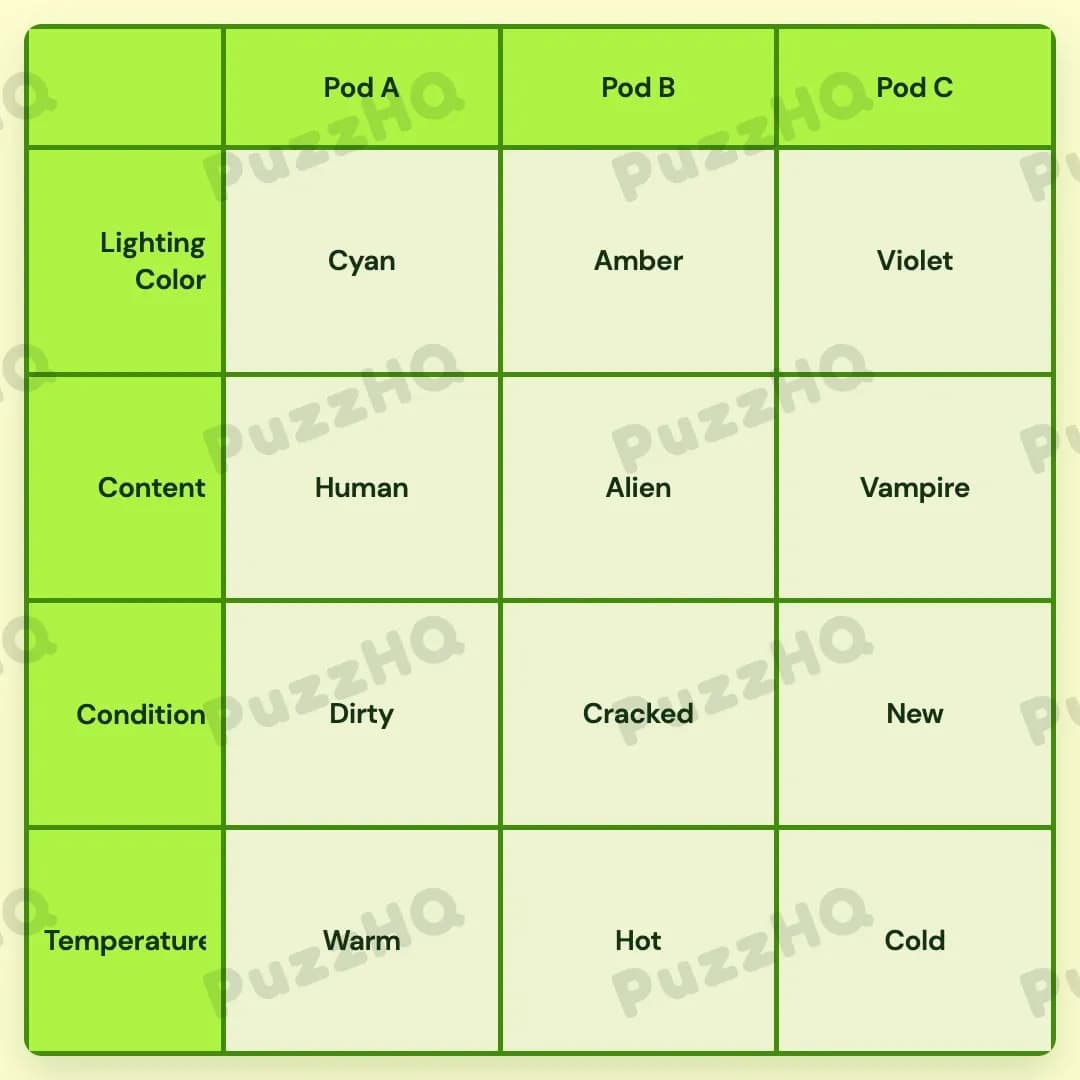
If you are looking for the confirmed layout to check your final arrangement, here is the complete record for all three containment units.
| Trait | Pod A | Pod B | Pod C |
|---|---|---|---|
| Lighting Color | Cyan | Amber | Violet |
| Content | Human | Alien | Vampire |
| Condition | Dirty | Cracked | New |
| Temperature | Warm | Hot | Cold |
The Logic Behind Profile Perfect Level 269
This grid is built around its outer boundaries. Rather than forcing you to juggle multiple overlapping possibilities across the entire row, the puzzle establishes firm anchors on both ends almost immediately. Once the extreme left and right positions are locked down, the remaining deductions unfold along clean adjacency lines where each discovered fact hands off directly to the next.
Anchoring The Outer Edges First
A great deal of clarity arrives on the very first read. We are told outright that the leftmost pod houses the Human and is illuminated by Cyan light. Because our three subjects are arranged sequentially from Pod A to Pod C, this immediately secures Pod A as the Human habitat under Cyan illumination.
Right alongside that direct placement, another clue points across to the opposite end of the facility, stating that Violet light shines inside Pod C. With Cyan locked into Pod A and Violet firmly assigned to Pod C, only one lighting color remains unaccounted for. Amber light must belong to the middle chamber, Pod B.
The occupant lineup falls into place just as quickly. With the Human claiming Pod A, only the Alien and the Vampire need quarters. The clue stating that the Alien is in one of the pods to the left of the Vampire resolves any ambiguity. The Alien takes Pod B, leaving Pod C for the Vampire. In just a few smooth moves, the occupants and the lighting across all three pods are completely settled.
Tracing Maintenance Across The Row
With the physical layout of the subjects established, the condition of each pod can be traced through maintenance duties and physical proximity.
The janitor clue notes that cleaning is required for the Human pod. Since the Human is situated in Pod A, Pod A must be the unit in Dirty condition. From there, physical damage guides the next step. A cracked pod is described as being beside the one that needs cleaning. Because Pod A is the dirty unit and sits on the far left edge, its only possible neighbor is Pod B. That means Pod B is the Cracked unit.
The chain finishes at the far right. The clues describe the New pod sitting in sharp contrast next to the broken one. With Pod B established as the cracked and broken chamber, the New label naturally falls onto its right-hand neighbor, Pod C. The physical state of the entire row is now fully cataloged without any guesswork.
Separating Extremes In Temperature
Thermal settings provide the final layer of the solve, relying on relative intensity and physical spacing rather than named assignments.
We learn that the Warm and Cold pods are not neighbors. In a three-pod lineup, the only way two pods can avoid being adjacent is if they occupy the two outer flanks, Pod A and Pod C. This leaves the center chamber, Pod B, as the only available spot for the remaining temperature tier, Hot.
Determining which outer pod takes Warm and which takes Cold comes down to a comparative reading. The clue notes that the highest temperature pod sits to the right of the average one. In this three-tier scale, Hot represents the highest temperature, Warm represents the average temperature, and Cold represents the lowest.
Because Hot is located in Pod B, it must sit to the right of the average pod. That means the Warm setting has to belong to Pod A on its left. With Warm locked into Pod A and Hot in Pod B, Cold claims the final remaining slot in Pod C. Every trait is accounted for, closing out the deduction cleanly.
The Clue I Would Read Twice
The instruction stating that the highest temperature pod is to the right of the average one is easily the standout deduction in the set. It never uses the explicit words Hot, Warm, or Cold, requiring you to interpret real-world temperature vocabulary into a functional hierarchy. Recognizing that average refers to the middle temperature tier, and pairing that with the spatial restriction that Warm and Cold cannot touch, transforms a brief descriptive sentence into the key that resolves the entire thermal grid.
Final Thoughts
Level 269 offers a tidy, highly structured solve where every category feels grounded in the narrative theme of a secure research lab. The interplay between physical damage, containment temperatures, and subject biology makes the deduction process feel intuitive from start to finish.
Comments