
Profile Perfect Level 325 Answer
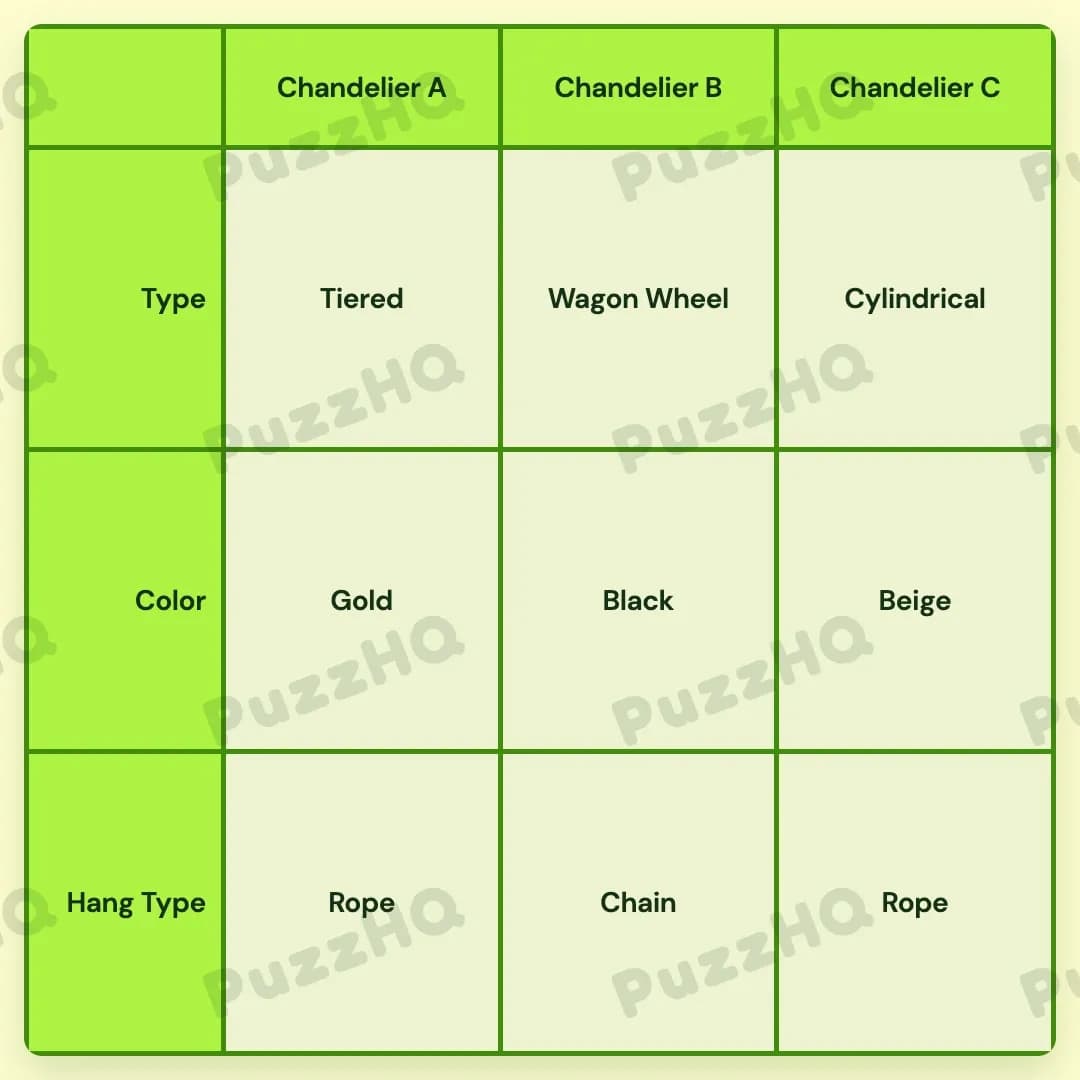
Here is the complete solution for this chandelier showcase, detailing the fixture type, finish, and hanging style for every position across the ceiling.
| Trait | Chandelier A | Chandelier B | Chandelier C |
|---|---|---|---|
| Type | Tiered | Wagon Wheel | Cylindrical |
| Color | Gold | Black | Beige |
| Hang Type | Rope | Chain | Rope |
The Logic Behind Profile Perfect Level 325
At first glance, this puzzle presents a clean three-slot layout, but its real charm lies in how physical descriptions translate into fixture geometry. Rather than relying on simple direct name tags, the clues challenge you to visualize how lights hang, how shapes occupy space, and where each item sits relative to its neighbors. Once you recognize that the physical row layout dictates which shapes can coexist, the entire arrangement falls into place without requiring any guesswork.
Anchoring The Center And The First Shape
Every successful solve needs a secure footing, and here that footing comes directly from the position of the middle fixture. We are told right away that black is used for the chandelier in the middle. With three fixtures labeled sequentially from Chandelier A to Chandelier C, the center slot belongs entirely to Chandelier B. Assigning black to the middle chandelier gives us our very first confirmed characteristic on the board.
From there, we can look at the physical description given for the first position. Chandelier A is described as having its lights placed at different elevations. When thinking about lighting designs, having illumination staggered across multiple heights is the defining trait of a tiered fixture. This immediately establishes Chandelier A as the tiered chandelier. We now have two distinct subjects partially defined, with the first fixture locked into its structural type and the second locked into its finish color.
Using Adjacency To Lock Down The Fixtures
With the tiered chandelier sitting at Chandelier A, the placement of the remaining fixture types depends on spatial rules. We learn that the cylindrical chandelier is not next to the tiered one. Because Chandelier A is on the far left, the only position directly adjacent to it is Chandelier B in the center. If the cylindrical model cannot sit next to the tiered fixture, it cannot occupy the middle position.
That restriction leaves only one available home for the cylindrical chandelier, which is Chandelier C on the far right. By pure process of elimination, the remaining open type slot at Chandelier B must belong to the wagon wheel chandelier. Just like that, all three lighting styles are placed in their proper positions along the ceiling, establishing a clear progression of tiered at A, wagon wheel at B, and cylindrical at C.
Finishing The Palettes And Suspension Hardware
Now that the types are fixed, the remaining details around color and hanging methods resolve cleanly. One clue mentions that a wide tube like chandelier is using a beige color. A wide tube is the natural physical form of a cylindrical fixture, meaning our cylindrical fixture at Chandelier C receives the beige finish. Looking back at our color options, we have black at Chandelier B and beige at Chandelier C, which leaves gold as the only remaining choice for Chandelier A.
Finally, we turn our attention to how these heavy fixtures are suspended from above. We are told that the wheel chandelier will not fall easily. Among the available hanging methods, a heavy-duty chain provides the maximum security implied by that phrasing, assigning the chain suspension directly to the wagon wheel fixture at Chandelier B. The remaining positions at Chandelier A and Chandelier C take the rope suspension, completing the entire grid with every single trait accounted for.
The Clue I Would Read Twice
The clue stating that the cylindrical chandelier is not next to the tiered one is easily the pivotal line in this puzzle. It looks modest because it is a simple negative statement, but it quietly does all the heavy structural work for the middle column.
Without this clue, you might be tempted to wonder if the cylindrical shape could sit in the middle slot next to Chandelier A. Because it explicitly forbids that placement, it pushes the cylindrical model all the way to the right edge at Chandelier C. That single push simultaneously solves the type for both Chandelier B and Chandelier C, while also setting up the color deduction for the beige tube right afterward. It is a fantastic reminder that a well-placed negative constraint can be just as potent as a direct assignment.
Final Thoughts
What makes Level 325 memorable is the way it grounds its logic in physical characteristics rather than arbitrary labels. Visualizing stepped heights for tiered lighting, wide tubes for cylindrical forms, and heavy chains for securing a wagon wheel makes the puzzle feel like setting up an actual showroom. It is a compact, elegant solve that rewards careful reading and clean spatial reasoning from start to finish.
Comments