
Profile Perfect Level 33 Answer
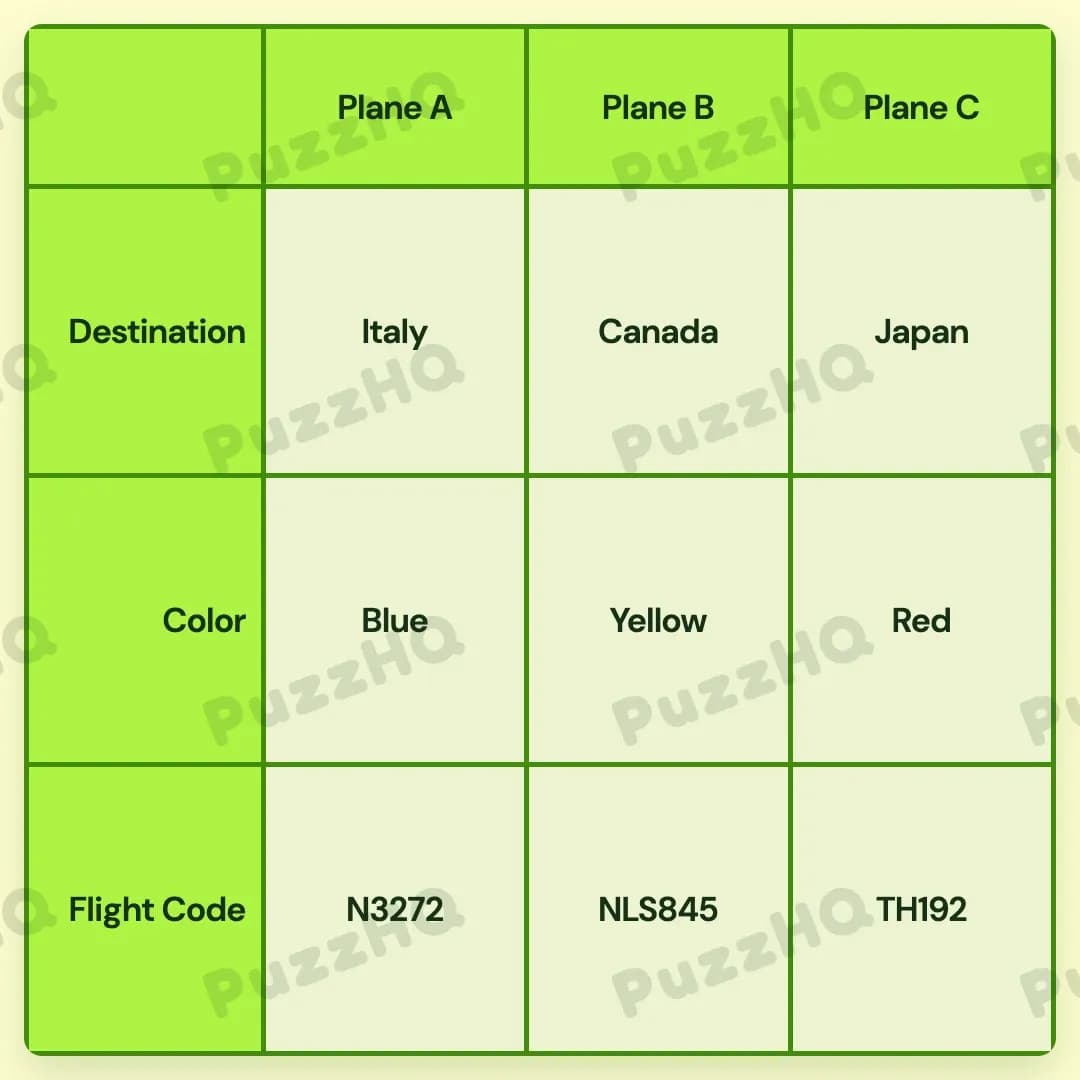
Plane A is a Blue plane flying to Italy with flight code N3272, Plane B is a Yellow plane flying to Canada with flight code NLS845, and Plane C is a Red plane flying to Japan with flight code TH192.
| Trait | Plane A | Plane B | Plane C |
|---|---|---|---|
| Destination | Italy | Canada | Japan |
| Color | Blue | Yellow | Red |
| Flight Code | N3272 | NLS845 | TH192 |
How To Think Through Profile Perfect Level 33
The most effective habit for solving this puzzle is building trait clusters before deciding where they belong. Several clues connect destinations directly to colors and flight codes without naming the plane letter. If you group those linked traits together first, you can drop the entire package into place as soon as you find a single opening on the board.
Start With Direct Matches: Place Italy And Yellow Immediately
Direct placement clues give you immediate anchors on the board. Look for clues that name a specific subject position or letter and assign an exact trait value.
- The first plane is heading to Italy.
- Plane B has a bright Yellow coating.
Because Plane A is the first plane in the sequence, the first clue directly establishes that Plane A's destination is Italy. The second clue gives Plane B its color trait, which is Yellow.
These two initial placements may seem simple, but direct anchors serve as the bedrock for every deduction that follows. Without Plane A assigned to Italy and Plane B assigned to Yellow, later relational clues cannot be tested against specific columns.
Bundle Linked Traits: Connect Blue Directly To Italy
When a clue mentions two different traits together without naming a specific plane, it creates a trait bundle.
- The Blue plane headed to Italy is next to the Yellow plane.
This clue establishes a permanent link between the color Blue and the destination Italy. Because you already know from your first step that Plane A is heading to Italy, Plane A must also be the Blue plane.
Notice how this step builds directly on your direct anchor. You do not need to guess whether Plane A, Plane B, or Plane C is Blue. The trait bundle tells you that wherever Italy goes, Blue must go too. Since Italy is locked onto Plane A, Blue immediately fills the color row for Plane A. The neighbor detail in the clue also confirms that Plane A is right next to Plane B, which is Yellow.
Chain Multiple Clues To Build A Three Trait Package
Sometimes two separate clues reference the same trait value. When that happens, you can merge them into an even larger bundle before placing them on the board.
- Flight Code TH192 is heading to Japan.
- The long flight to Japan is boarded on the Red plane.
Both clues share the destination Japan. The first clue links Japan to flight code TH192. The second clue links Japan to the color Red. Combining these two clues produces a complete profile package: one single plane must have the destination Japan, the color Red, and the flight code TH192.
Now look across your three subjects to see where this complete package can fit:
- Plane A is already assigned to Italy and Blue, so it cannot take Japan or Red.
- Plane B is already assigned to Yellow, so it cannot take Red.
- Plane C is completely open in all categories.
By eliminating Plane A and Plane B, Plane C becomes the only possible location for this entire three trait package. You can immediately assign Plane C the destination Japan, the color Red, and the flight code TH192.
Resolve Remaining Trait Values By Elimination And Pattern Rules
At this stage, most of the board is filled, leaving only a few open cells. You can resolve the remaining empty spaces by combining simple column elimination with pattern-based clues.
First, look at the destination row:
- Plane A is Italy.
- Plane C is Japan.
- Therefore, Plane B must take the only remaining destination, which is Canada.
Now you only need flight codes for Plane A and Plane B. The remaining clues provide specific patterns to test against the flight code options.
- The plane to Canada has 3 letters in its Flight Code.
Looking at your available flight codes, NLS845 contains three letters (N, L, and S), while N3272 contains only one letter (N). Since Plane B is flying to Canada, Plane B must receive flight code NLS845.
This leaves flight code N3272 as the final remaining code, which naturally fills the last open cell on Plane A.
You can also use the remaining clue to verify your final grid:
- Plane C's Flight Code first letter is different from the rest.
Plane C has flight code TH192, which starts with the letter T. Plane A has N3272 and Plane B has NLS845, both of which start with the letter N. Because T is distinct from N, this confirms your entire flight code placement is completely accurate.
What This Level Teaches You
Trait Bundles Are Independent Of Subject Labels
Clues often tell you that two traits belong together without specifying which subject owns them. Treating traits like Blue and Italy or Japan and Red as locked pairs allows you to move them as a single unit. As soon as one part of the pair finds a home, the other part follows automatically.
Overlapping Clues Create Complete Profiles
When two clues mention the same anchor word, such as Japan appearing in two different clues, combine them before taking action on the grid. Merging clues into a three-trait package lets you test entire profiles against open slots, eliminating invalid options in a single step.
Pattern Clues Function Best In The Endgame
Clues that describe formatting details, such as counting letters or comparing starting characters, become much easier to evaluate once you have narrowed the pool of possible candidates. Save structural pattern clues for the end of your solve to quickly distribute the final values.
Final Thoughts
The key to solving this level smoothly is identifying the shared reference to Japan across two separate clues. Once you combine those clues into a complete set containing Japan, Red, and TH192, you can eliminate the other planes and solve the rest of the board with basic elimination.
Comments