
Profile Perfect Level 362 Answer
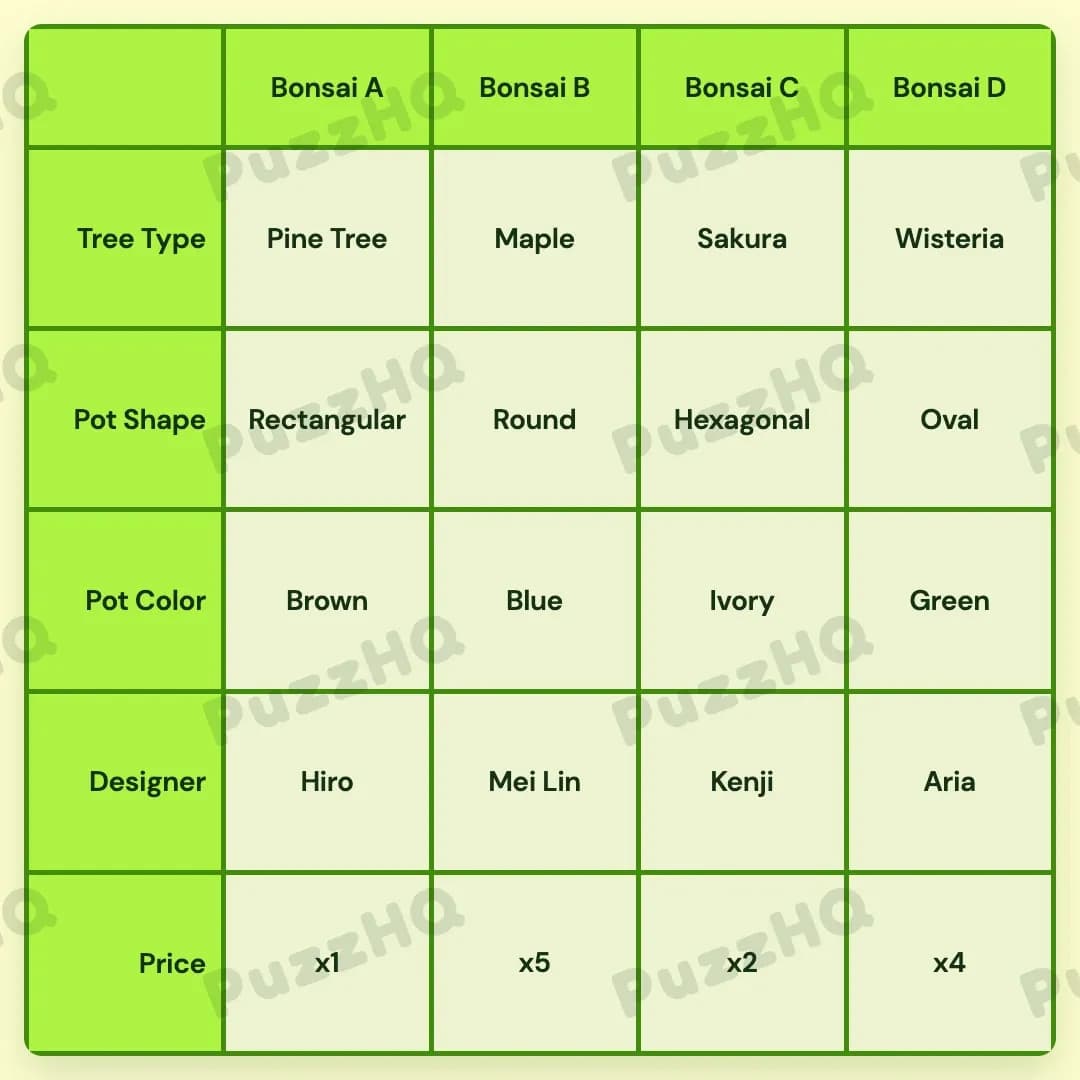
Bonsai A is Hiro's x1 Rectangular Brown Pine Tree, Bonsai B is Mei Lin's x5 Round Blue Maple, Bonsai C is Kenji's x2 Hexagonal Ivory Sakura, and Bonsai D is Aria's x4 Oval Green Wisteria.
| Trait | Bonsai A | Bonsai B | Bonsai C | Bonsai D |\n| --- | --- | --- | --- | --- |\n| Tree Type | Pine Tree | Maple | Sakura | Wisteria |\n| Pot Shape | Rectangular | Round | Hexagonal | Oval |\n| Pot Color | Brown | Blue | Ivory | Green |\n| Designer | Hiro | Mei Lin | Kenji | Aria |\n| Price | x1 | x5 | x2 | x4 |
How To Think Through Profile Perfect Level 362
Solving logic puzzles efficiently requires you to categorize clues by what they achieve. Some clues give you an immediate spot on the board, while others define relationships between items that you can only place once surrounding pieces are settled. In this level, the most effective habit is looking for slot restrictions based on neighbor requirements before attempting to place individual traits.
Start With Direct Identifiers: Secure Clear Board Anchors
Direct placement clues give you immediate foundations. Whenever a clue explicitly names a specific column or subject, place it right away to narrow down future search spaces.
- The color of Bonsai C's pot is Ivory. Fill in Ivory under Bonsai C immediately.
- Bonsai D's pot is shaped like a slightly flattened sphere, which identifies the shape as Oval. You can lock Oval directly into Bonsai D.
Placing these two values sets fixed anchors on the right half of the board. Knowing Bonsai D has an Oval pot becomes critical in the very next step.
Use Positional Constraints: Place The Maple Tree
Clues that mention multiple neighbors provide powerful spatial limits. When a clue mentions both neighbors of an item, that item cannot sit on either end of the row.
The clue notes that both neighbors of the Maple tree use pots with edges. This single statement provides two crucial deductions:
- The Maple tree must have two neighbors, meaning it cannot be Bonsai A or Bonsai D. It must belong to either Bonsai B or Bonsai C.
- Both adjacent pots must have straight edges, such as Rectangular or Hexagonal shapes.
Now look at your established anchors. Bonsai D has an Oval pot, which has curved edges rather than straight edges. If the Maple tree were Bonsai C, one of its neighbors would be Bonsai D with an Oval pot. Because that violates the clue, the Maple tree cannot be Bonsai C.
The Maple tree must be Bonsai B.
Because Bonsai B is the Maple tree, its two neighbors are Bonsai A and Bonsai C. Both of these pots must be the edged shapes: Rectangular and Hexagonal. That leaves Round as the only remaining shape for Bonsai B itself.
Combine Relative Positions With Multi Trait Clues
Once general locations are narrowed down, relative direction clues help you determine exact placements.
- The Rectangular pot is located to the left of the Blue pot.
- Since Bonsai A and Bonsai C hold the Rectangular and Hexagonal pots, Bonsai A must be the Rectangular pot to remain to the left of Bonsai B.
- Bonsai B is therefore the Blue pot, and Bonsai C receives the Hexagonal pot.
Next, bring in the designer pairings:
- Hiro uses a Rectangular pot he made himself. Because Bonsai A is Rectangular, Hiro belongs to Bonsai A.
- Kenji stands to the left of his sensei, Aria, who is to his right. With Bonsai A occupied by Hiro, the only consecutive pair of empty designer slots is Bonsai C and Bonsai D. Place Kenji at Bonsai C and Aria at Bonsai D.
- The only remaining designer slot at Bonsai B goes to Mei Lin.
Resolve Tree Types And Colors Using Negative Logic
With shapes, designers, and several colors filled, you can use negative constraints and paired traits to complete the trees and colors.
- The Pine bonsai thrives in the Brown pot. Bonsai A is the only profile currently missing both a tree type and a pot color. Assign Pine Tree and Brown to Bonsai A.
- The only unassigned pot color is Green, which goes to Bonsai D.
- The bonsai classified as a legume is not next to the Blue pot. Wisteria is a legume, and Bonsai B has the Blue pot. Because Bonsai B cannot touch Wisteria, Wisteria cannot be placed in Bonsai A or Bonsai C. Place Wisteria at Bonsai D.
- The last available tree type is Sakura, which fills the remaining space at Bonsai C.
Apply Mathematical Comparisons Instead Of Guessing
When sorting numeric attributes like prices, look for clues that link values through multipliers or rankings.
- The Maple bonsai by a female designer is the priciest. Bonsai B is the Maple designed by Mei Lin, so Bonsai B receives the maximum price of x5.
- The Green pot has exactly twice the price of the Hexagonal pot. The Green pot is Bonsai D and the Hexagonal pot is Bonsai C. The available unused prices that fit a two to one ratio are x4 and x2. Therefore, Bonsai D is x4 and Bonsai C is x2.
- The Pine bonsai is slightly cheaper than the Sakura one. Bonsai A (Pine) receives the remaining price of x1, which is directly below Bonsai C (Sakura at x2).
Every cell is now logically proven without making any assumptions.
What This Level Teaches You
Both Neighbors Means An Interior Slot
Whenever a clue mentions both neighbors of a subject, you can instantly eliminate the leftmost and rightmost slots. In this puzzle, that rule eliminated Bonsai A and Bonsai D as candidates for the Maple tree. Testing whether the remaining interior slots had valid neighbors allowed you to place the Maple tree cleanly.
Check Known Traits Against Neighbor Conditions
When a clue sets a requirement for adjacent cells, compare those requirements against traits you have already placed. We knew Bonsai D had an Oval pot. Because an Oval does not have edges, no subject that requires edged neighbors could ever sit next to Bonsai D. Using known traits to block invalid placements prevents early errors.
Pair Ratios Before Filling Individual Values
Multiplicative clues like double the price provide exact mathematical pairings. When evaluating remaining values such as x1, x2, and x4, finding a pair where one is twice the other immediately isolates x2 and x4 for those two specific slots. The remaining odd value naturally resolves the final slot.
Final Thoughts
The key to mastering this level was combining interior slot logic with existing shape anchors. Rather than guessing where the Maple tree belonged, checking the neighbor requirements against Bonsai D's curved pot solved the entire layout smoothly. Always look for neighbor restrictions early to unlock the structure of the puzzle.
Comments