
Profile Perfect Level 427 Answer
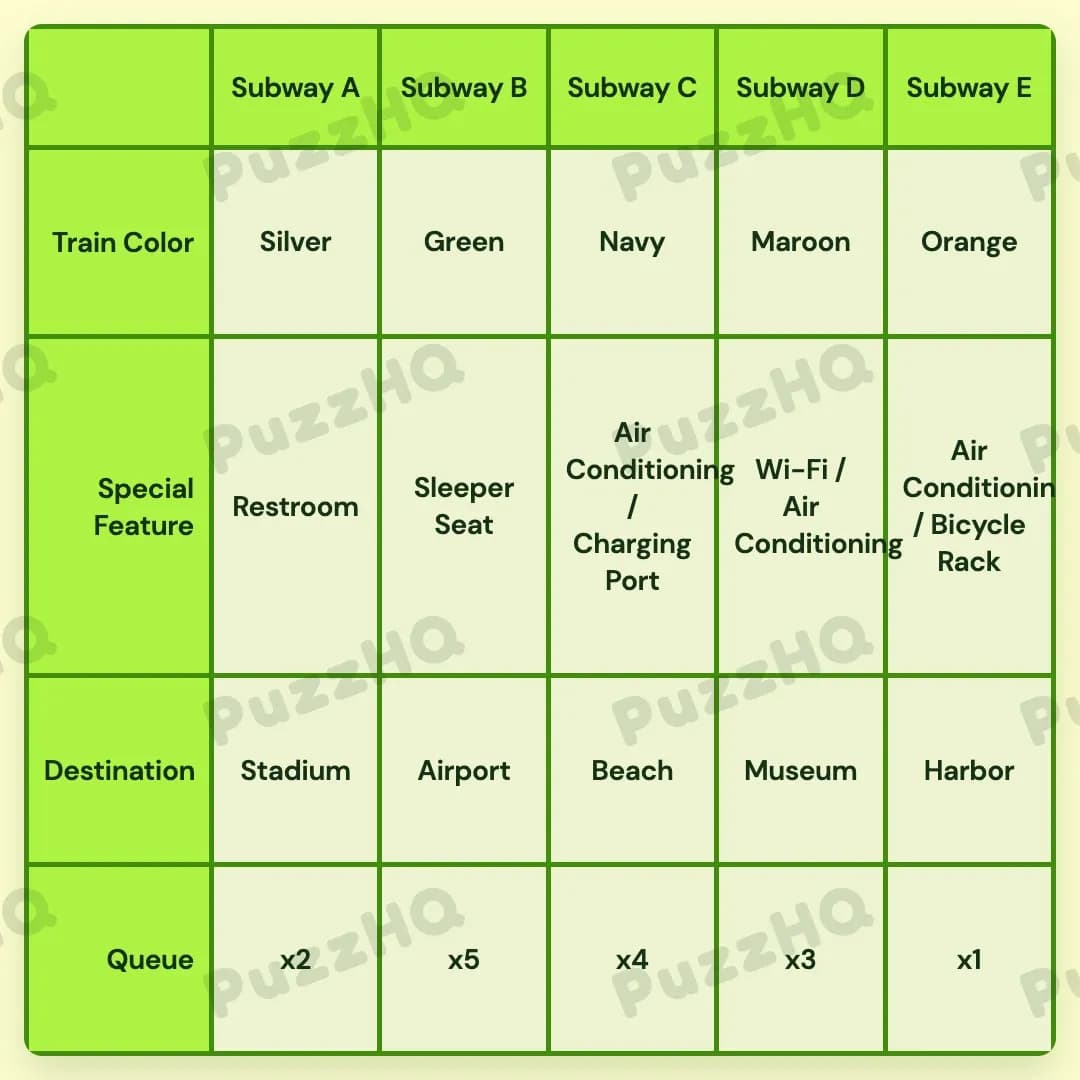
Subway B features sleeper seats with the maximum queue heading to the airport, while Subway E is the orange harbor train with the shortest queue.
| Trait | Subway A | Subway B | Subway C | Subway D | Subway E |
|---|---|---|---|---|---|
| Train Color | Silver | Green | Navy | Maroon | Orange |
| Special Feature | Restroom | Sleeper Seat | Air Conditioning / Charging Port | Wi-Fi / Air Conditioning | Air Conditioning / Bicycle Rack |
| Destination | Stadium | Airport | Beach | Museum | Harbor |
| Queue | x2 | x5 | x4 | x3 | x1 |
How To Think Through Profile Perfect Level 427
The most effective habit on this board is using numerical extremes and spacing clues to create solid anchor points before attempting directional comparisons.
Anchor Extremes: Lock In The Longest And Shortest Queues
Extreme value clues provide immediate certainty because only one cell can occupy the highest or lowest slot in a sequence.
Clue 2 states that Subway B has the longest queue. Because queue sizes span from x1 to x5, Subway B immediately claims the x5 queue value.
Clue 10 states that the Orange train headed to the Harbor has the shortest queue. This bundles three traits together:
- Train Color is Orange
- Destination is Harbor
- Queue size is x1
Because Subway B already holds queue x5, this Orange Harbor bundle cannot belong to Subway B.
Clue 4 notes that the crowded subway attracts many due to its Sleeper Seat. In this context, crowded refers to the longest queue of x5 at Subway B. We can firmly assign the Sleeper Seat feature to Subway B.
Measure Grid Spacing: Place Features Fixed Distances Apart
Fixed column gap clues drastically narrow column choices across a five subject grid.
Clue 8 states that the Restroom facility is 3 columns away from Wi-Fi. In a five subject layout from Subway A through Subway E, a gap of exactly 3 columns can only exist between two specific column pairings:
- Subway A and Subway D
- Subway B and Subway E
Now test both options against what is already known:
- Subway B already contains the Sleeper Seat. Therefore, Subway B cannot hold either the Restroom or Wi-Fi. This eliminates the pair between Subway B and Subway E.
- The only remaining possibility is that the Restroom and Wi-Fi occupy Subway A and Subway D.
Next, look at Clue 7, which states that the Sleeper Seat is next to the Silver train headed to the Stadium. Subway B holds the Sleeper Seat, meaning its neighbor must be either Subway A or Subway C.
Clue 8 will resolve which end holds the Restroom once we examine queue conditions and color restrictions.
Combine Parity And Comparison: Solve The Remaining Queue Numbers
Number properties like odds, evens, and comparisons allow you to distribute the remaining queue values without guessing.
We already know:
- Subway B has queue x5
- The Orange Harbor train has queue x1
- Remaining queue values to assign: x2, x3, and x4
Clue 12 specifies that the subway with Wi-Fi has an odd-numbered queue length. The only odd numbers in the set are x1, x3, and x5.
- Queue x5 is locked to Subway B (Sleeper Seat).
- Queue x1 is locked to the Orange Harbor train.
- Therefore, the Wi-Fi subway must have a queue of x3.
Now look at Clue 11: the subway with the Bicycle Rack has less queue than Subway A. Because queue x1 is the lowest possible queue, the Bicycle Rack must belong to the x1 train (the Orange train to the Harbor).
Since the Bicycle Rack train has queue x1, Subway A must have a larger queue.
Now check Clue 6: the second least crowded subway does not have Air Conditioning. The second least crowded position is queue x2.
Clue 5 states that the majority of subways are equipped with Air Conditioning (3 out of 5 trains). Subway A holds the Restroom, leaving Subway D for Wi-Fi. Wi-Fi is at Subway D with queue x3. That means Subway A takes queue x2.
This places the final unassigned queue value, x4, directly onto Subway C.
Reviewing our queue distribution:
- Subway A: x2
- Subway B: x5
- Subway C: x4
- Subway D: x3
- Subway E: x1 (Orange train to Harbor with Bicycle Rack)
Link Multi-Trait Clusters: Position Colors And Destinations
With the subjects mapped to their queue lengths, we can connect the remaining feature clusters.
Subway A has queue x2 and holds the Restroom facility. Clue 7 noted that the Sleeper Seat at Subway B is next to the Silver train headed to the Stadium. Because Subway A is adjacent to Subway B, Subway A is the Silver train headed to the Stadium.
Clue 13 tells us that Sleeper Seat passengers get their visas ready for inspection. Visas connect directly to international travel, confirming that Subway B heads to the Airport.
Now place the remaining destinations using directional clues:
- Clue 1: Subway to the Museum is to the right of the Navy one.
- Clue 3: Subway to the Beach is to the left of the Museum.
The available destinations left to assign are Beach and Museum. The available columns are Subway C and Subway D. Subway C is to the left of Subway D. Therefore:
- Subway C heads to the Beach.
- Subway D heads to the Museum.
Because the Museum at Subway D is to the right of the Navy train, Subway C must be the Navy train.
Resolve The Final Traits By Elimination
Only a few empty slots remain on the board.
For Train Color:
- Subway A is Silver.
- Subway C is Navy.
- Subway E is Orange.
- Remaining colors: Green and Maroon.
- Clue 9 states that Subway B is neither Maroon nor Orange.
- Therefore, Subway B must be Green.
- Subway D takes the remaining color, Maroon.
For Special Features:
- Clue 5 notes that the majority of subways have Air Conditioning (3 out of 5 trains).
- Clue 6 stated that the second least crowded subway (Subway A with queue x2) does not have Air Conditioning.
- Subway B has the Sleeper Seat.
- This leaves Subway C, Subway D, and Subway E to receive Air Conditioning.
- Adding the specific secondary features completes each cell: Subway C has Charging Port, Subway D has Wi-Fi, and Subway E has Bicycle Rack.
Every row and column is now completely resolved.
What This Level Teaches You
- Fixed column distance clues drastically cut down the board. A clue specifying a gap of three columns in a five column puzzle can only fit two possible pairs. Eliminating one subject immediately locks down both endpoints.
- Parity restrictions narrow numerical lists fast. When odd or even conditions combine with already claimed values, multi-choice fields usually collapse to a single valid number.
- Directional clues work best after subjects are anchored. Placing Subway C and Subway D first made relative left and right placement simple and eliminated any guesswork between the Beach and Museum destinations.
Final Thoughts
Puzzles with complex numerical conditions become straightforward when you anchor the highest and lowest values first. Once the boundaries are set, mathematical traits like parity and inequality smoothly guide the rest of the board into place.
Comments