
Profile Perfect Level 488 Answer
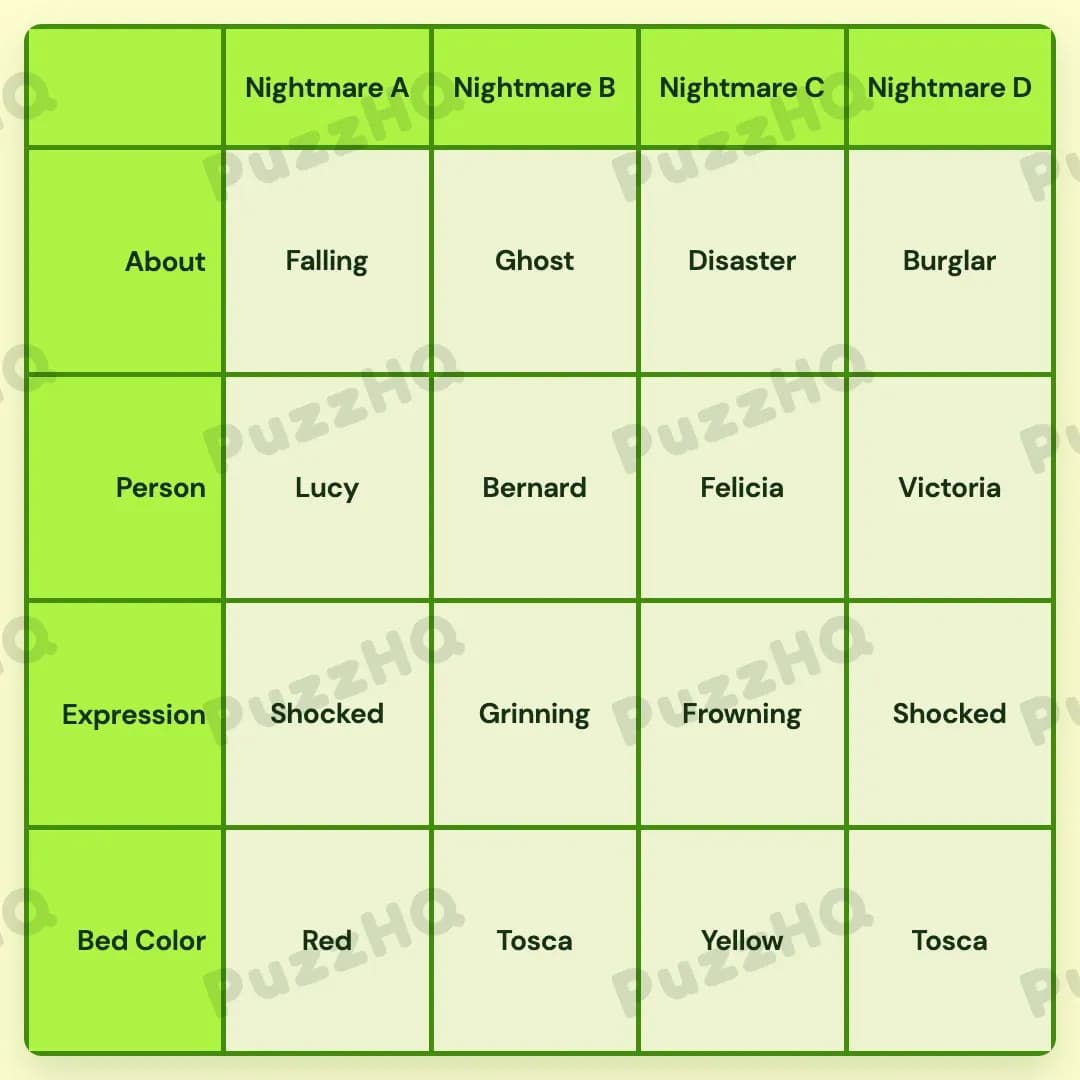
Victoria has a nightmare about a burglar in the rightmost Tosca bed, while Lucy falls in the Red bed, Bernard grins at a ghost in the other Tosca bed, and Felicia frowns at a disaster in the Yellow bed.
| Trait | Nightmare A | Nightmare B | Nightmare C | Nightmare D |
|---|---|---|---|---|
| About | Falling | Ghost | Disaster | Burglar |
| Person | Lucy | Bernard | Felicia | Victoria |
| Expression | Shocked | Grinning | Frowning | Shocked |
| Bed Color | Red | Tosca | Yellow | Tosca |
How To Think Through Profile Perfect Level 488
Solving logic puzzles efficiently requires recognizing the difference between clues that fix a location immediately and clues that group traits together for later placement. In this puzzle, your best habit is to secure the fixed edge position first, identify linked pairs of dream topics and bed colors, and then apply spatial spacing rules to position the remaining traits cleanly across the four beds.
Anchor The Fixed Position: Victoria Claims The Rightmost Bed
A direct placement clue is always the best place to begin because it gives you an immovable reference point on the board. When a clue specifies an absolute slot, you do not have to guess or wait for other pieces to fall into place.
Clue 3 states that Victoria is the one getting a nightmare at the rightmost bed. Looking at the four subjects arranged from left to right, Nightmare D represents the far right position.
- Set Nightmare D's Person to Victoria.
Establishing Victoria at Nightmare D instantly reduces the search space for all other people. Any clue describing another person or a male character cannot belong to Nightmare D, giving you a firm anchor on the right edge of the grid.
Connect Paired Traits: Red Bed And Falling Dream
Before worrying about which column owns every item, look for direct trait-to-trait links. These clues act like compound puzzle pieces. Once two traits are bound together, they move as a single unit, which drastically narrows where they can fit.
Clue 1 notes that the person on the Red bed feels like they are in a bottomless pit. A bottomless pit directly describes the Falling nightmare.
- Pair the Red bed color with the Falling nightmare.
Even though you do not place this pair into a specific nightmare slot yet, you know that whichever bed has the Red color must also feature Falling. It also tells you that the Falling dream cannot belong to any bed that uses a different color.
Group Related Items By Category: The Two Entity Dreams Share Tosca Beds
Some clues describe patterns across groups of items rather than naming single cells. Recognizing how these group rules limit your choices lets you solve multiple slots simultaneously.
Clue 4 tells you that the person attacked by the Burglar is on a Tosca bed. Clue 2 adds that the two people on the same bed color dream about another entity. Looking through the available nightmare topics, the only two entities mentioned are the Burglar and the Ghost.
Because the Burglar is already on a Tosca bed, Tosca must be the color that appears twice. Clue 2 therefore binds the Burglar and the Ghost to the two Tosca beds.
- Tosca belongs to both Nightmare topics involving an entity: Burglar and Ghost.
- The remaining bed colors are Red and Yellow.
- Since the Red bed is already paired with Falling, the Yellow bed must belong to the remaining topic, Disaster.
Now you have all four bed colors paired with their respective nightmare topics:
- Falling belongs with Red.
- Disaster belongs with Yellow.
- Burglar belongs with Tosca.
- Ghost belongs with Tosca.
Use Pronouns And Reactions To Separate Shared Colors
When two subjects share the same trait value, such as two beds sharing the Tosca color, look for secondary details like personal pronouns or distinct emotional reactions to tell them apart.
Clue 6 states that the one meeting a Ghost is happy that he can finally talk to one. This sentence gives you two critical facts:
- The person meeting the Ghost is male, which points directly to Bernard among the list of names.
- The person is happy, which corresponds to the Grinning expression.
Because Bernard is meeting the Ghost, and Victoria is already fixed at Nightmare D, Victoria cannot be the one meeting the Ghost. Victoria must therefore have the other entity nightmare on a Tosca bed: the Burglar.
- Assign the Burglar nightmare to Nightmare D alongside Victoria.
- Set Nightmare D's Bed Color to Tosca.
- Assign the Ghost nightmare to Bernard, giving him a Tosca bed and the Grinning expression.
Because Bernard has the Ghost nightmare on a Tosca bed, and Nightmare D is already occupied by Victoria, Bernard must take the other Tosca bed at Nightmare B.
- Set Nightmare B's Person to Bernard.
- Set Nightmare B's About trait to Ghost.
- Set Nightmare B's Bed Color to Tosca.
- Set Nightmare B's Expression to Grinning.
Apply Spacing Constraints: Shocked People Are Not Neighbors
Negative relationship clues, such as non-neighbor rules, become very easy to resolve once you have partially filled the grid.
Clue 5 states that the people who are jolted awake are not neighbors. Being jolted awake corresponds to the Shocked expression.
Look at the remaining expressions across the four positions:
- Nightmare B is already Grinning.
- That leaves Nightmare A, Nightmare C, and Nightmare D to receive two Shocked expressions and one Frowning expression.
- If Nightmare C were Shocked, it would be adjacent to whichever outer bed was also Shocked, violating the rule that the two Shocked people cannot be neighbors.
- Therefore, the two Shocked expressions must sit at the opposite outer ends: Nightmare A and Nightmare D.
- Nightmare C must take the remaining expression, Frowning.
Updating the grid with these expressions gives:
- Nightmare A's Expression is Shocked.
- Nightmare D's Expression is Shocked.
- Nightmare C's Expression is Frowning.
Fill The Final Slots By Elimination
Once the structural clues have done their work, the remaining empty spaces can be completed by straightforward elimination.
Look at the remaining unassigned traits:
- The available nightmare topics left to place are Falling and Disaster for Nightmare A and Nightmare C.
- The available bed colors left to place are Red and Yellow.
- Clue 7 states that Felicia is seeing herself flying up high, which aligns with Nightmare C.
- Placing Felicia at Nightmare C leaves Lucy as the only person remaining for Nightmare A.
- Since Nightmare A contains Lucy, she takes the Falling dream and the Red bed.
- Felicia at Nightmare C receives the Disaster dream and the Yellow bed.
Every cell is now completely determined without guessing.
What This Level Teaches You
Lock Down Outer Edges Before Resolving Duplicated Traits
A single absolute placement, such as Victoria on the rightmost bed, acts as a boundary marker for the rest of the board. Because Victoria occupied Nightmare D from the start, she prevented the male character, Bernard, from being assigned to the right edge. Always look for clues that mention edges or specific columns first.
Group Clues Solve Entire Trait Pairs In One Step
Clue 2 and Clue 4 worked together by describing the relationship between entities and shared bed colors. Instead of looking for a clue that outright said who slept in each bed, you deduced that Tosca had to be the duplicated color because both the Burglar and the Ghost were entities. Recognizing when a clue addresses a shared set rather than an individual slot saves time.
Final Thoughts
The key habit in this puzzle was organizing traits into paired blocks before deciding where they belonged horizontally. Once the dreams were tied to their respective bed colors, the non-neighbor rule for the Shocked expressions made the rest of the layout fall into place naturally.
Comments