
Profile Perfect Level 493 Answer
Every haunted gallery holds secrets across its canvas frames, and working through the physical borders and creator signatures reveals exactly which masterpiece brought ruin upon its collectors.
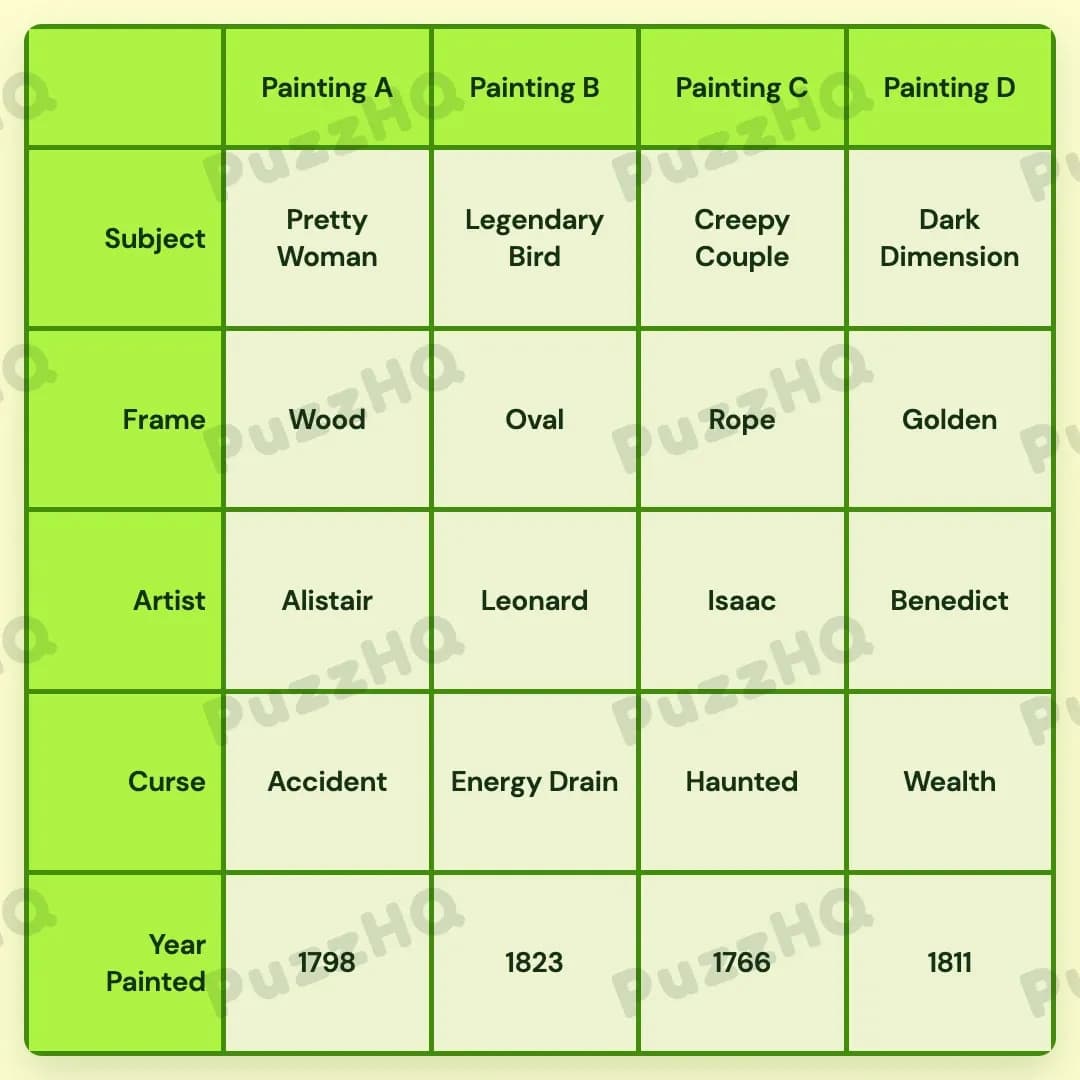
| Trait | Painting A | Painting B | Painting C | Painting D |
|---|---|---|---|---|
| Subject | Pretty Woman | Legendary Bird | Creepy Couple | Dark Dimension |
| Frame | Wood | Oval | Rope | Golden |
| Artist | Alistair | Leonard | Isaac | Benedict |
| Curse | Accident | Energy Drain | Haunted | Wealth |
| Year Painted | 1798 | 1823 | 1766 | 1811 |
Building The Grid By Trait
Starting with the physical frames and the artists provides the cleanest foundation. Direct placements and positional relationships quickly lock down the outer boundaries of the gallery row, giving the conceptual traits like curses and painted subjects solid anchors to attach to.
Frame Positions Define The Gallery Layout
The frames set up immediate structural limits across the four display spots. One clue specifies that the wooden frame rests at the opposite end of the gallery from the golden frame. This means one must occupy Painting A while the other occupies Painting D.
Meanwhile, the egg shaped frame holds the legendary bird. An egg shape corresponds to the oval frame option. Because the opposite ends belong to wood and gold, this oval frame cannot sit at Painting A or Painting D. When paired with the artist signature on Painting B, the oval frame naturally locks into Painting B.
With Painting B taking the oval frame, only Painting C remains without an assigned outer or inner frame slot. By elimination among the available materials, the rope frame must belong to Painting C. At the same time, the painting created in 1811 that is newer than its neighbor ties directly into the golden frame at Painting D, which places the wooden frame securely on Painting A.
Artist Names Attach To Fixed Locations
Once the physical positions take shape, the artists begin finding their respective canvases. A direct clue confirms that Leonard proudly left his signature on Painting B. This aligns directly with the newly established oval frame.
Another clue points out that the painter at position C trapped the souls of his parents for eternity. This identifies Painting C as the creation of Isaac, who is tied to the portrait of his trapped parents.
Next, we learn that the only painting carrying a positive curse belongs to Benedict. Since Benedict holds the beneficial curse, and that curse is paired with the dark dimension canvas, Benedict cannot be the artist who obsessively painted his wife. Alistair fits the obsessive husband profile, which places Alistair at Painting A alongside his wife. With Alistair at Painting A, Leonard at Painting B, and Isaac at Painting C, Benedict completes the artist row at Painting D.
Curse Traits Separate Malicious Effects From Illusions Of Fortune
The curses distribute across the four paintings based on their moral alignment and the chronological history of their owners. The clue concerning the sole positive curse explicitly names Benedict as its owner. Benedict created the golden framed piece at Painting D, meaning the curse of wealth belongs at Painting D.
The remaining negative curses include accident, energy drain, and haunted. The historical record indicates that the second oldest painting caused all its previous owners to die in accidents. Determining which year corresponds to the second oldest painting places the accident curse squarely on Painting A.
For the middle two paintings, Leonard is noted as definitively not owning the haunted canvas. Since Painting B belongs to Leonard, the haunted curse cannot be placed on Painting B. This leaves Painting C as the haunted piece, which makes sense given that painter Isaac trapped souls inside it. The remaining curse, energy drain, drops into the open slot for Leonard at Painting B.
Subjects Complete The Visual Imagery
The subjects of each painting fall into line through descriptive clues linked to their creators and curses. The clue describing the legendary bird specifies that it is held within an egg shaped frame. Since the oval frame is fixed to Painting B, the legendary bird becomes the subject of Painting B.
Alistair's curse stemmed from an unhealthy obsession with a painting of his wife. Because Alistair occupies Painting A, his portrait of a pretty woman must be Painting A.
At Painting D, the pursuit of wealth connects directly to the dark dimension, making that cosmic horror the subject of Benedict's golden framed work. Finally, the portrait of parents trapped for eternity corresponds to the creepy couple, which slots neatly into Painting C under Isaac's brushwork.
Year Painted Establishes The Chronology
The chronological dates complete the puzzle by matching the historical clues. The four dates available span from the eighteenth century into the early nineteenth century: 1766, 1798, 1811, and 1823.
The golden framed piece at Painting D was completed in 1811 and was explicitly newer than its neighboring canvas. Its only neighbor is Painting C. To satisfy this condition, Painting C must have been created earlier than 1811. The earliest year on the list is 1766, which fits Painting C perfectly.
Between the remaining years, 1798 and 1823, the clue regarding accidents specifies that the second oldest painting caused accidental deaths. Arranging the four years in order from oldest to newest gives 1766, 1798, 1811, and 1823. The second oldest date is 1798. Because the accident curse belongs to Painting A, Painting A receives 1798. This leaves the newest year, 1823, for Leonard's legendary bird at Painting B.
Where The Trait Rows Intersect
Frames And Subjects Reveal Painting B
Rather than deducing the subject row in isolation, the egg shaped frame clue creates a direct link between frame geometry and subject matter. Knowing that an egg shape equates to an oval allows the subject of the legendary bird to merge immediately with the oval frame. Once Leonard claimed Painting B, that single cross connection resolved both the frame and the subject for the second column simultaneously.
Dates And Curses Pin Down Painting A
The timeline does not simply arrange years from left to right; it dictates where a specific tragedy struck. The clue stating that the second oldest painting led to fatal accidents requires comparing all available dates before assigning the curse. Identifying 1798 as the second oldest date bridged the timeline trait directly to the accident curse, anchoring both traits to Painting A where Alistair and the wooden frame were already situated.
Themes And Artists Lock Painting D
The relationship between the positive curse of wealth and the subject of the dark dimension creates an important thematic intersection. Neither clue reveals the position alone, but together they connect Benedict, the golden frame, and the year 1811. Understanding that the only beneficial supernatural effect was monetary wealth allowed the artist, subject, and curse traits to resolve in one cohesive package at the end of the gallery.
Final Grid Check
Every row now harmonizes across the four gallery locations. The physical frames sit in balanced opposition, with wood on the far left and gold on the far right. The artists align with their respective motivations, from Alistair's romantic obsession in 1798 to Benedict's perilous bargain with wealth in 1811. Isaac's haunted portrait of his parents remains safely separated from neighboring soul curses, and Leonard's late masterpiece drains energy inside its oval border. Every clue is satisfied, confirming that the reconstruction of the gallery is complete.
Comments