
Profile Perfect Level 505 Answer
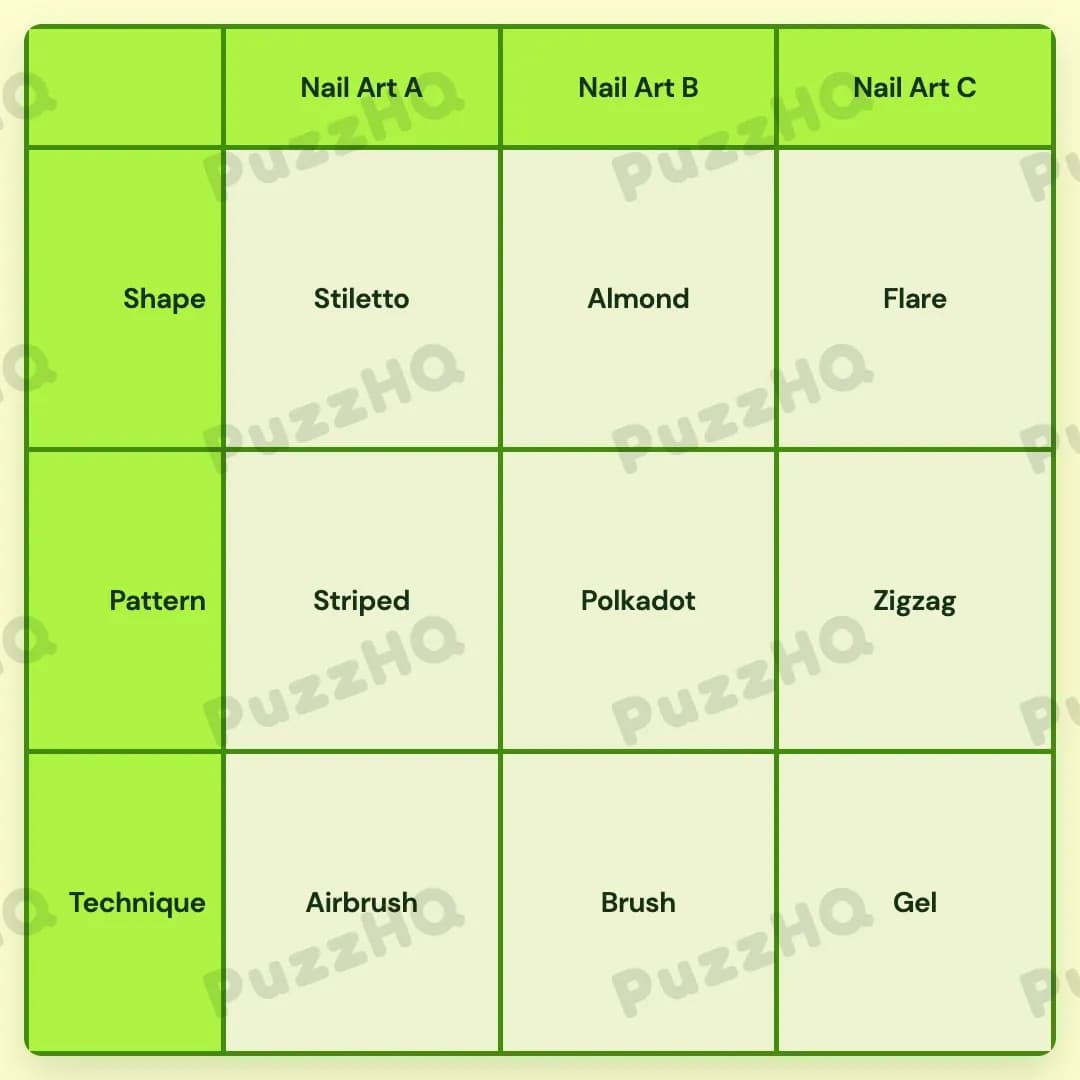
Each nail design is defined by an exact pairing of geometric structure, decorative finish, and application method, leading to a singular layout across the board.
| Trait | Nail Art A | Nail Art B | Nail Art C |
|---|---|---|---|
| Shape | Stiletto | Almond | Flare |
| Pattern | Striped | Polkadot | Zigzag |
| Technique | Airbrush | Brush | Gel |
Building The Grid By Trait
When approaching this layout, looking at the Pattern category first provides an unbeatable opening move. Rather than guessing which subject receives which treatment, the patterns come with rigid relative positioning that maps directly across the three display columns. Once the horizontal span is secured, the remaining traits can be layered on top by watching how application methods and silhouettes connect to those established coordinates.
Pattern Establishes The Spatial Foundation
The fastest way into the puzzle is through the strict geometric spacing provided for the patterns. We are working across three designated columns: Nail Art A on the far left, Nail Art B in the center, and Nail Art C on the far right.
A key clue states that the Zigzag pattern is located two columns to the right of the Striped pattern. In a three column grid, there is only one possible placement that allows for a span of two columns. The item on the left must occupy column one, and the item on the right must occupy column three. Therefore, Nail Art A must be Striped, and Nail Art C must be Zigzag.
With the outer wings of the Pattern row locked down immediately, only one pattern remains unassigned: Polkadot. By default, Polkadot must occupy the center slot belonging to Nail Art B. Another clue confirms this alignment by noting that tiny little circles were drawn using a specific tool. Those tiny circles represent the Polkadot theme, completely securing the Pattern row in one clean deduction.
Technique Binds To The Pattern Framework
Now that each column has an assigned pattern, the Technique row can be resolved by connecting application styles to those existing anchors.
We learn early on that the Brush technique is responsible for creating the pattern positioned in the middle. Because Nail Art B is fixed as the middle column and holds the Polkadot design, Nail Art B immediately claims Brush as its technique. This reinforces the clue noting that the tiny circular dots were created with a brush, creating perfect consistency between the design style and its physical application.
That leaves two techniques unsettled: Airbrush and Gel. These remaining methods must be divided between Nail Art A and Nail Art C. Resolving them requires glancing ahead at how application tools interact with the nail contours. We are told that the Stiletto contour was applied using an Airbrush. This dual association means that whichever column takes the Airbrush technique must also take the Stiletto shape. Looking at the open candidates, Nail Art B is already spoken for because it uses a Brush. The choice between Nail Art A and Nail Art C becomes clear once the silhouettes are evaluated.
Shape Finalizes The Profiles
The Shape category finishes the puzzle by tying spatial observations and technique requirements together.
The first silhouette clue notes that the nail art on the far right features the most different shape among the collection. The available shapes in the puzzle are Stiletto, Almond, and Flare. While Stiletto and Almond both taper toward the tip in traditional pointed curves, Flare widens outward dramatically at the free edge, making it structurally the most unconventional and distinct shape of the group. Because this unique silhouette sits on the far right, Flare belongs to Nail Art C.
Assigning Flare to Nail Art C instantly resolves the pending technique choice. Since Nail Art C has the Flare shape, it cannot be the nail that features the Stiletto shape. As established earlier, the Stiletto shape is tied directly to the Airbrush technique. Because Nail Art B already uses a Brush, and Nail Art C is Flare, the combination of Stiletto and Airbrush can only belong to Nail Art A.
With Nail Art A taking Stiletto and Nail Art C taking Flare, the only shape remaining in the pool is Almond. Almond slots naturally into the middle column for Nail Art B. Similarly, with Airbrush placed at Nail Art A and Brush placed at Nail Art B, the final remaining technique of Gel is assigned to Nail Art C.
Where The Trait Rows Intersect
Solving logic grids smoothly depends on spotting where individual categories collide. Paying attention to cross-trait interactions saves significant time compared to treating each row in isolation.
How Pattern Spacing Dictates Middle Technique
The absolute positional clue governing the Pattern row does far more than just place designs on the board. By establishing that Striped sits at the far left and Zigzag sits at the far right, it defines the entire horizontal layout. When a clue specifies that a Brush was used to paint the middle pattern, that clue becomes actionable solely because the pattern spacing has already isolated Nail Art B as the center subject. The intersection of pattern positioning and technique assignment allows two distinct rows to lock together without trial and error.
The Dual Requirement Of Airbrush And Silhouette
Another powerful crossroads occurs when a technique is explicitly bound to a shape. The clue linking the Airbrush technique directly to the Stiletto shape creates a compound block. Instead of evaluating Airbrush as a free floating technique and Stiletto as an unattached shape, they must be viewed as an indivisible unit. Once Nail Art B claims the Brush technique and Nail Art C claims the Flare shape, that compound block has only one open home left on the board. Connecting traits to each other before connecting them to a column makes short work of the remaining grid.
Resolving Rightmost Extremes Through Contour Differences
The distinction highlighted on the far right nail provides a crucial anchor where shape logic meets column geography. Recognizing Flare as the outlier shape solves Nail Art C's physical contour in isolation. However, the real value of this deduction appears when it intersects with the Pattern and Technique rows. By occupying the right column with Flare, it prevents the Airbrush and Stiletto pairing from landing there, thereby resolving both Nail Art A and Nail Art C across all three trait categories simultaneously.
Final Grid Check
Every category now aligns in complete harmony. Nail Art A pairs a sharp Stiletto profile with a classic Striped design sprayed on via Airbrush. Nail Art B combines a soft Almond contour with a playful Polkadot pattern painted by Brush in the center position. Nail Art C finishes the lineup on the right with a bold Flare shape showing off a Zigzag pattern set in Gel. Every directional condition, tool pairing, and pattern relationship fits into place without conflict.
Comments