
Profile Perfect Level 50 Answer
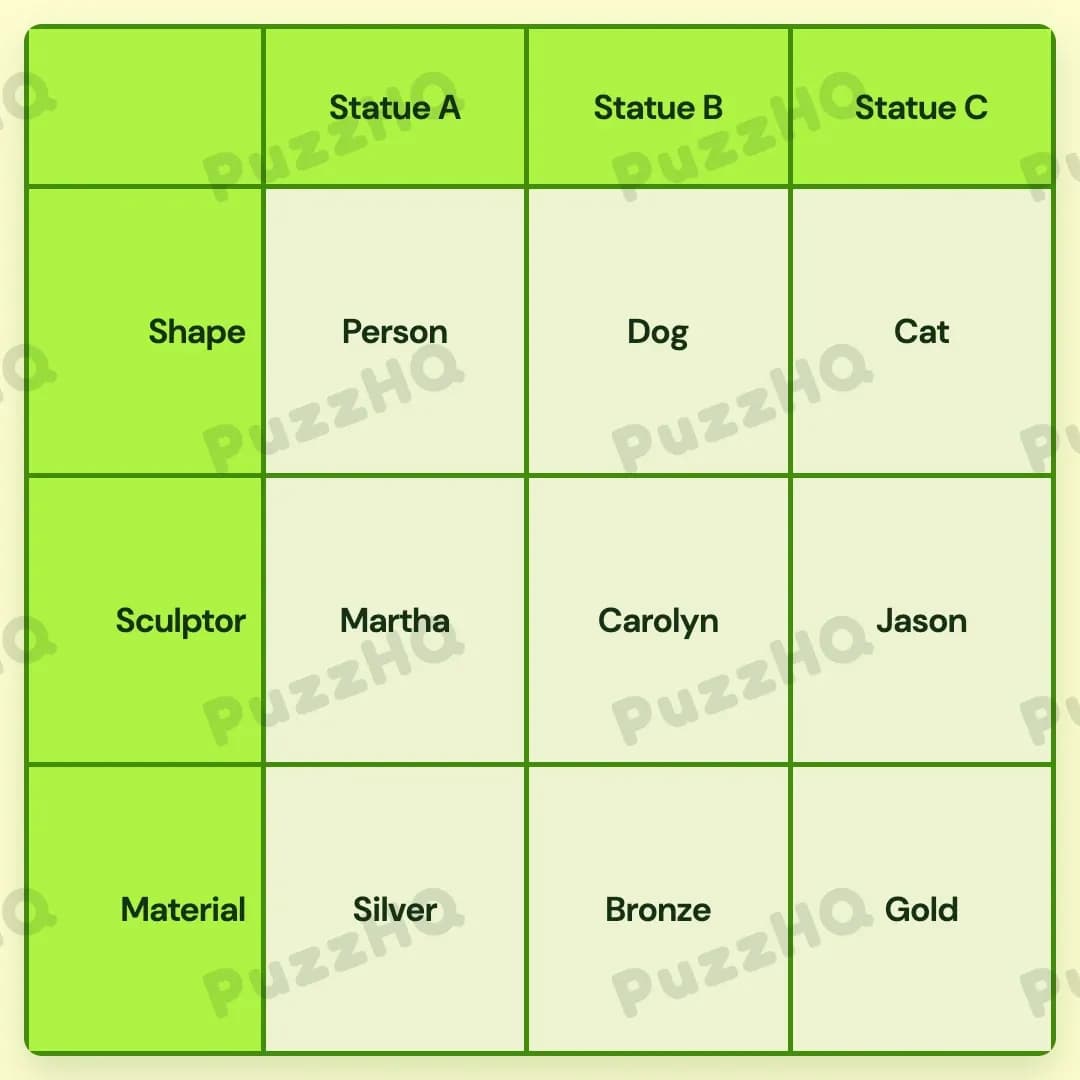
Here is the complete solution for Level 50, which pairs each statue with its shape, sculptor, and material.
| Trait | Statue A | Statue B | Statue C |
|---|---|---|---|
| Shape | Person | Dog | Cat |
| Sculptor | Martha | Carolyn | Jason |
| Material | Silver | Bronze | Gold |
How To Think Through Profile Perfect Level 50
The most effective habit for this puzzle is locking down fixed locations first, then using relational and paired clues to populate the remaining slots. When you establish absolute anchors early on, relative spatial clues like "to the right of" become immediate direct assignments rather than floating possibilities.
Lock In Fixed Positions: Martha Belongs On The Left
Begin by looking for clues that name an exact position without requiring any outside information. In this level, one clue states that Martha sculpted the statue on the left.
Because the subjects are laid out in order from left to right as Statue A, Statue B, and Statue C, the statue on the left is Statue A. You can place Martha as the sculptor of Statue A right away.
Direct placement clues are the strongest starting moves in any grid puzzle. They give you a permanent anchor and instantly reduce the search space for that specific trait category.
Establish Explicit Subject Traits: Statue B Is Made From Bronze
Next, look for direct trait assignments that name a specific subject. One clue plainly tells you that Statue B is made from Bronze.
This gives you a second fixed anchor across a different trait category. At this stage, you know:
- Statue A is sculpted by Martha.
- Statue B is made from Bronze.
Placing direct subject assignments immediately is crucial because other clues often reference those specific materials or positions in their conditions.
Use Positional Clues With Known Anchors: The Cat Sits To The Right Of Bronze
Now look for clues that describe relative positioning. One clue states that the Cat statue is to the right of the Bronze statue.
Because you have already placed Bronze at Statue B, this relative statement becomes a direct location deduction:
- Bronze is located at Statue B in the middle.
- The only position to the right of Statue B is Statue C.
- Therefore, Statue C must be the Cat statue.
Relative positioning clues can feel slippery when multiple columns are empty. By solving the Bronze anchor first, you turn a relative clue into a single definitive placement for Statue C's shape.
Apply Multi-Trait Bundles: Jason Pairs With Gold
Multi-trait clues tie two attributes together without explicitly naming which subject owns them. One clue tells you that Jason made a statue out of Gold. This means the sculptor Jason and the material Gold must occupy the exact same subject column.
Look at the remaining available columns for both a sculptor and a material:
- Statue A already has Martha as its sculptor, so it cannot take Jason and Gold.
- Statue B already has Bronze as its material, so it cannot take Jason and Gold.
- Statue C has no assigned sculptor and no assigned material yet.
Because Statue C is the only column that has an open slot in both the sculptor row and the material row, Jason and Gold must belong to Statue C.
This step illustrates why multi-trait bundles are so powerful: they require an entire column profile to have openings in all matching trait categories, which often eliminates every candidate except one.
Connect Paired Traits: The Silver-Person Statue
Another multi-trait clue states that the Silver-Person statue is highly praised by visitors. This establishes a fixed link between the shape Person and the material Silver.
Look at where this pair can fit:
- Statue C already has the shape Cat and the material Gold.
- Statue B already has the material Bronze.
- Statue A currently has no assigned shape and no assigned material.
This leaves Statue A as the only valid location for both the Person shape and the Silver material. Place Person as the shape for Statue A and Silver as the material for Statue A.
Resolve The Final Unmatched Values By Elimination
At this point, nearly every cell in the grid is filled. You can complete the remaining slots through simple elimination:
- For the material row, Silver is at Statue A, Bronze is at Statue B, and Gold is at Statue C. The material category is complete.
- For the shape row, Person is at Statue A and Cat is at Statue C. The only remaining shape is Dog, which must belong to Statue B.
- For the sculptor row, Martha is at Statue A and Jason is at Statue C. The only remaining sculptor is Carolyn, who must belong to Statue B.
Filling the final spaces by process of elimination guarantees that every subject receives exactly one unique value for each trait without any guesswork.
What This Level Teaches You
Direct Anchors Activate Relative Clues
A clue that mentions a relative position, such as being to the right of another object, becomes trivial once the reference object has a fixed location. In this puzzle, identifying Statue B as Bronze immediately resolved the placement of the Cat statue at Statue C. Always look to build direct anchors before evaluating relative directional clues.
Bundled Pairs Eliminate Multiple Columns At Once
Clues that link two traits together, such as Jason with Gold or Silver with Person, do not need to name a specific column to be useful. When a column already has one of those traits assigned to a different value, that entire column is eliminated from holding the pair. Look for open trait slots across candidate columns to place paired traits quickly.
Process Of Elimination Cleans Up The Remainder
You do not need an explicit clue for every single trait value. In this level, Carolyn and Dog were never directly mentioned by a dedicated clue, but they were placed with complete certainty because all alternative choices had been assigned. Tracking used options lets you close out the puzzle cleanly.
Final Thoughts
The key to mastering Profile Perfect Level 50 is sequencing your deductions properly. Starting with fixed positional and identity clues creates the foundation needed to resolve directional hints and bundled trait pairs, leaving the rest of the board to fall into place through elimination.
Comments