
Profile Perfect Level 530 Answer
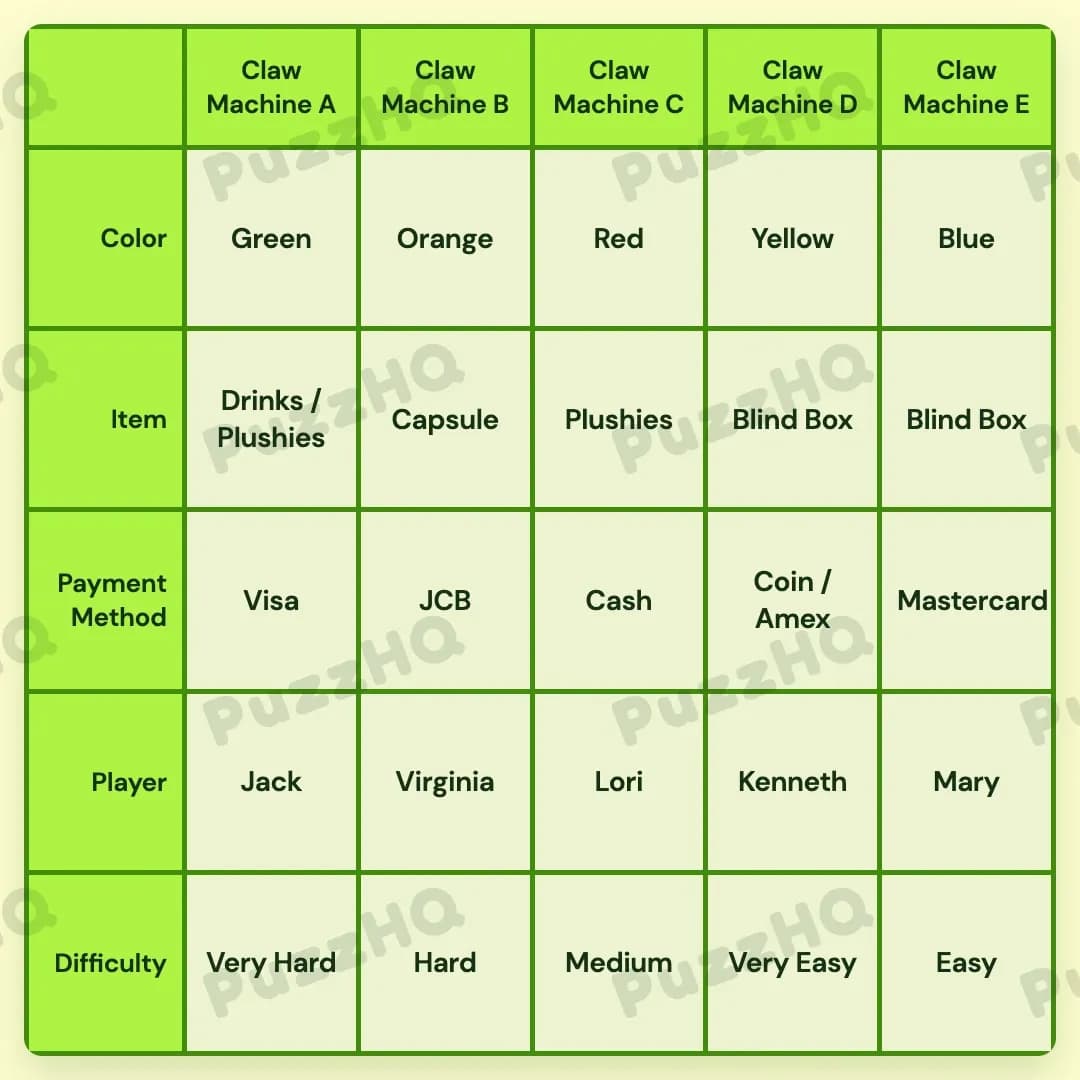
The claw machines line up from left to right with Jack on Green, Virginia on Orange, Lori on Red, Kenneth on Yellow, and Mary on Blue.
| Trait | Claw Machine A | Claw Machine B | Claw Machine C | Claw Machine D | Claw Machine E |
|---|---|---|---|---|---|
| Color | Green | Orange | Red | Yellow | Blue |
| Item | Drinks / Plushies | Capsule | Plushies | Blind Box | Blind Box |
| Payment Method | Visa | JCB | Cash | Coin / Amex | Mastercard |
| Player | Jack | Virginia | Lori | Kenneth | Mary |
| Difficulty | Very Hard | Hard | Medium | Very Easy | Easy |
How To Think Through Profile Perfect Level 530
The most useful solving habit for this puzzle is using rigid spatial constraints to fix key anchor subjects before trying to assign multi trait packages. When a clue defines an exact span across a row, it severely limits where anyone can stand. Once the board has anchored players, negative clues quickly narrow down the rest of the layout.
Use Symmetric Distance To Find The Anchor: Lori Takes The Center
A clue states that Lori is two columns away from both Mary and the brave man.
In a five column grid running from Claw Machine A to Claw Machine E, symmetric distance clues are among the strongest starting points. For one person to be exactly two spaces away from two different people simultaneously, that person must sit in the third column. If Lori were in any other spot, you could not fit two separate people two columns to her left and two columns to her right.
This immediately places Lori at Claw Machine C.
Furthermore, this means Mary and the brave man must occupy the outer edges at Claw Machine A and Claw Machine E. While you do not know which outer edge belongs to Mary yet, identifying Lori as the center anchor splits the grid cleanly in half and sets up the next elimination.
Resolve The Two Ends With Negative Constraints: Jack And Mary
Now consider the outer columns. You know that Claw Machine A and Claw Machine E are split between Mary and the brave man.
Another clue reveals that Kenneth is not brave enough to take on Claw Machine A. This confirms two things at once: Kenneth is not the brave man, and Kenneth cannot be at Claw Machine A. Looking at the player list, Jack is the only remaining male player. Therefore, Jack must be the brave man.
Because Jack is the brave man who takes on Claw Machine A, place Jack at Claw Machine A. Mary takes the opposite end at Claw Machine E.
This leaves only two players unplaced: Virginia and Kenneth, who must divide Claw Machine B and Claw Machine D.
Eliminate Invalid Columns With Neighbor Blocks: Kenneth And The Green Machine
To decide where Kenneth and Virginia go, examine the negative neighbor rule: neither Kenneth nor his neighbors play the Green machine.
You also know from another clue that the two rightmost machines (Claw Machine D and Claw Machine E) are neither Red nor Green.
Test what happens if Kenneth were placed at Claw Machine B. If Kenneth were at Claw Machine B, his neighbors would be Claw Machine A and Claw Machine C. The rule would forbid Claw Machine A, Claw Machine B, and Claw Machine C from being Green. Since Claw Machine D and Claw Machine E are already forbidden from being Green by the rightmost machine rule, Green would have no possible column on the entire board.
That contradiction proves Kenneth cannot be at Claw Machine B. Kenneth must be at Claw Machine D. Consequently, Virginia must be at Claw Machine B.
Now return to the Green machine. With Kenneth at Claw Machine D, his neighbors are Claw Machine C and Claw Machine E. Green cannot be at C, D, or E. Nor can Green be at B, because a clue tells you that the Orange machine is the second-hardest machine, meaning Orange sits in the main lineup. That leaves only Claw Machine A for Green. Assign Green to Claw Machine A.
Follow The Difficulty Chain: Very Hard To Very Easy
Next, look at the difficulty traits. A clue notes that a machine sits between Jack and Medium difficulty. Jack is at Claw Machine A. The only machine that can sit between column A and another difficulty requires Medium difficulty to be two steps over at Claw Machine C.
Another clue states that Claw Machine A is harder than its neighbor. Claw Machine B is the Orange machine, which is known as the second-hardest machine. In a five tier scale spanning Very Hard, Hard, Medium, Easy, and Very Easy, the second-hardest tier is Hard. Therefore, Claw Machine B has Hard difficulty and Orange color. Because Claw Machine A is harder than Hard, Claw Machine A must be Very Hard.
With Claw Machine A established as Very Hard, use the clue stating that the machine furthest from Very Hard accepts only Mastercard. The column furthest from Claw Machine A is Claw Machine E. Assign Mastercard to Claw Machine E.
Now find the remaining difficulties. A clue tells you that the easiest machine is Yellow and requires Coin to play. The easiest difficulty is Very Easy. Because Claw Machine E already requires Mastercard, it cannot be the easiest machine that requires Coin. Claw Machine D must be the easiest machine, giving it Very Easy difficulty, Yellow color, and Coin payment.
This leaves Claw Machine E with Easy difficulty and the final unused color, Blue. Claw Machine C takes the remaining color, Red.
Group Physical Currencies And Secure The Remaining Payments
Payment methods come together by grouping matching types. A clue states that machines accepting physical money are next to each other.
The two physical payment types in the list are Coin and Cash. Coin is already locked at Claw Machine D. Its available neighbors are Claw Machine C and Claw Machine E. Claw Machine E already has Mastercard. Therefore, Cash must belong to Claw Machine C.
For the remaining payment slots at Claw Machine A and Claw Machine B, check the clue stating that the Visa machine's reward involves no element of chance. Another clue specifies that only the leftmost machine's reward contains liquid. A reward with liquid represents Drinks, which does not rely on random chance like capsules or blind boxes. Claw Machine A is the leftmost machine, so it receives Drinks / Plushies and Visa payment.
The last remaining payment method is JCB, which completes Claw Machine B.
Sort Rewards By Physical Mechanics: Capsules And Boxes
With players, colors, difficulties, and payments settled, finish the items.
Claw Machine A already holds Drinks / Plushies based on the liquid clue. A clue states that the person next to Virginia has their eyes on the Plushies. Virginia is at Claw Machine B, and her neighbors are Jack at A and Lori at C. Since Jack has Drinks / Plushies, Lori at Claw Machine C gets Plushies.
Finally, consider the mechanical clue: twisting will not help you open the Amex machine's reward. The Amex machine is paired with Coin at Claw Machine D. Twist mechanisms belong to Capsules, whereas Blind Boxes are opened by tearing or pulling. Therefore, the Capsule cannot go to Claw Machine D.
Place Capsule at Claw Machine B. This leaves Blind Box to fill the remaining slots at Claw Machine D and Claw Machine E, completing the board.
What This Level Teaches You
Equal Distance Demands The Board Center
When a clue places a subject an equal distance away from two other subjects, check board boundaries immediately. In a five slot layout, being two spaces away from two distinct people is mathematically impossible anywhere except column three. Recognizing this instantly anchors your grid without guessing.
Test Negative Neighbor Rules Against Empty Options
Negative neighbor clues often look weak on their own, but they become decisive when combined with regional bans. When a clue forbids a subject and both neighbors from sharing a trait, placing that subject in the middle of your remaining candidates can completely wipe out every legal spot for that trait. Always test whether a placement eliminates all remaining options for an entire color or item.
Use Scale Ends To Drive Spatial Distance
Clues that reference the furthest distance from a specific trait require you to establish the extreme end of that trait first. Once you know that the hardest machine sits on an outer edge, the furthest point automatically locks onto the opposite outer edge.
Final Thoughts
Patience with board geometry is the key to solving this level. Rather than trying to pair colors and items early, locating the center anchor through symmetric spacing untangles the entire player lineup. Once the players take their seats, the difficulty chain and payment rules fall into place in a clean, logical sequence.
Comments