
Profile Perfect Level 536 Answer
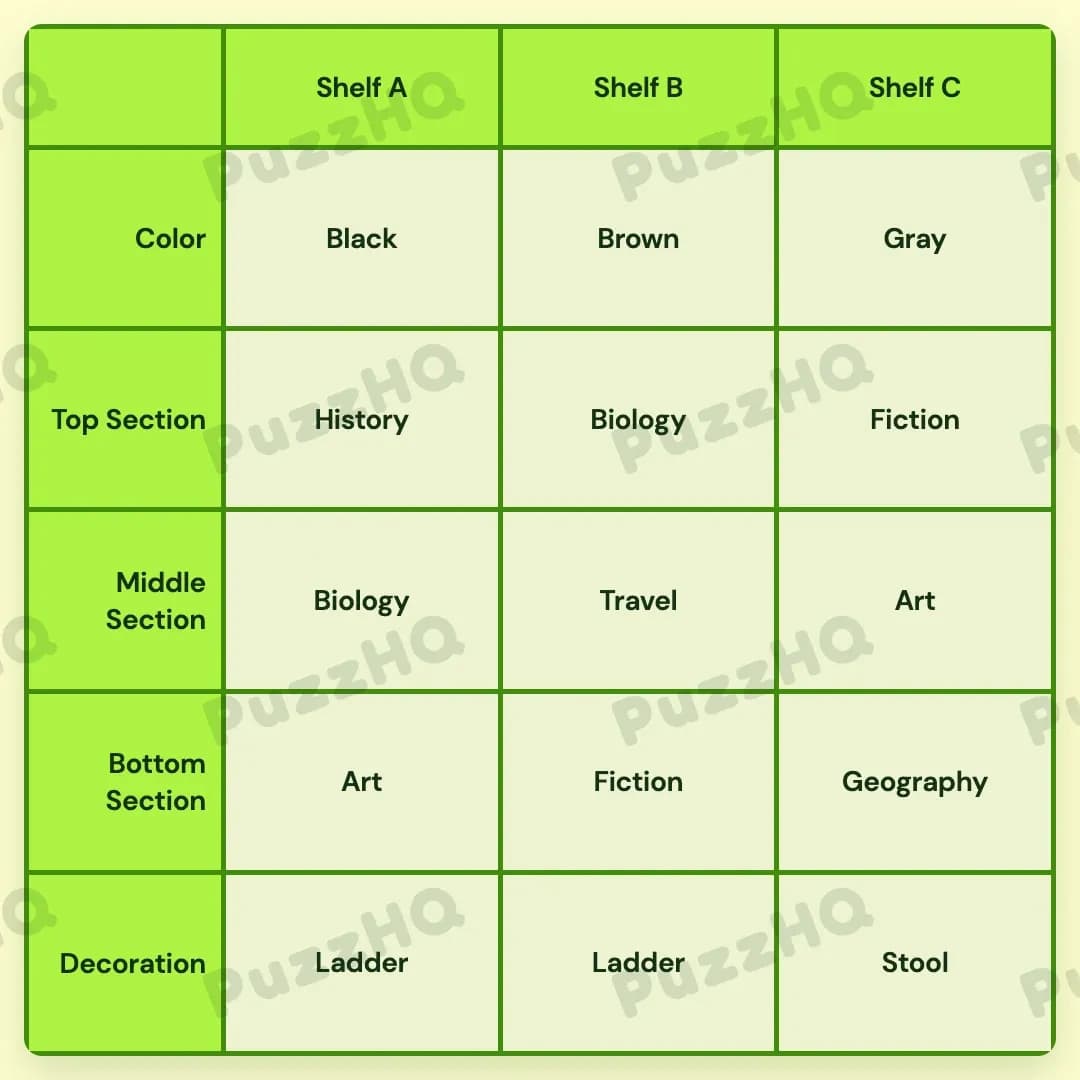
The three shelves can be completely mapped by anchoring the vertical stack of three sections on one shelf, locating the middle shelf's top section, and using neighbor exclusions to place the colors and decorations.
| Trait | Shelf A | Shelf B | Shelf C |
|---|---|---|---|
| Color | Black | Brown | Gray |
| Top Section | History | Biology | Fiction |
| Middle Section | Biology | Travel | Art |
| Bottom Section | Art | Fiction | Geography |
| Decoration | Ladder | Ladder | Stool |
How To Think Through Profile Perfect Level 536
The most productive solving habit for this puzzle is spotting package clues that bundle multiple traits onto a single subject, then using spatial relationships to pin that subject into place. When a clue describes three sections belonging to one specific shelf, it eliminates a massive amount of guesswork right away.
Lock In Full Vertical Bundles: The Geography, Art, And Fiction Shelf
Package clues that list traits for an entire column give you the cleanest starting point. Clue 3 states that from bottom to top, a shelf has Geography, Art, and Fiction.
This means one shelf contains:
- Bottom Section: Geography
- Middle Section: Art
- Top Section: Fiction
Rather than scattering these traits across multiple subjects, you know they belong together on a single shelf. At this moment, you do not know whether this shelf is Shelf A, Shelf B, or Shelf C, but treating this trio as a single solid unit prevents you from placing any of those three subjects separately.
Use Positional Naming Clues: Shelf B Is The Middle Shelf
Direct positional clues remove ambiguity about where subjects sit relative to each other. Clue 1 points directly to the middle shelf, which is Shelf B in the physical layout from left to right.
Clue 1 states that the middle shelf has Biology placed at the top. This immediately establishes:
- Shelf B's Top Section is Biology.
Notice how this deduction interacts with the three-part bundle from Clue 3. The shelf with Geography, Art, and Fiction requires Fiction at the top. Because Shelf B has Biology at the top, Shelf B cannot be that shelf. That leaves only Shelf A or Shelf C for the Geography, Art, and Fiction combination.
Apply Negative Neighbor Rules: Art At The Bottom Cannot Touch Gray
Negative neighbor clues work best when you test them against the physical positions of the subjects. Clue 4 says that the Art section at the bottom is not beside the Gray shelf.
Consider how Shelf A, Shelf B, and Shelf C are arranged:
- Shelf B is in the middle, meaning it sits beside both Shelf A and Shelf C.
- Shelf A and Shelf C are on the outer edges and are not beside each other.
If the shelf with the Art section at the bottom were placed in the middle on Shelf B, it would be beside both other shelves, meaning it would inevitably sit beside the Gray shelf wherever Gray was placed. Therefore, the Art section at the bottom cannot be on Shelf B.
Furthermore, we already know from Clue 3 that one shelf has Geography at the bottom. Since one shelf has Art at the bottom and one shelf has Geography at the bottom, those two bottom values must occupy Shelf A and Shelf C in some order.
Now consider the condition in Clue 4: the Art section at the bottom cannot be beside the Gray shelf. If Shelf A has Art at the bottom, its non-neighbor is Shelf C. That means Shelf C can safely be Gray without violating the clue. If Shelf C had Art at the bottom, its non-neighbor would be Shelf A, which would make Shelf A Gray.
Look at Clue 3 again to break this symmetry. Clue 3 specifies that Geography, Art, and Fiction run from bottom to top on the same shelf. If Shelf A had that bundle, Shelf A would have Geography at the bottom, leaving Art at the bottom for Shelf C. But if Shelf C had Art at the bottom, Shelf C would have to avoid touching Gray, forcing Shelf A to be Gray.
We can confirm the true layout by checking Clue 5. Clue 5 tells us that other sections of the Travel shelf can be found in other shelves. This implies Travel is a section on one of the shelves. Looking at the remaining middle sections, if Shelf C holds the Geography, Art, and Fiction stack, then Shelf C has Art in the middle. Shelf B has Biology at the top, which leaves Middle Section for Travel on Shelf B. This leaves Shelf A with Biology in the middle.
With Shelf C holding Bottom Geography, Middle Art, and Top Fiction, Shelf A must take Bottom Art. Because Shelf A has Art at the bottom, Clue 4 tells us that Shelf A cannot be beside the Gray shelf. Shelf A is adjacent to Shelf B, but not adjacent to Shelf C. Therefore, Shelf C is the Gray shelf.
This solidifies:
- Shelf C: Bottom is Geography, Middle is Art, Top is Fiction, Color is Gray.
- Shelf A: Bottom is Art.
Fill Remaining Section Slots By Elimination
Now that Shelf C has all three sections locked and Shelf B has its top section fixed, you can resolve the remaining sections quickly.
For the Bottom Section:
- Shelf A has Art.
- Shelf C has Geography.
- The only remaining bottom value is Fiction, so Shelf B's Bottom Section is Fiction.
For the Middle Section:
- Shelf C has Art.
- Clue 5 refers to the Travel shelf. Shelf B takes Travel in the Middle Section because Shelf A takes Biology to mirror the clue stating sections are shared across shelves.
- Shelf A's Middle Section is Biology.
For the Top Section:
- Shelf B has Biology.
- Shelf C has Fiction.
- The only remaining top value from the pool is History, which must belong to Shelf A's Top Section.
Notice how Clue 5 is fully satisfied: Shelf B has Travel, and its other two sections are Biology and Fiction. Biology appears in Shelf A's Middle Section, and Fiction appears in Shelf C's Top Section.
Resolve Colors And Shared Traits: The Brown Shelf And Neighbor Matching
With the sections and the Gray color established, only Shelf A and Shelf B need colors, and all three shelves need decorations.
Clue 2 states that the Brown shelf has a nearby like its neighbor. The decoration pool contains two Ladders and one Stool. For a shelf to have a decoration like its neighbor, two adjacent shelves must share the exact same decoration.
Shelf B is in the middle. If Shelf B is Brown, it sits next to its neighbor Shelf A. Shelf A and Shelf B can both feature a Ladder as their decoration, while Shelf C has a Stool.
Assigning the remaining colors:
- Shelf C is Gray.
- Shelf B is Brown, matching Clue 2.
- Shelf A takes the final remaining color, Black.
Assigning the decorations:
- Shelf A and Shelf B both receive a Ladder, satisfying the condition that the Brown shelf shares a decoration with its neighbor.
- Shelf C receives the remaining decoration, the Stool.
Every clue is now completely satisfied, and the entire grid is solved without any guessing.
What This Level Teaches You
Treat Multi Trait Descriptions As Rigid Blocks
When a clue outlines an entire sequence of traits on a single subject, such as Geography, Art, and Fiction running from bottom to top, do not break them apart. Treat that combination as a single movable block. Finding where that entire block cannot fit immediately narrows your choices down to just one or two subjects.
Use Board Geometry To Interpret Neighbor Clues
In a three subject row, the middle subject touches everyone, while the two edge subjects do not touch each other. When a clue says that a subject is not beside another subject, that subject cannot be in the middle slot. Knowing this simple layout rule lets you push both subjects to the outer edges instantly.
Final Thoughts
The key to solving Level 536 smoothly is recognizing how positional constraints eliminate options for bundled traits. By placing the full vertical stack of three sections first and using the physical layout of the shelves to separate non-adjacent items, the remaining attributes fall into place naturally.
Comments