
Profile Perfect Level 548 Answer
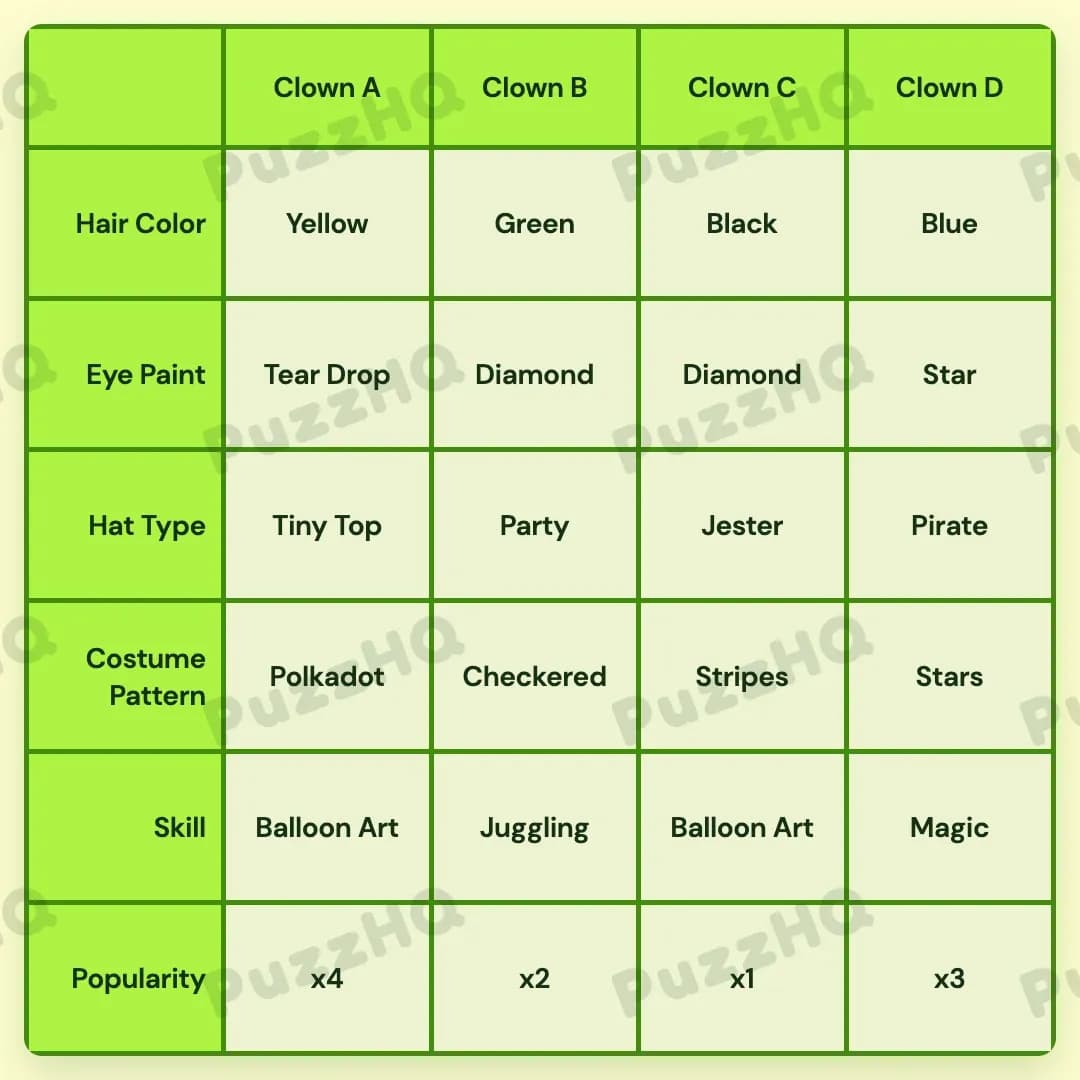
The circus lineup comes together by pairing Clown A's distinctive melancholic appearance with the spatial clues that span the four podiums.
| Trait | Clown A | Clown B | Clown C | Clown D |
|---|---|---|---|---|
| Hair Color | Yellow | Green | Black | Blue |
| Eye Paint | Tear Drop | Diamond | Diamond | Star |
| Hat Type | Tiny Top | Party | Jester | Pirate |
| Costume Pattern | Polkadot | Checkered | Stripes | Stars |
| Skill | Balloon Art | Juggling | Balloon Art | Magic |
| Popularity | x4 | x2 | x1 | x3 |
Building The Grid By Trait
Starting with Costume Pattern and Eye Paint gives the most reliable foundation. Several clues establish exact positions on the board by referencing patterns and cosmetics, allowing you to anchor Clown A before branching across the remaining columns.
Costume Pattern And Eye Paint Establish The Layout
Costume Pattern offers an immediate foothold because Clown A is explicitly assigned the Polkadot costume. From there, eye cosmetics and fabric prints work together to map out the horizontal ordering of the troupe.
A key clue states that a clown stands between the Stripes pattern and the Tear eye paint. Because Clown A wears the Tear paint (which also pairs with a bright yellow wig), the clown standing in the middle must be Clown B, placing the Stripes pattern squarely on Clown C. This immediately accounts for the first three positions in the costume row. With Polkadot on Clown A and Stripes on Clown C, the remaining pattern options are Checkered and Stars.
Later clues clarify that the least popular performer sits to the left of the Stars costume. Since Clown D is the only performer to the right of the middle lineup, Clown D claims the Stars costume, which leaves Checkered as the only remaining choice for Clown B.
The Eye Paint row fills in alongside these pattern assignments. Clown A is established with Tear Drop paint, giving that performer a sad expression. Another clue notes that the excited-eyed clown is not next to the sad one. The excited design, represented by the Star eye paint, cannot sit adjacent to Clown A, which means it belongs to Clown D on the far right. That leaves Diamond paint to fill the remaining two slots for Clown B and Clown C.
Popularity Ranks Reveal Hair Color
Once the physical positions are structured by patterns and eye paint, Popularity becomes the driving force that uncovers Hair Color. The four popularity tiers span from x1 to x4.
We learn that the most popular performer is painted to look sad. Because Clown A carries the Tear Drop paint, Clown A claims the top popularity rank of x4. From there, relative spacing dictates where the lowest rank lands. The clowns with the biggest popularity gap cannot be neighbors. The widest gap exists between x4 and x1, meaning the performer with an x1 ranking cannot stand next to Clown A. Clown B is therefore ruled out, leaving Clown C or Clown D.
Here, the costume clues cross back into the logic: the least popular clown sits to the left of the Stars costume. Since Clown D wears the Stars costume, Clown C must be the least popular performer with a ranking of x1.
With x4 on Clown A and x1 on Clown C, only x2 and x3 remain. A direct clue identifies the blue-haired clown as the second most popular artist in the show, which translates to a popularity ranking of x3. Clown D takes this x3 value along with Blue hair, leaving Clown B with a popularity rank of x2.
The remaining hair colors resolve quickly. Clown A wears the Yellow wig associated with Tear make-up. A positional clue notes that the clown with natural dark hair sits to the left of the performer doing Magic. Natural dark hair means Black, which fits Clown C, directly to the left of Clown D. The only hair color left for Clown B is Green.
Skill And Hat Type Complete The Lineup
The final two rows, Skill and Hat Type, fall into place by referencing the established hair colors and stage positions.
The skill row begins with the dark-haired performer sitting to the left of the one doing Magic. Because Clown C has Black hair and sits directly to the left of Clown D, Clown D is confirmed as the magician. Between the remaining options of Juggling and Balloon Art, a clue specifies that the juggler is not the least popular clown. Since Clown C holds the lowest popularity rank, Clown C cannot juggle. That gives Juggling to Clown B, while Clown A and Clown C share the craft of Balloon Art.
Hat Type finalizes the entire troupe. We are told that the hats of Clown B and Clown C have attachments at their tips. The available hat styles are Party, Jester, Pirate, and Tiny Top. Both the Party hat (with its pompom) and the Jester hat (with its pointed tips and bells) match this description.
A positional constraint resolves their exact assignments: the hat of the joker is to the left of the Pirate clown. The joker style corresponds to the Jester hat, which must sit to the left of Clown D. This places the Jester hat on Clown C and the Pirate hat on Clown D. Consequently, Clown B wears the Party hat, leaving the Tiny Top hat as the finishing accessory for Clown A.
Where The Trait Rows Intersect
Melancholy Paint Unlocks The Popularity Crown
The connection between Eye Paint and Popularity serves as the turning point for the upper half of the board. Rather than calculating popularity purely through numerical ranges, the clue linking the sad expression to the x4 rank instantly locks Clown A in place. Because Tear Drop paint already belongs to Clown A through wig and costume clues, this single conceptual overlap defines the highest value on the board and triggers the neighbor restriction for the lowest rank.
Costume Spacing Bridges Eye Paint And Stage Sequence
The relationship between the Stripes pattern and Tear eye paint acts as a physical bridge across columns. Instead of restricting clues to a single subject, this clue requires one clown to stand between two distinct traits. By knowing Clown A wears the Tear paint, the Stripes pattern is forced into Clown C, which simultaneously fixes Clown B as the middle subject and narrows down the layout of the entire stage.
Dark Hair Anchors Stage Magic
Hair Color directly governs the distribution of the Skill row. Knowing that natural dark hair sits to the left of the magician creates a directional link between Clown C and Clown D. Because Black hair has already been positioned on Clown C through popularity deductions, Magic immediately anchors to Clown D without needing any direct mention of Clown D's name.
Final Grid Check
Every row confirms the findings of the others. Clown A's melancholy teardrop look matches the maximum popularity rank, while the spacing of the costume patterns keeps the x4 and x1 performers separated. Meanwhile, Clown D's magician persona and pirate theme neatly complement the blue hair and star paint on the far right. The completed traits form a cohesive, perfectly balanced circus stage.
Comments