
Profile Perfect Level 70 Answer
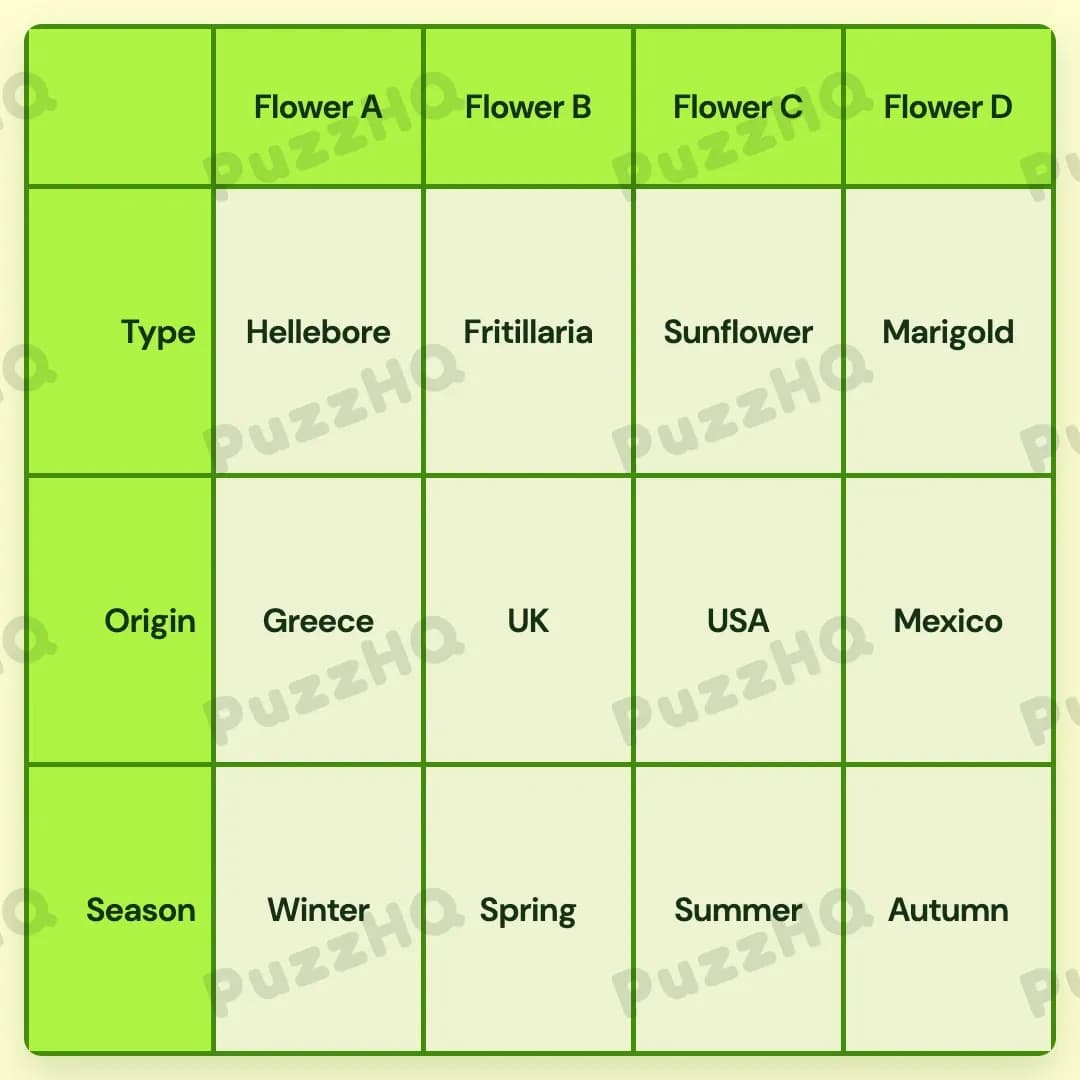
Each flower aligns uniquely with its blooming season, country of origin, and botanical type across the four slots.
| Trait | Flower A | Flower B | Flower C | Flower D |
|---|---|---|---|---|
| Type | Hellebore | Fritillaria | Sunflower | Marigold |
| Origin | Greece | UK | USA | Mexico |
| Season | Winter | Spring | Summer | Autumn |
How I Solved Profile Perfect Level 70
The first thing I noticed when scanning the board was how many clues directly tied flower names to specific seasons. Because there were only four flowers and four seasons in total, pairing up the types with their seasons gave me a very clean entry point before I even started worrying about positional columns.
Linking Every Flower To Its Blooming Season
I began by gathering every clue that mentioned a season or environmental condition:
- Marigold blooms when red leaves are falling, which links Marigold directly to Autumn.
- Sunflower gets the sunlight needed during Summer, establishing Sunflower as the Summer flower.
- Hellebore, also known as the Christmas Rose, blooms in the cold season, pairing Hellebore with Winter.
That accounted for three of the four types. Since Spring was the only season left without a flower, and Fritillaria was the only type without a season, Fritillaria had to be the Spring bloom. At this point, all four flower types were paired with their corresponding seasons:
- Hellebore belongs to Winter.
- Fritillaria belongs to Spring.
- Sunflower belongs to Summer.
- Marigold belongs to Autumn.
Pinning Down Origins For Two Distinct Flowers
Next, I looked for clues connecting these established pairs to geographic origins.
One clue directly stated that Fritillaria can be found in the United Kingdom. That gave me a complete profile for the Spring bloom: Fritillaria comes from the UK and blooms in Spring.
Another clue stated that the Autumn flower is found in a country bordering the USA. Looking at the list of available origins (Greece, UK, USA, and Mexico), Mexico is the only bordering country available. Since I already knew that Marigold is the Autumn flower, Marigold was locked to Mexico.
Now I had two fully completed profiles:
- Fritillaria / Spring / UK
- Marigold / Autumn / Mexico
The remaining two flower types (Hellebore in Winter, Sunflower in Summer) had to divide the two remaining origins (Greece and USA).
Using Positional Clues To Place The Columns
With the trait pairings mostly sorted, the next challenge was figuring out which flower occupied which column from Flower A through Flower D.
I turned to the clue stating that the Greek flower is not beside the Mexican one.
Because Mexico belongs to Marigold, and the only unassigned origins were Greece and the USA, the Greek flower had to be kept at a distance from Marigold.
At the same time, another clue specified that the Winter flower is on the left of the Spring flower.
Knowing that Winter belongs to Hellebore and Spring belongs to Fritillaria, Hellebore had to appear somewhere to the left of Fritillaria.
If Marigold (Mexico) was placed at Flower D at the far right end, the adjacent slot at Flower C could not belong to Greece. That meant Flower C had to take the USA, leaving Greece for Flower A.
Assigning Greece to Flower A immediately assigned Hellebore and Winter to Flower A as well.
Completing The Grid Across All Four Slots
Once Flower A was set as Hellebore from Greece in Winter, the remaining columns fell into place naturally:
- Flower A was Winter, which satisfied the requirement that the Winter flower is to the left of the Spring flower.
- Flower B took the Spring profile: Fritillaria from the UK.
- Flower C took the Summer profile: Sunflower from the USA.
- Flower D took the Autumn profile: Marigold from Mexico.
This arrangement satisfied every constraint on the board:
- Winter (Flower A) sat directly to the left of Spring (Flower B).
- Greece (Flower A) was separated from Mexico (Flower D) by two intermediate columns, completely fulfilling the rule that Greece cannot sit beside Mexico.
- Every type, origin, and season matched its respective clue.
The Point Where I Nearly Went Wrong
The easiest place to make an assumption was with the clue stating that the Winter flower is on the left of the Spring flower. It is easy to misread "on the left of" as meaning "immediately adjacent to the left."
While in this final layout Flower A (Winter) does end up directly adjacent to Flower B (Spring), relying on strict adjacency too early could have caused issues if other arrangements were possible. Treating "on the left" simply as an ordering constraint allowed the origin restrictions to dictate the exact column placement without forcing unproven assumptions.
Looking Back At The Solution
Pairing the four flower types with their blooming seasons right at the start gave me solid building blocks. Once the seasons, types, and origins were bundled together, the negative adjacency clue between Greece and Mexico made locating the exact columns straightforward.
Comments