
Profile Perfect Level 79 Answer
Locker B uses the Number Lock, which quickly anchors the neighboring positions across the row.
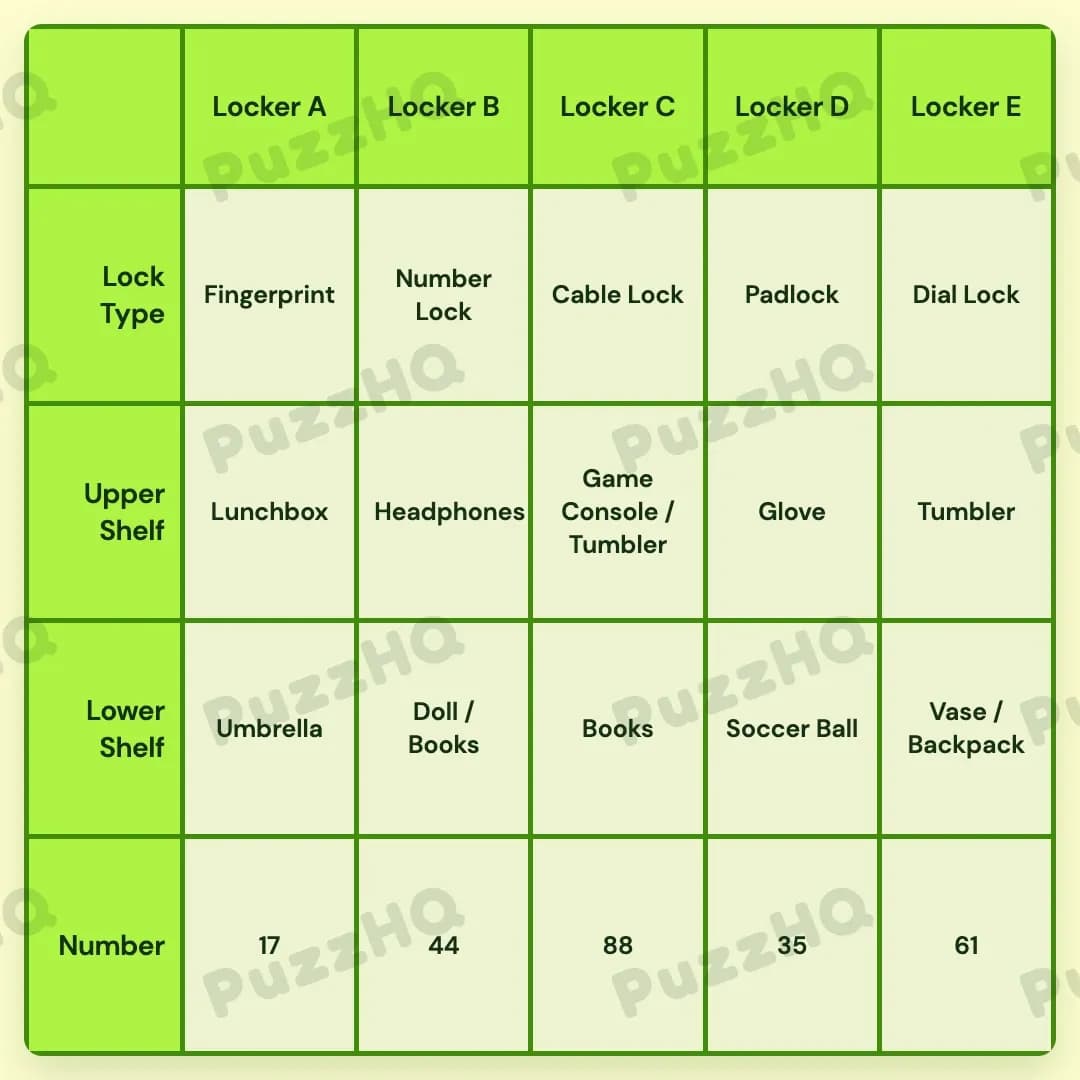
| Trait | Locker A | Locker B | Locker C | Locker D | Locker E |
|---|---|---|---|---|---|
| Lock Type | Fingerprint | Number Lock | Cable Lock | Padlock | Dial Lock |
| Upper Shelf | Lunchbox | Headphones | Game Console / Tumbler | Glove | Tumbler |
| Lower Shelf | Umbrella | Doll / Books | Books | Soccer Ball | Vase / Backpack |
| Number | 17 | 44 | 88 | 35 | 61 |
How To Think Through Profile Perfect Level 79
Solving this locker grid requires you to identify a fixed physical anchor before attempting to place floating positional clues. When a clue names an exact locker, use it immediately. Once an anchor is in place, relative clues like left, right, and adjacent lockers lock into precise spots without any guesswork.
Start With Direct Placement: Locker B Sets The Anchor
Direct identity clues are always the best place to begin because they remove ambiguity from surrounding spaces. The clue states that Locker B unlocks with a number code. This gives Locker B the Number Lock right away.
Because Locker B sits between Locker A and Locker C, this single direct match immediately turns Locker B into a reference point for multiple neighbor clues. You do not need to test hypothetical positions when a subject is already locked down.
Use Neighbor Clues To Populate Surrounding Lower Shelves
Once Locker B is known as the Number Lock, look for clues that mention this exact feature. The clue states that the Umbrella and Books are beside the Number Lock. That means the lower shelves of Locker A and Locker C must hold the Umbrella and Books in some combination.
Next, look at the clue stating that the lower shelf of Locker B does not have any long objects, while another clue notes that the Cable Lock is on the right of the Doll. This tells you that Locker B holds the Doll alongside Books. Since Locker B contains the Doll, the locker directly to its right must hold the Cable Lock. Locker C is to the right of Locker B, so Locker C receives the Cable Lock.
Now you can resolve the Umbrella and Books pair on the sides of Locker B. Since Locker B contains Books, and another clue mentions both lockers with Books are owned by gamers, Books go into Locker C, leaving the Umbrella for Locker A.
Link Number Logic To Lock Types
Number clues often rely on specific digits or comparative values. The clue mentions that lucky number 7 appears in the Fingerprint locker's number. Looking at the available values, 17 is the only number containing a 7. This means the Fingerprint lock belongs to the locker numbered 17.
Combine this with the clue stating that the locker beside the Dial Lock has the second-smallest number. The available numbers across the puzzle are 17, 35, 44, 61, and 88. The second-smallest number is 35.
If the locker beside the Dial Lock has 35, you must determine where the Dial Lock can fit:
- Locker A has the Fingerprint lock and number 17.
- Locker B has the Number Lock and number 44.
- Locker C has the Cable Lock and number 88.
- Locker E must be the Dial Lock, placing Locker D directly beside it with the number 35.
This placement leaves Padlock as the only remaining lock type, which fills Locker D. Locker E takes the remaining number 61.
Use Item Pairings To Fill The Upper Shelves
Now that the locker identities and numbers are mapped, resolve the contents of the upper shelves. One clue states that the two highest-numbered lockers share the same top-shelf item.
The two highest numbers are 61 and 88, located in Locker E and Locker C. Both of these lockers must share an item on the top shelf. The shared item is the Tumbler, which sits in Locker E, and alongside the Game Console in Locker C.
Next, use the clue stating that the goalkeeper stores the Ball alongside his Glove. Another clue notes that the Soccer Ball is not placed with other items in the lower shelf, which fits Locker D's lower shelf. Therefore, Locker D receives the Glove on the upper shelf and the Soccer Ball on the lower shelf.
To place the remaining upper shelf items:
- The clue notes that the locker with the Glove and the locker with Headphones are not neighbors.
- Locker D has the Glove, so its neighbors Locker C and Locker E cannot have Headphones.
- This leaves Locker B as the only valid location for Headphones.
- Locker A receives the remaining upper shelf item, the Lunchbox.
Eliminate Options Using Value Properties
The lower shelf still needs its final items sorted between Locker B and Locker E. The clue states that the Backpack is not in the locker with repeated numbers.
The numbers in this puzzle with repeating digits are 44 in Locker B and 88 in Locker C. Because Locker B has repeated digits, the Backpack cannot be placed there. Locker E takes the Vase and Backpack combination. Locker B is left with the Doll and Books combination.
With every condition satisfied, the full grid is completely solved.
What This Level Teaches You
Fixed Anchors Activate Neighbor Clues
A neighbor clue is impossible to resolve on its own if neither subject has a known spot. In this level, placing the Number Lock into Locker B first made the clue about the Umbrella and Books immediately actionable. Always search for clues that name an exact subject before attempting to process relative location clues.
Comparative Numbers Eliminate Grid Slots Quickly
When a clue mentions comparative ranks, such as the second-smallest number or the two highest numbers, list out the full set of available values. Sorting 17, 35, 44, 61, and 88 immediately revealed that 35 was the target value for the neighbor of the Dial Lock, and that 61 and 88 had to share the Tumbler.
Negative Constraints Resolve Multi-Item Compartments
When subjects share compartments or have multiple items, negative clues provide clean eliminations. Noting that the Backpack cannot appear in a locker with repeated digits eliminated Locker B (44) and Locker C (88), immediately steering the Backpack into Locker E without any guessing.
Final Thoughts
The key to solving this level efficiently is moving from fixed anchors to relative positions, and then using numerical ranks to lock down the remaining items. Whenever a puzzle offers an explicit match in the first clue, use it as the foundation for every neighbor clue that follows.
Comments