
Profile Perfect Level 125 Answer
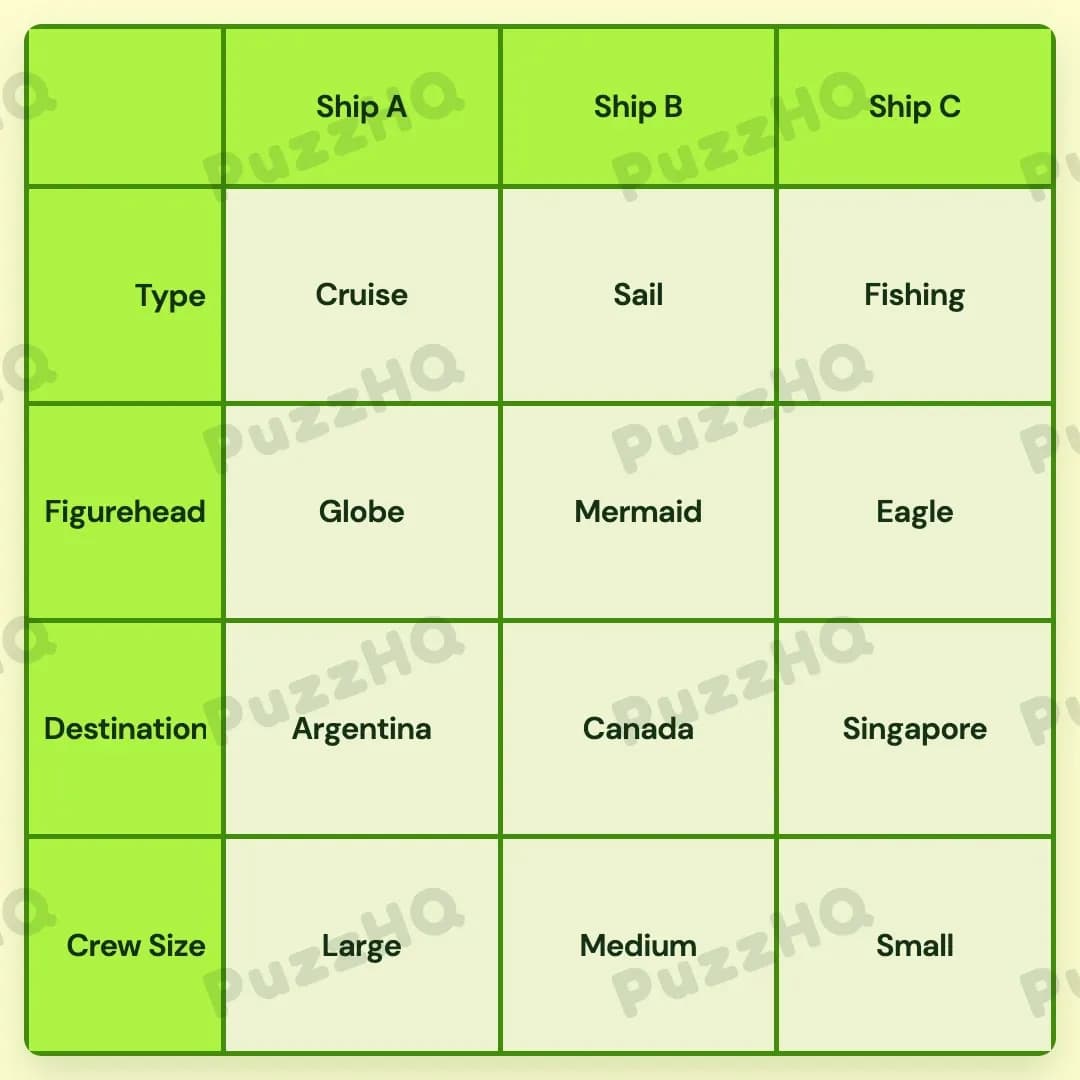
Before reading through the detailed walkthrough below, review the completed fleet manifest to see how every trait falls into place across the three vessels.
| Trait | Ship A | Ship B | Ship C |
|---|---|---|---|
| Type | Cruise | Sail | Fishing |
| Figurehead | Globe | Mermaid | Eagle |
| Destination | Argentina | Canada | Singapore |
| Crew Size | Large | Medium | Small |
The Logic Behind Profile Perfect Level 125
At its core, this puzzle is built around interlocking trait pairs that only snap into place once a single spatial relationship fixes the ships in left to right order. The initial batch of clues offers several tight bundles of information, such as specific ship types paired with crew sizes or cities linked to figureheads, but none of these immediately pin down all three columns on their own. The breakthrough comes when you recognize how a positional clue splits the crew sizes cleanly across the board, which instantly unlocks the vessel types, destinations, and carvings in rapid succession.
Sorting Vessels by Direct Assignment
The solve begins with the most straightforward direct match on the board. We are told right away that Ship C is used by sailors to go fishing. Placing the fishing type directly into Ship C gives the rightmost column an immediate identity and reduces the remaining ship types to just the cruise ship and the sail ship.
From there, we look at how the remaining vessel types connect to other traits. A medium crew is aboard the sail ship, while the cruise ship is on a voyage that concludes in Buenos Aires. While we cannot place these pairs into specific subject columns yet, we know that the cruise ship and the sail ship represent distinct vessels with distinct crew sizes and travel plans. Because Ship C is already established as the fishing vessel, whichever ships turn out to be the cruise and sail vessels will completely account for Ship A and Ship B.
Positional Placement Secures the Fleet
The puzzle turns into a structured board the moment we evaluate the relationship between the crew sizes and the figureheads. We learn that the ship with the small crew sits to the right of the vessel carrying the mermaid figurehead.
Because there are only three ships lined up across the board from left to right, being located to the right of another ship leaves very few possibilities. The ship carrying the mermaid must occupy a slot to the left of the small crew vessel. Furthermore, we already know from our earlier bundles that the medium crew belongs to the sail ship, which means the small crew cannot be on the sail ship. Since the cruise ship has its own distinct identity and destination, the small crew naturally aligns with the fishing vessel on the far right, which is Ship C.
With Ship C established as carrying the small crew, the ship to its left, Ship B, must be the one bearing the mermaid figurehead. Since Ship B carries the mermaid and Ship C holds the small crew, the medium crew must belong to Ship B. Because the medium crew is aboard the sail ship, Ship B is confirmed as the sail vessel.
By basic elimination across the subjects, Ship A has to be the cruise ship, and its crew size can only be large. In just a few logical steps, every subject column now has a confirmed ship type and an established crew size.
Geographic Destinations Settle the Remaining Details
Once the ships and crew sizes are firmly locked into place, the remaining clues handle the destinations and the last two figureheads. The clue regarding travel routes notes that the cruise ship is headed toward Buenos Aires. Since Argentina represents this destination in the grid and Ship A is our cruise ship, Argentina belongs to Ship A.
Next, we look at the destination tied to the medium crew. The ship bound for Vancouver carries a medium sized crew. Because Ship B is our vessel with the medium crew, Ship B must be the ship travelling to Canada. This leaves only Singapore as the remaining open destination, which naturally assigns itself to Ship C.
Finishing the figureheads is just as smooth. We are told that the ship returning to Singapore features an eagle mounted on its front. With Ship C established as the Singapore bound vessel, the eagle figurehead belongs in Ship C. That leaves only one figurehead unassigned, the globe, which settles neatly into Ship A. This nicely mirrors the observation that Ship A determines its route using its figurehead. Every trait across all three ships is now fully accounted for without contradiction.
The Clue I Would Read Twice
The clue stating that the ship with the small crew is on the right of the mermaid is easily the most critical line on the page. It looks simple at a glance, but it does double duty by bridging positional mechanics with two completely separate trait categories.
If you attempt to place the mermaid before establishing which vessel carries the small crew, you risk guessing between multiple layout configurations. The secret is to notice how the other clue bundles restrict crew sizes. Once you realize the medium crew is tied to the sail ship and the cruise ship is tied to Buenos Aires, the small crew has nowhere left to go except the fishing boat at Ship C. Recognizing that positional prompt as the true keystone of the puzzle prevents any unnecessary backtracking.
Final Thoughts
What makes this puzzle enjoyable is the clean economy of its design. It avoids sprawling deduction chains in favor of a tight, satisfying sequence where geographic cues, ship functions, and decorative carvings support each other seamlessly. Once the spatial anchor falls into place, the entire fleet organizes itself with total clarity.
Comments