
Profile Perfect Level 164 Answer
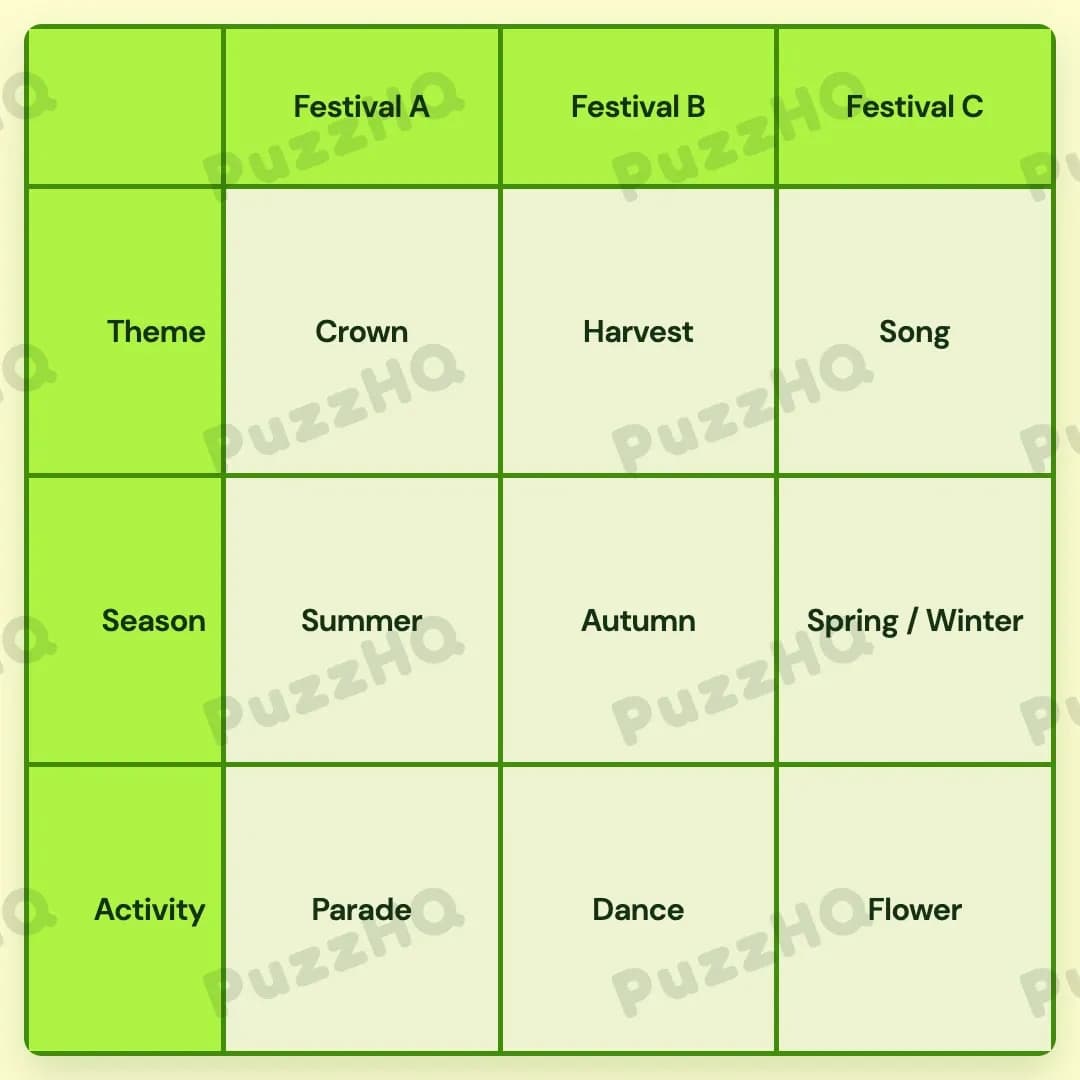
Festival A features the Crown theme during Summer with a Parade, Festival B features Harvest during Autumn with a Dance, and Festival C features Song across Spring and Winter with Flower arranging.
| Trait | Festival A | Festival B | Festival C |
|---|---|---|---|
| Theme | Crown | Harvest | Song |
| Season | Summer | Autumn | Spring / Winter |
| Activity | Parade | Dance | Flower |
How To Think Through Profile Perfect Level 164
The key to mastering this level is connecting descriptive traits together before trying to place them into specific columns. When clues describe combinations of seasons, themes, and activities without naming a festival directly, you should assemble those matching traits into a single profile bundle. Once a bundle is formed, adjacency and spatial rules will immediately reveal exactly which column it belongs to.
Bundle Multi Trait Clues: Combine Song, Multi Season, And Flowers
Before worrying about Festival A, Festival B, or Festival C, look for clues that share common characteristics.
Clue 2 states that the Song themed festival is held twice a year. Looking at the possible seasonal options, only one entry contains two seasons: Spring / Winter. This directly binds the Song theme to the Spring / Winter season.
Next, Clue 1 states that the Spring festival is about arranging Flowers. Because the Song festival takes place during Spring and Winter, it contains the Spring season. That means the Flower arranging activity must belong to the exact same festival profile as the Song theme and the Spring / Winter season.
By linking these clues early, you create a complete profile bundle:
- Theme: Song
- Season: Spring / Winter
- Activity: Flower
This eliminates confusion and prevents you from scattering these three traits across different columns.
Use Adjacency Constraints: Position The Song Bundle Away From The Parade
Now that you have a full bundle containing Song, Spring / Winter, and Flower, you must determine its column position.
Look at Clue 4, which states that the Parade is not next to the Song festival. In a three festival layout arranged in a row from Festival A to Festival C, the middle position, Festival B, is adjacent to both ends. If the Song festival were placed in the middle at Festival B, every other festival on the board would be next to it. That would make it impossible to place the Parade anywhere without violating Clue 4.
Therefore, the Song bundle cannot be placed in the center column. It must sit on an outer edge.
Clue 3 provides further guidance: the festival next to the Flower festival is held during Autumn. Since the Song bundle includes Flower, placing this bundle at Festival C means its only neighbor, Festival B, must have Autumn as its season.
Because the Parade cannot be next to Song at Festival C, the Parade cannot be assigned to Festival B. This forces the Parade activity directly into Festival A.
This step establishes two critical anchors:
- Festival C has the Song theme, the Spring / Winter season, and the Flower activity.
- Festival A has the Parade activity.
Resolve Neighboring Slots: Complete Festival B
With Festival C fully solved and Festival A holding the Parade, you can turn your attention to Festival B.
From Clue 3, the festival adjacent to the Flower festival occurs during Autumn. Since Festival B is the only neighbor to Festival C, Festival B's season is confirmed as Autumn.
Next, check the remaining activities. The available activities across the board are Flower, Parade, and Dance. With Flower assigned to Festival C and Parade assigned to Festival A, only Dance remains. Assign Dance as the activity for Festival B.
At this point, Festival B is partially completed:
- Season: Autumn
- Activity: Dance
Festival A also gains ground:
- Activity: Parade
Now only the seasons and themes for the first two festivals need to be settled.
Apply Negative Elimination: Summer Directs The Final Themes
Look at the remaining unassigned seasons. We have Spring / Winter at Festival C and Autumn at Festival B. The only remaining season is Summer.
Clue 5 confirms that there is a festival held only on Summer. By process of elimination, Summer must belong to Festival A.
With all three seasons locked in place, you can resolve the remaining themes: Crown and Harvest.
Clue 6 states that they do not Harvest the crops during Summer. Because Festival A takes place in Summer, Festival A cannot have the Harvest theme.
Eliminating Harvest from Festival A leaves only one possible subject for it: Festival B. Assign Harvest to Festival B.
Finally, place the remaining theme, Crown, into Festival A.
The entire grid is now completely solved with zero guessing.
What This Level Teaches You
Build Multi Trait Bundles Before Assigning Columns
When multiple clues describe intersecting traits without mentioning subject names, assemble those traits into a complete profile first. In this puzzle, identifying that Song belongs to a two season festival and that Spring involves Flowers allowed you to weld Song, Spring / Winter, and Flowers into a single unit. Solving trait relationships in isolation makes grid placement much easier.
Recognize The Strategic Danger Of Center Positions
In a three subject line, the middle position touches every other position. When a clue states that two items cannot be next to each other, neither item can sit in the center if doing so leaves no legal spot for the other. Recognizing that the Song festival could not be in the middle immediately narrowed its placement to the outer columns.
Use Negative Clues To Settle Final Pairs
Negative conditions are just as powerful as positive statements. Knowing that Harvest could not occur in Summer instantly broke the tie between the final two theme slots. Always check your negative rules when two candidate traits remain.
Final Thoughts
The most important solving habit for this level is trait bundling. By merging the theme, multi season trait, and activity before assigning them to a festival letter, you turn several complex clues into one simple, movable block. Once that block is placed using neighbor logic, the rest of the board solves smoothly through simple elimination.
Comments