
Profile Perfect Level 24 Answer
If you found yourself staring at the visitor numbers before looking at anything else, you took the right path into this grid.
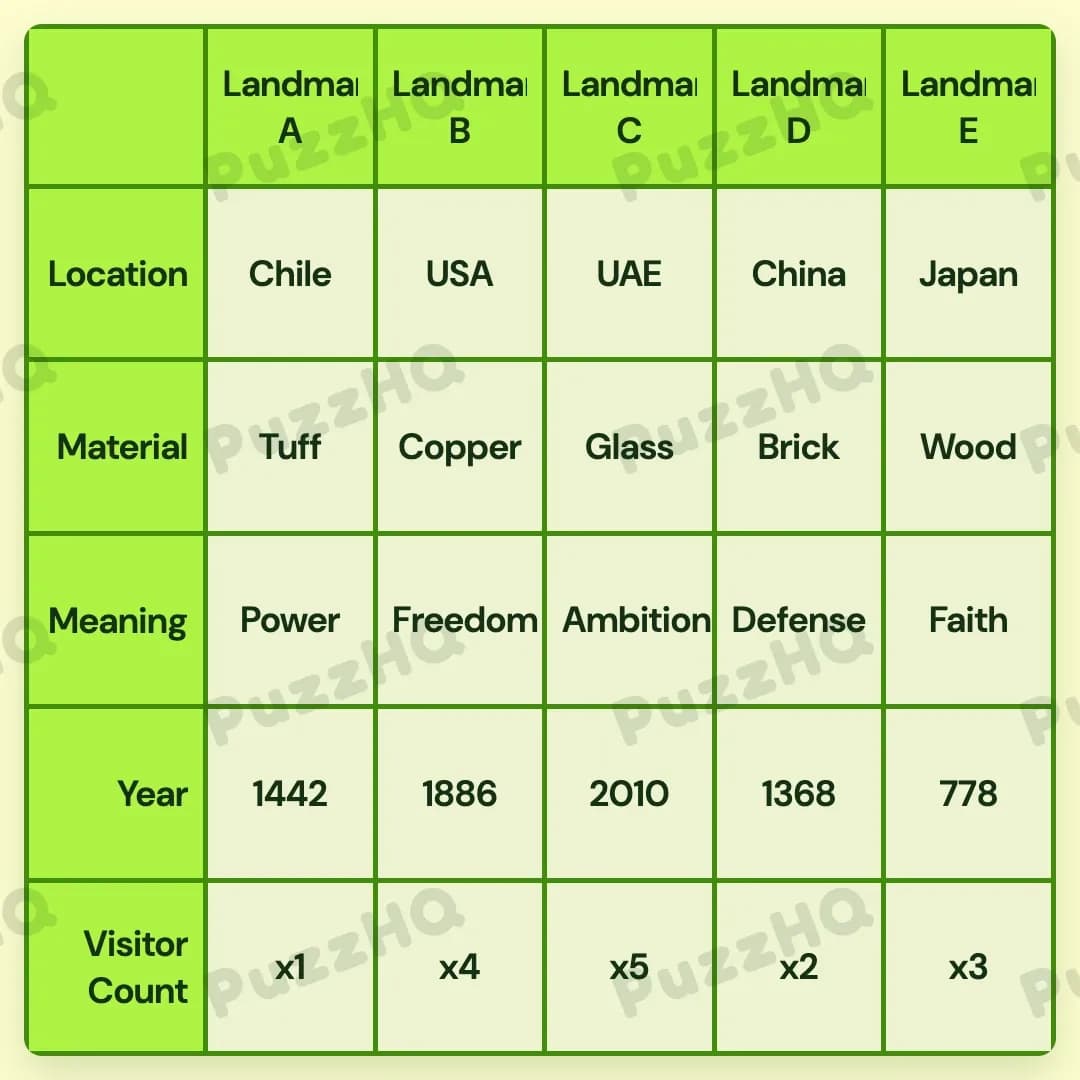
| Trait | Landmark A | Landmark B | Landmark C | Landmark D | Landmark E |
|---|---|---|---|---|---|
| Location | Chile | USA | UAE | China | Japan |
| Material | Tuff | Copper | Glass | Brick | Wood |
| Meaning | Power | Freedom | Ambition | Defense | Faith |
| Year | 1442 | 1886 | 2010 | 1368 | 778 |
| Visitor Count | x1 | x4 | x5 | x2 | x3 |
The Logic Behind Profile Perfect Level 24
The key to solving Level 24 lies in recognizing how quickly the crowd sizes resolve when treated as a single arithmetic chain. Rather than scattering attention across multiple unconnected attributes, sorting the visitor counts right away unlocks the material assignments and establishes solid anchors across the rest of the board.
Crowd Sizes Establish The First Complete Line
The solve begins with the visitor count trait, which offers three direct statements about relative popularity. Landmark A is identified as having the smallest crowd, placing it firmly at the base tier of x1. From there, Landmark B is defined as being twice as crowded as Landmark D, while Landmark C holds an even larger crowd than Landmark B.
With five distinct tiers spanning from x1 up to x5, Landmark D cannot be x1 because that position belongs to Landmark A. If Landmark D were x3, doubling it would exceed the maximum range entirely. That forces Landmark D into x2, which immediately elevates Landmark B to x4. Landmark C must outrank Landmark B, leaving x5 as its only possible slot. Landmark E takes the remaining count of x3.
In just a few linked deductions, the entire row of crowd values is settled without ambiguity.
Material And Geography Snap Together
Once the attendance numbers are locked down, materials and locations begin to attach to specific columns. We are told that the copper structure is the second most crowded of the group. Since x4 is the second highest value on the board, Landmark B claims copper without any competition. At the same time, direct clues hand glass to Landmark C and place Landmark E in Japan, where the structure is built of wood.
The locations narrow down just as rapidly. Landmark B, Landmark D, and Landmark E are explicitly excluded from Chile. Since Landmark E is already located in Japan, Chile can only belong to Landmark A or Landmark C. The clue noting that the monument representing Freedom sits next to Chile helps make that distinction clear.
Placing Chile at Landmark A allows Landmark B to become Freedom, neatly aligning with the physical neighbor relationship. That leaves the United Arab Emirates, China, and the United States to fill the open slots. Landmark D becomes China, Landmark C takes the United Arab Emirates, and Landmark B rounds out the set in the United States. With materials, the remaining assignments fall neatly into place: Landmark D takes brick, and Landmark A claims tuff.
Centuries And Meanings Fill The Remaining Gaps
The final phase ties together construction dates and symbolic meanings. Landmark B was constructed in the nineteenth century, securing the 1886 date. The structure representing Ambition is described as the newest across the entire collection, which awards it the 2010 year mark. China's landmark has a known construction year of 1368, directly assigning that date to Landmark D.
The meaning behind each monument falls into line through neighbor clues and dates. Ambition and Defense sit side by side as neighbors. With Landmark C holding the newest date of 2010, it naturally takes Ambition, forcing Landmark D into Defense. We also know that the neighbors of Freedom were not built in 778. Because Landmark B represents Freedom, neither Landmark A nor Landmark C can take 778, pushing that earliest date to Landmark E.
Landmark E receives the meaning of Faith, Landmark A takes Power alongside the date 1442, and the remaining traits settle into their final places without friction.
The Clue I Would Read Twice
The clue stating that Freedom's neighbors were not made in 778 is easy to skim past, but it does heavy lifting during the late solve. Because Landmark B represents Freedom, its immediate neighbors on the board are Landmark A and Landmark C.
At first glance, one might try to use this clue to locate Freedom itself, but its real power is negative elimination. By barring both adjacent columns from holding the year 778, it prevents you from guessing whether the oldest date belongs to South America or the Middle East. It redirects that early century year straight to Landmark E in Japan, which neatly untangles the rest of the chronological order.
Final Thoughts
Level 24 offers a balanced grid where numerical logic and adjacency clues complement one another rather than getting in each other's way. Resolving the visitor ratios early turns what could have been a confusing web of dates and materials into a smooth, orderly deduction path from left to right.
Comments