
Profile Perfect Level 242 Answer
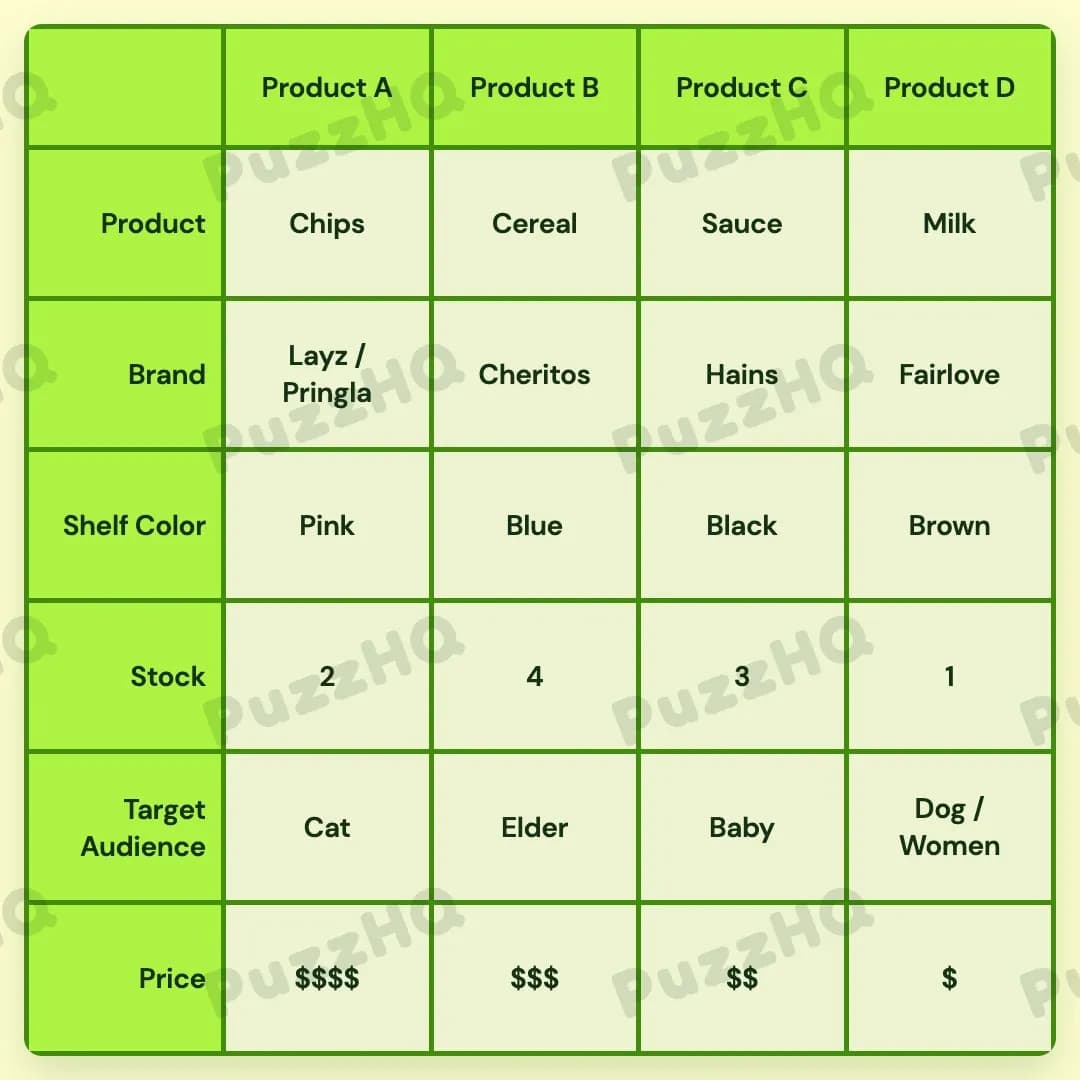
Product A is Chips from Layz / Pringla on the Pink shelf with 2 stock for Cats at $$$$, Product B is Cereal from Cheritos on the Blue shelf with 4 stock for Elders at $$$, Product C is Sauce from Hains on the Black shelf with 3 stock for Babies at $$, and Product D is Milk from Fairlove on the Brown shelf with 1 stock for Dogs and Women at $.
| Trait | Product A | Product B | Product C | Product D |
|---|---|---|---|---|
| Product | Chips | Cereal | Sauce | Milk |
| Brand | Layz / Pringla | Cheritos | Hains | Fairlove |
| Shelf Color | Pink | Blue | Black | Brown |
| Stock | 2 | 4 | 3 | 1 |
| Target Audience | Cat | Elder | Baby | Dog / Women |
| Price | $$$$ | $$$ | $$ | $ |
How To Think Through Profile Perfect Level 242
Solving this puzzle smoothly requires building a reliable frame of fixed positions before handling relational conditions. When you link traits together into bundles first, you reduce the mental effort needed to evaluate shelf distances, neighbor restrictions, and ranking comparisons.
Start With Multi Trait Pairs: Lock In Obvious Matches Early
Direct identity clues provide instant building blocks. Even when you do not yet know the column position of every item, combining two traits into a single unit makes every subsequent spatial clue easier to test.
Several clues in this puzzle pair traits immediately:
- The Milk placed on the Brown shelf connects Milk directly to Brown.
- Hains's Sauce was just added this month connects Sauce directly to Hains.
- Layz products are lined up at the Pink shelf attaches Layz to Pink.
- Special Cereal is a product aimed for the older people attaches Cereal to the Elder audience.
- Fairlove made the human-friendly product also good for Dog connects Fairlove with the combined Dog and Women audience.
By combining these traits right away, you no longer need to track individual names in isolation. You can treat Milk and Brown as a single puzzle piece, Sauce and Hains as another, and Cereal and Elder as a third.
Use Extreme Distance Clues To Anchor The Grid Edges
Once you have your core trait pairs, look for clues that mention maximum distance or outer positions. In a four-column row, the farthest possible distance always runs between the two outer ends: Product A on the far left and Product D on the far right.
The clue stating that the Brown shelf is the farthest from the second least stock amount gives you an anchor. The available stock numbers are 1, 2, 3, and 4. The second lowest amount is 2.
Because the Brown shelf and the stock of 2 must sit at opposite ends of the grid:
- Product D takes the Brown shelf, which also brings Milk and Fairlove with the Dog and Women audience to this column.
- Product A takes the stock value of 2 at the opposite end.
Now check the shelf placement restriction. The clue states that the Black and Pink shelves are not next to each other. With Brown already fixed at Product D:
- Pink must go to Product A so that it stays separate from Black.
- Black must sit at Product C.
- The remaining color, Blue, occupies Product B.
This step anchors every shelf color in place across the grid: Product A is Pink, Product B is Blue, Product C is Black, and Product D is Brown.
Track Product Placement And Brand Elimination
With the shelf colors fixed, you can fill in the paired traits linked to those colors:
- Pink shelf at Product A must hold the Layz / Pringla brand.
- Black shelf at Product C must hold Sauce, which belongs to Hains.
- Brown shelf at Product D already holds Milk and Fairlove.
This leaves only one available product slot for Cereal at Product B. Because Cereal is paired with the Elder audience, Product B receives the Elder audience trait. Product A takes the remaining product, Chips.
Now look at brand assignment. The remaining brand without a home is Cheritos. Since Product A, Product C, and Product D already have their brands set, Cheritos goes directly to Product B.
Apply Neighbor Clues To Resolve Stock Values
Neighbor clues become straightforward once your product names and columns are locked in.
First, the clue states that the Black shelf has the second most products left. In the set of stock numbers (1, 2, 3, 4), the second highest value is 3. Since Product C is the Black shelf, assign a stock of 3 to Product C.
Next, use the clue stating that Chips is beside the item with the most stock. Chips is at Product A. Its only neighbor is Product B. Therefore, Product B must have the highest stock value, which is 4.
With stocks 2, 4, and 3 assigned to Products A, B, and C, the final remaining stock value of 1 belongs to Product D.
Eliminate Outliers To Finish Price And Target Audience
Negative conditions allow you to eliminate incorrect columns for the final two categories: Price and Target Audience.
Consider the price clues:
- Sauce and neighboring products are not the most expensive. Sauce is at Product C, and its neighbors are Product B and Product D. This eliminates Products B, C, and D from being the most expensive ($$$$). That leaves Product A as $$$$.
- All similar priced products are neighbors. To keep adjacent price ranks next to each other, the prices must descend in order: Product A is $$$$, Product B is $$$, Product C is $$, and Product D is $.
Finally, place the remaining target audiences:
- The feline-aimed product is not from Cheritos nor Hains. Cheritos is Product B and Hains is Product C, which means the Cat audience cannot be at Product B or C. Product D already has Dog and Women, so Cat must belong to Product A.
- The Baby audience fills the final open spot at Product C.
This satisfies every condition, including the rule that the products for Elder (Product B) and Women (Product D) are separated by Product C.
What This Level Teaches You
Bundle Traits Before Testing Layouts
When a clue connects two traits directly without mentioning positions, pair them immediately. Combining Milk with Brown and Sauce with Hains early in the process prevented you from having to test loose names across multiple columns.
Turn Maximum Distance Clues Into Edge Anchors
Whenever a rule mentions that two items are the farthest apart in a linear arrangement, both items must occupy the outer columns. Recognizing that the Brown shelf and the stock of 2 had to sit at opposite edges settled the orientation of the entire grid.
Use Neighbor Negations To Isolate Unique Ranks
When a clue states that an item and its neighbors cannot hold a top rank, you can cross off three positions at once in a four-column grid. Disqualifying Sauce and both adjacent columns from the highest price immediately forced the top price into the only remaining column.
Final Thoughts
The key habit in this level was letting edge constraints and trait bundles establish the foundation before trying to solve stock numbers or prices. Building a rigid frame early turns complex relational clues into simple eliminations.
Comments