
Profile Perfect Level 290 Answer
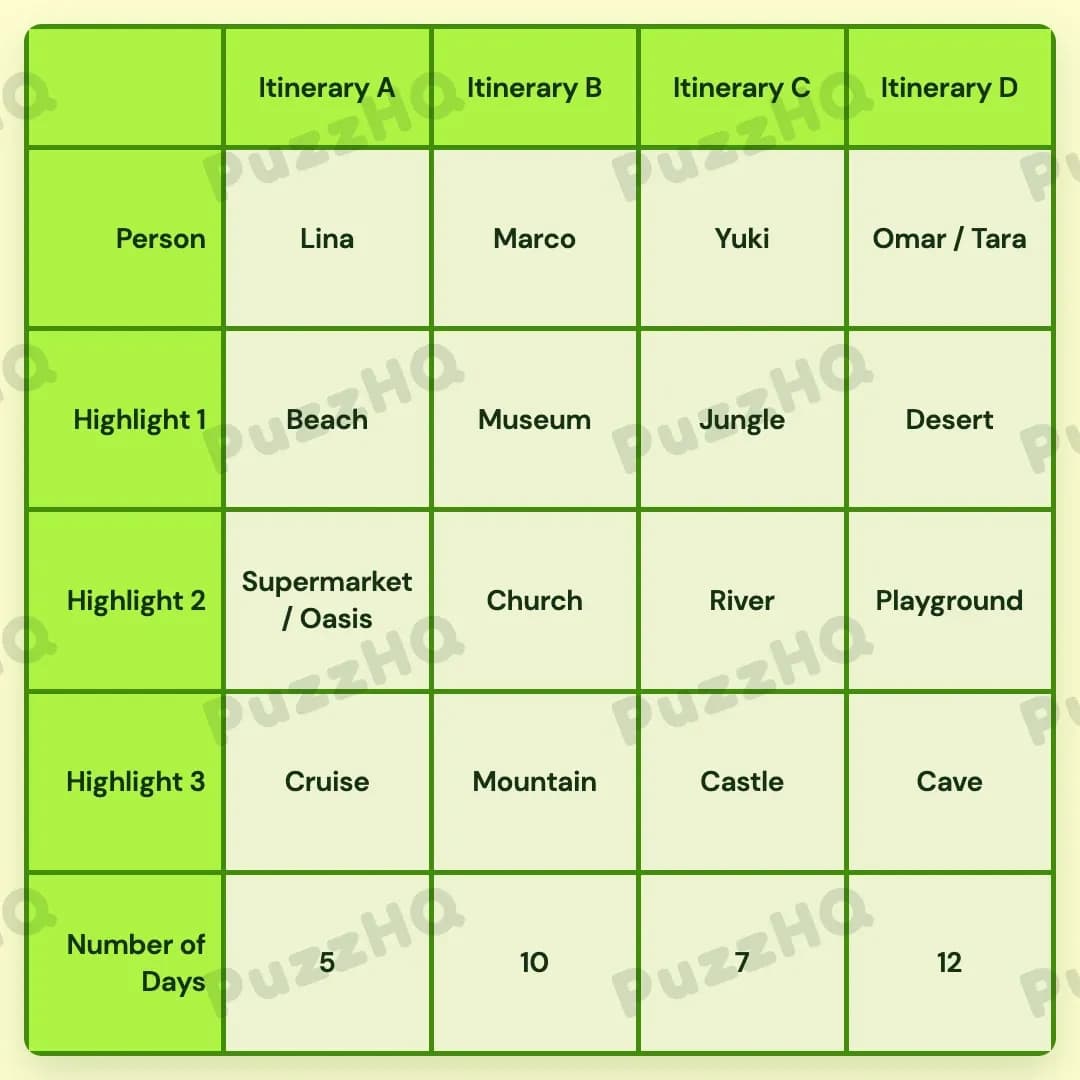
Each traveler matches a distinct trip duration, destination theme, and set of three activity highlights across the four itineraries.
| Trait | Itinerary A | Itinerary B | Itinerary C | Itinerary D |
|---|---|---|---|---|
| Person | Lina | Marco | Yuki | Omar / Tara |
| Highlight 1 | Beach | Museum | Jungle | Desert |
| Highlight 2 | Supermarket / Oasis | Church | River | Playground |
| Highlight 3 | Cruise | Mountain | Castle | Cave |
| Number of Days | 5 | 10 | 7 | 12 |
How To Think Through Profile Perfect Level 290
Solving this puzzle efficiently depends on finding strong anchor points right away. When a clue mentions a specific column label, such as Itinerary A or Itinerary B, it gives you a direct foundation. Once those anchors are in place, you can attach themed clues, map relative orderings, and resolve the remaining traits by process of elimination without ever needing to guess.
Start With Direct Column Anchors: Locking Itinerary A And B
Direct column clues give you fixed starting locations before any other information is known. Look for statements that reference specific itineraries by name.
The clue stating that Itinerary A starts from the shore and finishes on a ship immediately fills two traits for the first column. The shore corresponds to Beach for Highlight 1, and the ship corresponds to Cruise for Highlight 3.
Similarly, the clue mentioning that Itinerary B includes a plan for religious activity links Church to Highlight 2 in Itinerary B.
Starting with these exact column references establishes solid anchors. Instead of floating possibilities across the whole grid, you now have specific columns ready to receive linked details.
Link Thematic Clues To Anchored Columns: Matching Lina And Marco
Once an itinerary has fixed highlights, look for character clues that describe matching interests or gear. Thematic language often points to a single column because of the traits already established.
The clue stating that Lina packs her best bikini points directly to a coastal or water trip. Because Itinerary A already holds the Beach and Cruise highlights, Lina must belong to Itinerary A.
Next, consider the clue where Marco dedicates his first day to provenance research. Provenance research is an activity tied to artifacts and art history, which matches the Museum. Because Itinerary B already houses cultural and historical planning with the Church, Museum fits naturally into Itinerary B as Highlight 1, placing Marco as the traveler for Itinerary B.
By placing Lina in Itinerary A and Marco in Itinerary B, you narrow the traveler field down to only two remaining columns.
Bundle Multi Trait Clues: Fitting The Jungle Castle Into Itinerary C
Some clues connect two traits together without naming an itinerary column. The best way to use these multi trait bundles is to look across the grid for an empty column that can accommodate both values at once.
The clue describing a hidden medieval structure deep within the jungle combines Castle (Highlight 3) and Jungle (Highlight 1).
Now check the available columns:
- Itinerary A already has Beach and Cruise.
- Itinerary B already has Museum.
- Itinerary D is associated with the Desert through the clue about Omar and his wife.
The only column with open slots for both Jungle as Highlight 1 and Castle as Highlight 3 is Itinerary C. Placing this bundle leaves Itinerary C almost fully mapped, leaving only Desert to fill Highlight 1 in Itinerary D.
Connect The Remaining Travelers: Omar, Tara, And Yuki
With destination types assigned to all four columns, character clues with specific destination mentions can be placed instantly.
The clue stating that Omar and his wife plan to visit the Desert where they first met pairs Omar and Tara with Itinerary D. The clue stating that Tara prioritizes finding the best activity for her little one assigns Playground as Highlight 2 in Itinerary D.
At this stage, three columns have assigned travelers: Lina in A, Marco in B, and Omar and Tara in D. Yuki is the only traveler left, so Yuki automatically belongs to Itinerary C.
The clue stating that Yuki's vacation starts on Monday and ends on Sunday accounts for exactly 7 days. You can immediately assign 7 to the Number of Days for Itinerary C.
Use Positional And Numerical Relationships: Assigning The Days
When clues refer to lengths or neighbor positions, use your established layout to calculate exact values.
The clue stating that the second longest itinerary is next to the one that visits a Beach lets you determine Itinerary B's duration. The Beach is in Itinerary A. The only neighboring column is Itinerary B. Therefore, Itinerary B must be the second longest itinerary, which is 10 days.
Next, use the clue stating that the shortest itinerary is the one that visits the Supermarket. The available durations are 5, 7, 10, and 12 days. The shortest duration is 5 days. Since Yuki in Itinerary C has 7 days and Marco in Itinerary B has 10 days, the 5 day trip must belong to Itinerary A or Itinerary D.
The clue noting that the search for the mystical Oasis is not on the right half means Oasis must be in the left half, which consists of Itinerary A and Itinerary B. Since Itinerary B already has the Church, the combined Supermarket and Oasis trait must belong to Highlight 2 in Itinerary A. Consequently, Itinerary A receives the shortest duration of 5 days.
With durations of 5, 7, and 10 assigned to A, C, and B respectively, the remaining duration of 12 days belongs to Itinerary D.
Resolve The Final Traits By Comparison And Elimination
The final step is to place the remaining activity highlights by evaluating descriptive comparisons.
The clue stating that Itinerary B's third highlight has less oxygen than Itinerary D's third highlight compares two high or low elevation environments. High altitude mountain air contains less oxygen than air in a cave. This assigns Mountain to Highlight 3 in Itinerary B and Cave to Highlight 3 in Itinerary D.
The only remaining trait slot in the grid is Highlight 2 for Itinerary C. With Supermarket / Oasis, Church, and Playground already assigned, River fills the final space in Itinerary C, completing the entire solution.
What This Level Teaches You
- Always look for clues that mention specific subject columns first. Anchoring specific columns early creates a framework that makes thematic clues much easier to place.
- When a clue pairs two traits together without naming a subject, scan the grid for columns that have both trait rows completely open.
- Positional clues like left half or next to become straightforward math once the reference columns around them are already identified.
Final Thoughts
The key habit in this puzzle is moving systematically from direct anchors to bundled clues, and finally to positional math. Building a solid frame in Itinerary A and Itinerary B early prevented unnecessary guesswork and allowed every subsequent clue to fall into place naturally.
Comments