
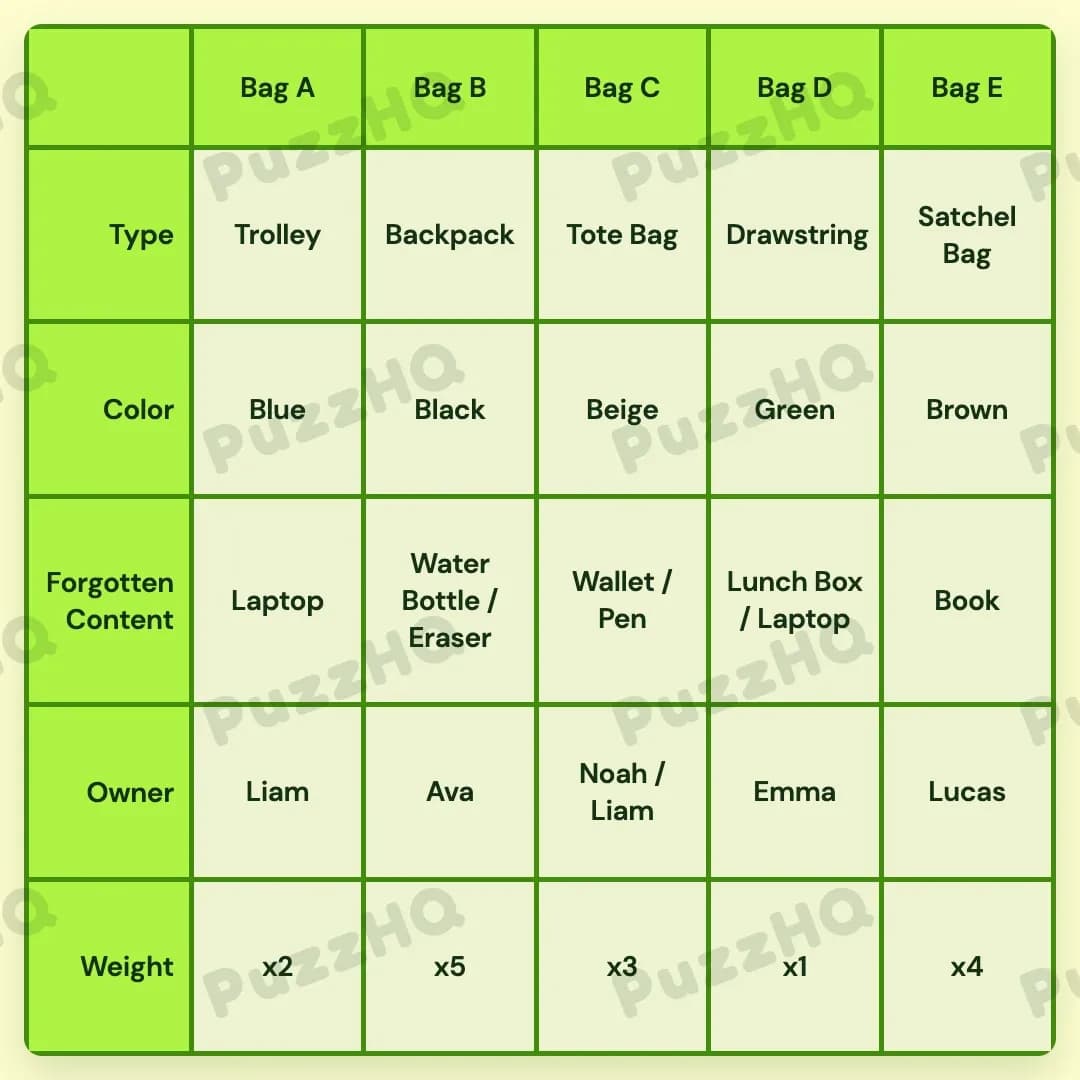
Profile Perfect Level 300 Answer
By anchoring the shared middle bag and resolving column distances, every bag type, color, weight, owner, and forgotten item falls into place across the five lockers.
| Trait | Bag A | Bag B | Bag C | Bag D | Bag E |
|---|---|---|---|---|---|
| Type | Trolley | Backpack | Tote Bag | Drawstring | Satchel Bag |
| Color | Blue | Black | Beige | Green | Brown |
| Forgotten Content | Laptop | Water Bottle / Eraser | Wallet / Pen | Lunch Box / Laptop | Book |
| Owner | Liam | Ava | Noah / Liam | Emma | Lucas |
| Weight | x2 | x5 | x3 | x1 | x4 |
How To Think Through Profile Perfect Level 300
The most productive habit for this puzzle is using rigid spatial clues to build an anchor framework before tackling individual trait descriptions. When a level gives you column distances and absolute board positions, those structural clues immediately restrict where items can exist. Once the positions are locked, descriptive clues and numerical comparisons can fill in the remaining attributes without guesswork.
Anchor The Middle And Use Distance Constraints
Start by looking for clues that pinpoint specific columns on the board. One clue states that the middle bag is shared by the nerdy guy and his sibling. In a five-column layout, the middle position is Bag C. This directly assigns the shared ownership of Noah and Liam to Bag C.
Next, look at the clue stating that the Drawstring bag is next to the middle bag. That restricts the Drawstring bag to either Bag B or Bag D. A companion clue states that the Blue bag is 3 columns away from the Drawstring bag.
Testing the two options reveals the correct layout:
- If the Drawstring bag were placed in Bag B (column 2), the Blue bag would have to be 3 columns away at Bag E (column 5).
- If the Drawstring bag is placed in Bag D (column 4), the Blue bag must be at Bag A (column 1).
A separate clue tells you that the Trolley bag has a neighbor with a Black color, while another clue notes that the Backpack has the color that absorbs light the most, which means the Backpack is Black. Placing the Drawstring bag at Bag D allows Bag A to be Blue and Bag B to be Black. This confirms the Drawstring bag belongs in Bag D, the Blue bag is Bag A, and the Backpack is Bag B.
Combine Descriptive Trait Clues To Build Anchors
Once positional boundaries are defined, combine multi-trait descriptions to solidify individual subjects.
The clue stating that a blonde girl has been using the Backpack for 5 years links the Backpack owner directly to Ava. Because the Backpack is already established as Bag B with the color Black, Ava is the owner of Bag B.
You are also told that no one can rival the weight of Ava's bag. This means Ava's bag carries the highest weight multiplier of x5. Another direct ranking clue mentions that Lucas owns the second heaviest bag, assigning Lucas a weight of x4.
Since Bag C is owned by Noah and Liam, and Bag B is owned by Ava, Lucas must occupy either Bag A, Bag D, or Bag E. Checking the rightmost bag reveals that Lucas fits Bag E.
Resolve Relative Weights Through Comparison Chains
Instead of guessing numerical values, organize the weight relationships into an ordered chain.
You know the available weight values range from x1 to x5:
- Ava's bag at Bag B holds the maximum weight of x5.
- Lucas's bag at Bag E holds the second heaviest weight of x4.
- The Drawstring bag at Bag D weighs less than its neighbors, which are Bag C and Bag E.
- Bag A is slightly heavier than Bag D.
Because Bag D weighs less than its neighbors and Bag A is slightly heavier than Bag D, Bag D must take the lowest available value, which is x1.
With Bag D set to x1, Bag A is slightly heavier at x2. The only remaining unassigned weight value is x3, which belongs to Bag C. The complete weight sequence from left to right becomes x2, x5, x3, x1, and x4.
Use Context Clues To Match Owners And Forgotten Items
With positions and weights completed, use the descriptive story clues to finish matching the remaining types, colors, owners, and forgotten items.
The clue stating that both of Noah's neighbors are of the same gender helps verify the owners of Bag B and Bag D. Bag B is owned by Ava, a female student. Therefore, Bag D must also be owned by a female student, which identifies Emma as the owner of Bag D. With Emma at Bag D and Lucas at Bag E, the remaining solo student Liam is assigned to Bag A.
For bag types, Bag A is the Trolley bag, Bag B is the Backpack, Bag D is the Drawstring bag, and Bag C is the Tote Bag based on the clue linking the hungry owner unable to buy food to the Tote Bag. This leaves the Satchel Bag for Bag E.
For colors, you know Bag A is Blue and Bag B is Black. The clue stating that the Satchel Bag is not Green means Bag E cannot be Green. Thus, Bag D takes Green, Bag E takes Brown, and the remaining color Beige goes to Bag C.
Finally, complete the forgotten items by reading the relational notes:
- Noah and Liam at Bag C forgot their Wallet and Pen, which explains why they are hungry yet unable to buy food.
- Bag B contains Water Bottle and Eraser.
- Bag D contains Lunch Box and Laptop, as their right neighbor was also hungry and Liam was not the only one who forgot a Laptop.
- Bag A contains Laptop.
- Bag E contains Book.
What This Level Teaches You
Fixed Column Spacing Narrows Potential Placements Instantly
When a clue mentions an exact distance between two traits, such as three columns apart, do not wait until the end of the puzzle to use it. On a five-column grid, a span of three columns can only connect column 1 to column 4, or column 2 to column 5. Testing those two possibilities against known neighbor restrictions immediately eliminates invalid configurations.
Comparison Clues Solve Numeric Scales Without Raw Numbers
Clues describing items as slightly heavier, the heaviest, or lighter than neighbors do not require explicit starting values. You can solve them by ranking every relative comparison from lowest to highest. Once the order is established, map the available numbers directly onto that relative chain.
Final Thoughts
Spatial distance clues combined with strict numerical comparisons formed the core logic of this puzzle. By anchoring fixed board positions first and letting relative weights eliminate impossible values, every trait locked into place smoothly without any need for guesswork.
Comments