
Profile Perfect Level 296 Answer
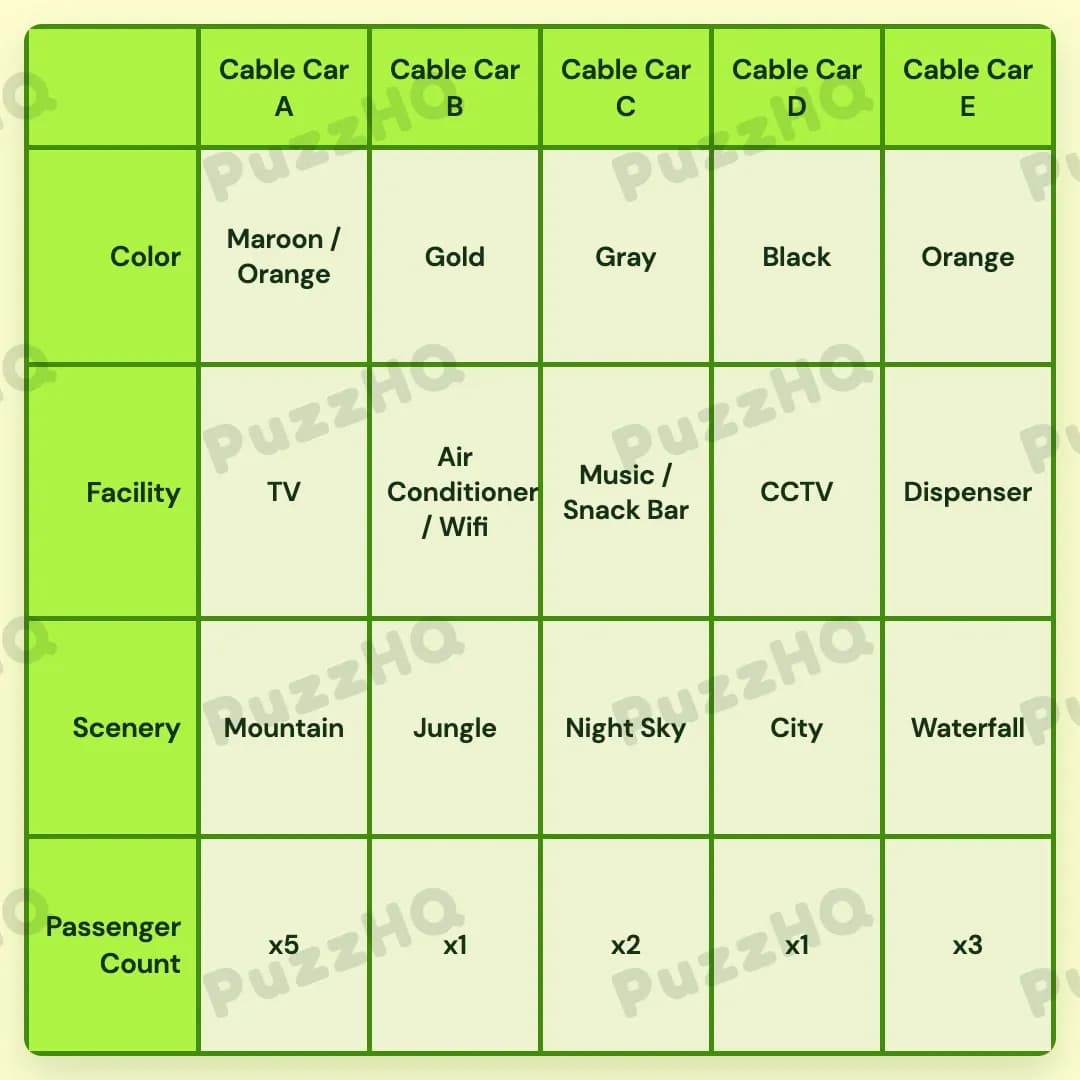
Cable Car A holds five passengers watching TV amidst mountain views, while the remaining cars follow an orderly progression of colors, facilities, and scenic routes across the line.
| Trait | Cable Car A | Cable Car B | Cable Car C | Cable Car D | Cable Car E |
|---|---|---|---|---|---|
| Color | Maroon / Orange | Gold | Gray | Black | Orange |
| Facility | TV | Air Conditioner / Wifi | Music / Snack Bar | CCTV | Dispenser |
| Scenery | Mountain | Jungle | Night Sky | City | Waterfall |
| Passenger Count | x5 | x1 | x2 | x1 | x3 |
How To Think Through Profile Perfect Level 296
Solving this cable car puzzle relies heavily on using fixed numeric anchors to narrow down adjacent positions. When a puzzle gives you a specific count or a strict neighbor condition, establishing that foundation first prevents confusing guesswork later on.
Start With Direct Wordplay: Pentaboo Locks The Passenger Count In Car A
Direct identity clues are worth using first because they establish an absolute reference point on the board.
The clue mentioning a family calling themselves "Pentaboo" inside Cable Car A gives away the passenger count immediately. The prefix "penta" represents five, which means Cable Car A holds five passengers.
Placing this value right away simplifies later arithmetic clues. Whenever you see wordplay pointing directly to a subject and a trait value, record it immediately to anchor your grid.
Use Multi Trait Clues: Pair Gold With The Jungle Scenery
Once an anchor exists, look for multi trait clues that bundle two or more characteristics together.
One clue states that riding the Golden car reveals scenery full of life and growth. A scenery filled with life and growth describes the Jungle. This tells you that whichever car is Gold must also look out at the Jungle.
Next, combine this with the clue stating that the Golden car has three neighboring facilities. Looking across the layout:
- Cable Car A has one facility (TV).
- Cable Car C has two facilities (Music and Snack Bar).
- Together, the facilities of Car A and Car C total three (1 + 2 = 3).
This proves that Cable Car B is the Golden car, sitting directly between Car A and Car C with Jungle scenery. Furthermore, Car B's passengers regret leaving their jackets behind because Car B is equipped with an Air Conditioner alongside its Wifi broadband connection.
Check Auditory Requirements: Distribute Facilities To Car B's Neighbors
Neighbor rules often act as filters to confirm or eliminate specific traits in adjacent cells.
The clue notes that both neighbors of the Jungle car have an auditory facility. Since Cable Car B is the Jungle car, its neighbors are Cable Car A and Cable Car C.
- Cable Car A receives the TV, which is an auditory and visual facility.
- Cable Car C receives the Music facility paired with the Snack Bar.
Placing the Music and Snack Bar combination in Cable Car C satisfies the requirement that the Air Conditioner in Car B is right next to the Snack Bar. Car B's Wifi also satisfies the clue stating that one of the Night Sky scenery neighbors uses satellite broadband.
Resolve Numeric Constraints: Orange Cars And Night Sky Neighbors
Arithmetic clues narrow down possibilities rapidly once base numbers are in place.
The clues give two specific passenger rules:
- The total number of passengers in the two Orange cars is eight.
- The total number of passengers in Cars A and C is an odd number.
Cable Car A is one of the Orange cars (Maroon / Orange) and already has five passengers. For the two Orange cars to total eight, the second Orange car in Cable Car E must have three passengers (8 - 5 = 3).
Because Cable Car A has five passengers (an odd number), Cable Car C must have an even number of passengers so that their sum remains odd. Cable Car C takes two passengers, making the total seven.
Now apply the clue stating that Night Sky neighbors have the same passenger count:
- Placing Night Sky in Cable Car C puts it between Cable Car B and Cable Car D.
- Cable Car B has one passenger.
- Cable Car D also receives one passenger.
Both neighbors match with one passenger each, confirming Cable Car C as Night Sky.
Complete The Layout: Security And Outer Scenery Placements
The final step is eliminating already used values and checking boundary conditions.
A clue states that no other cable car is as secure as the Black one. This identifies the Black car as having the CCTV security facility, which belongs in Cable Car D.
Another clue confirms that the car with a muted color is not the farthest from CCTV. Gray is a muted color, and placing Gray in Cable Car C puts it right next to Cable Car D's CCTV rather than at the far end of the line.
Finally, check the scenery clues for the remaining endpoints:
- The clue mentions that the car next to the Waterfall has a neighbor with a Music facility.
- Cable Car C has the Music facility.
- Cable Car D is next to Cable Car C.
- Cable Car E is next to Cable Car D, which means Cable Car E is the Waterfall car.
- Cable Car D takes the City scenery, while Cable Car A takes the Mountain scenery.
- Cable Car E receives the final facility, the Dispenser.
Every subject and trait now aligns with all structural and neighboring conditions.
What This Level Teaches You
Count Neighboring Trait Totals Carefully
When a clue specifies an exact count of neighboring items, such as three neighboring facilities, sum up the individual items in both adjacent cells. A single cell containing two items combined with an adjacent cell containing one item creates the required total of three.
Use Sums To Force Missing Integers
When a clue gives a total across shared traits, subtract your known value from the total. Knowing that Cable Car A held five passengers instantly reduced the eight passenger sum to a single possible value of three for the second Orange car.
Final Thoughts
The key to solving this level smoothly was anchoring Cable Car A's passenger count and using neighbor facility totals to pinpoint the central Golden car. Once the middle section was stabilized, arithmetic constraints solved the rest of the board without any guesswork.
Comments