
Profile Perfect Level 361 Answer
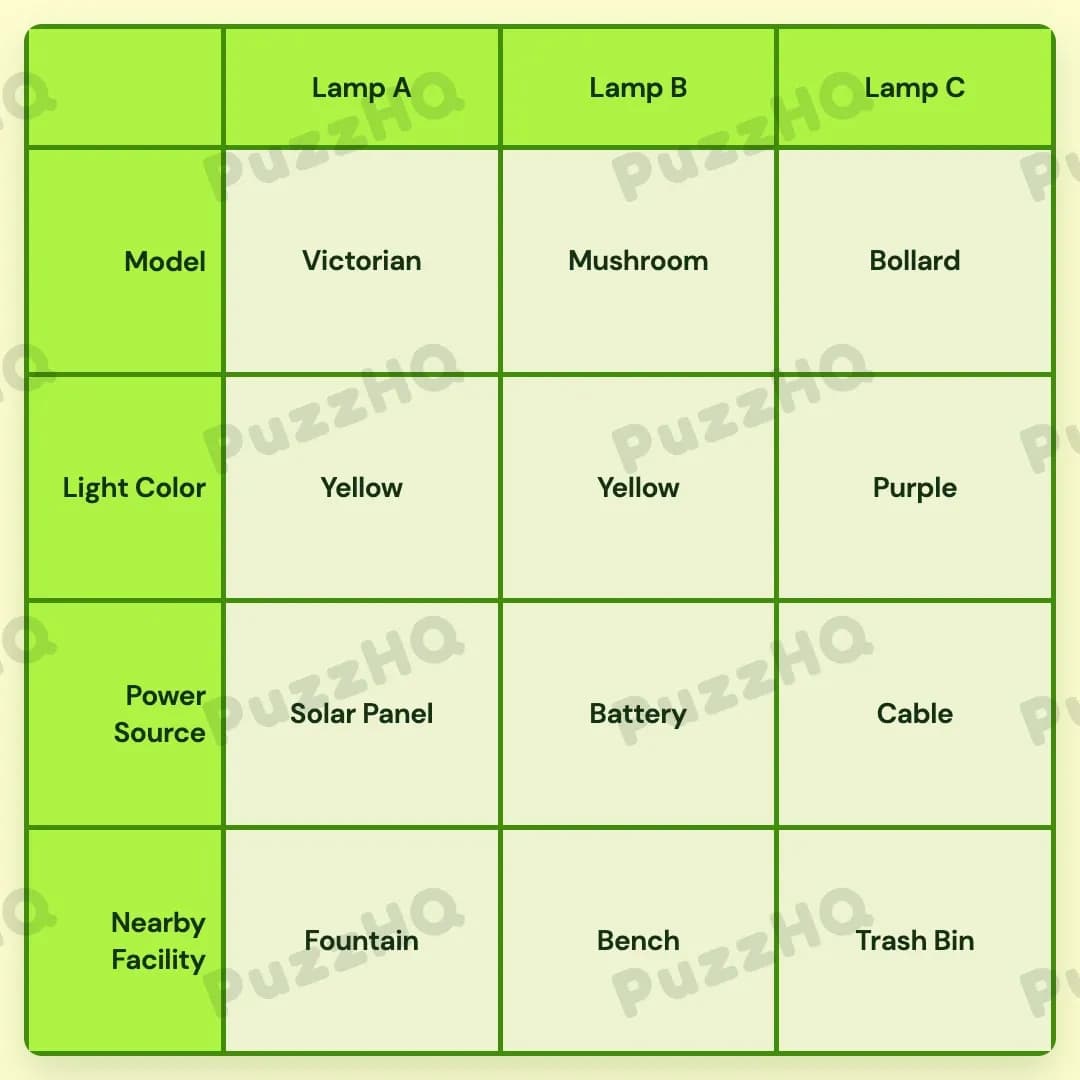
Every outdoor lamp in the park is fully identified once positional clues establish the historical model and link power methods to light colors.
| Trait | Lamp A | Lamp B | Lamp C |
|---|---|---|---|
| Model | Victorian | Mushroom | Bollard |
| Light Color | Yellow | Yellow | Purple |
| Power Source | Solar Panel | Battery | Cable |
| Nearby Facility | Fountain | Bench | Trash Bin |
Building The Grid By Trait
Starting with the spatial layout and the physical design of each lamp gives the strongest foundation. Once the models are locked into their positions across the row, the remaining attributes fall into place through direct hardware requirements and color restrictions.
Model And Nearby Facility Form The Structural Base
The physical positions of the lamps across the line, from Lamp A on the far left to Lamp C on the far right, immediately interact with historical and distance clues. Clue 1 states that the leftmost lamp has retained its style since the 1800s. Among the available designs, the Victorian model represents this nineteenth century heritage, assigning Victorian directly to Lamp A.
With Lamp A determined as Victorian, the remaining models to place are Mushroom and Bollard across Lamp B and Lamp C. Clue 5 introduces a spatial relationship between the models and the park facilities: the lamp near the Fountain is the farthest from the Bollard lamp. On a three lamp line spanning from Lamp A to Lamp C, the two farthest positions from one another are the outer ends, Lamp A and Lamp C. Because Lamp A is already established as Victorian, the Bollard model must occupy the opposite end at Lamp C. Consequently, the Mushroom model takes the middle position at Lamp B.
Since the lamp near the Fountain is the farthest possible point from Lamp C (the Bollard lamp), Lamp A must be located near the Fountain. Clue 2 notes that the Bollard lamp is not placed near the Beach, which eliminates any false options and leaves the remaining park facilities to settle naturally. With the Fountain anchored to Lamp A, the Bench pairs with Lamp B, and the Trash Bin pairs with the Bollard lamp at Lamp C. The entire physical footprint and model lineup across the three columns are now locked.
Power Source Connects Mechanics To Lamp Styles
With the models established, the power mechanisms can be assigned by analyzing how hardware fits specific fixtures. Clue 4 indicates that the Mushroom lamp relies on an internal Battery that requires annual replacement. Because Lamp B is the Mushroom lamp, Battery becomes the confirmed Power Source for Lamp B.
This leaves Solar Panel and Cable as the remaining power options for Lamp A and Lamp C. The distribution of these two sources relies on how power delivery interacts with the illumination colors across the set.
Light Color And Power Source Finalize The Columns
The color options include two Yellow lights and one Purple light. Clue 3 provides a critical restriction: both of the Yellow lamps are not connected using a Cable. This rule means that any lamp powered by a Cable cannot emit a Yellow glow, forcing the Cable powered lamp to be the unique Purple light.
Since Lamp B uses a Battery, it can safely take one of the two Yellow light assignments. Between Lamp A and Lamp C, one must take the Cable and the other must take the Solar Panel. If Lamp C takes the Cable, it cannot be Yellow, meaning Lamp C must carry the Purple light while Lamp A receives the second Yellow light. As a result, Lamp A must use the Solar Panel so that both Yellow lamps (Lamp A and Lamp B) avoid the Cable completely. Lamp C, running on a Cable, holds the single Purple light. Every trait row is now completely settled.
Where The Trait Rows Intersect
Solving logic puzzles efficiently requires observing how a single clue bridges two different rows at the same time. The clues in this puzzle create distinct bridges between models, facilities, power hardware, and illumination colors.
Model Distance Rules Anchor The Nearby Facility Row
Clue 5 bridges the Model row with the Nearby Facility row by using physical distance across the columns. Instead of stating where the Fountain is in isolation, the clue defines its location relative to the Bollard fixture. Because the Bollard lamp sits at the far right on Lamp C, the lamp that is farthest away must be on the opposite end at Lamp A. This single geometric relationship immediately solves two categories at once: it confirms Lamp C as the Bollard model and locks the Fountain to Lamp A.
Battery Requirements Bridge Model And Power Source
Clue 4 acts as a direct link between the Model row and the Power Source row. By detailing the maintenance needs of the Mushroom fixture's internal Battery, the clue transfers an equipment requirement straight to the middle column. Because Lamp B was already proven to be the Mushroom design, this mechanical relationship instantly fills the Power Source row for Lamp B without needing to test alternatives.
Color Restrictions Filter The Remaining Power Lines
Clue 3 creates an exclusionary bridge between the Light Color row and the Power Source row. By declaring that neither of the two Yellow lamps can be wired with a Cable, the clue forces a direct dependency between color selection and power method. This ensures that the Cable cannot belong to Lamp A or Lamp B, cleanly isolating the Cable to Lamp C and matching it with the lone Purple glow.
Final Grid Check
Reviewing the solved board confirms that every constraint operates in complete harmony. Lamp A sits on the left as a Victorian fixture powered by a Solar Panel, glowing Yellow next to the Fountain. Lamp B sits in the center as a Mushroom model running on an internal Battery, shining Yellow beside the Bench. Lamp C completes the row on the right as a Bollard model wired to a Cable, casting a Purple light next to the Trash Bin. All model placements, power sources, color pairings, and facility locations satisfy every rule without conflict.
Comments