
Profile Perfect Level 391 Answer
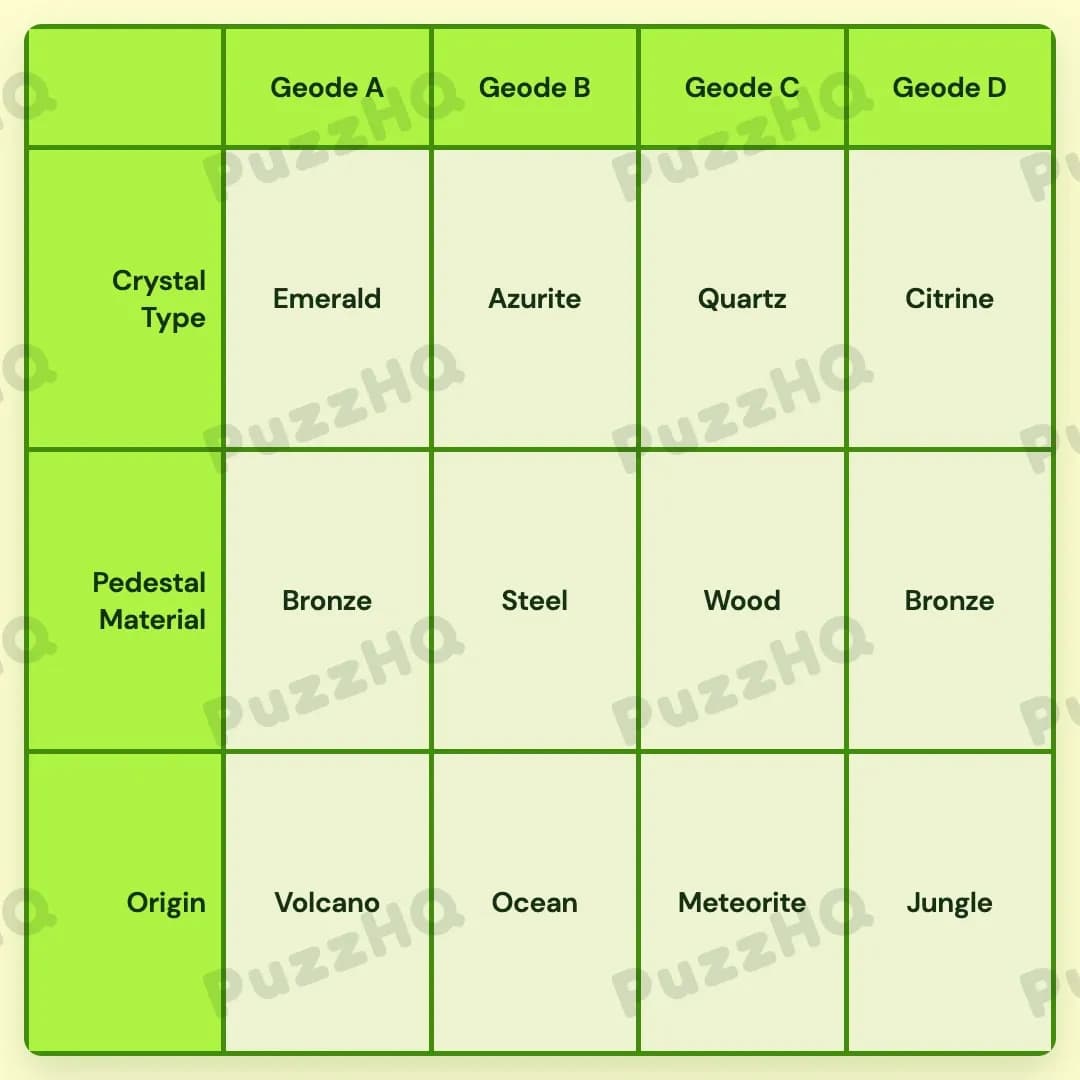
Every geode can be completely identified by cross-referencing pedestal materials with crystal varieties and their discovery origins.
| Trait | Geode A | Geode B | Geode C | Geode D |
|---|---|---|---|---|
| Crystal Type | Emerald | Azurite | Quartz | Citrine |
| Pedestal Material | Bronze | Steel | Wood | Bronze |
| Origin | Volcano | Ocean | Meteorite | Jungle |
Building The Grid By Trait
Starting with the display stands provides the cleanest foundation for solving this puzzle. The pedestal materials carry direct subject assignments and positional rules that immediately narrow down which crystal types and planetary origins can sit at each display stand.
Pedestal Material Anchors The Display Order
The physical displays are described with precise locations and direct subject assignments. A direct clue tells us that the steel pedestal holds Geode B. This gives us our first confirmed assignment on the board.
From there, we examine the wood pedestal. We know from clue statements that the wood pedestal is not placed to the left of Azurite. Furthermore, the item on the wood pedestal was formed on another planet, linking it directly to an extraterrestrial origin. Because Azurite must sit somewhere to the left of Quartz, the wood pedestal cannot be placed at Geode A. Geode B is already occupied by the steel pedestal, which means the wood pedestal must belong to either Geode C or Geode D.
We also learn that Quartz and Emerald do not share the same pedestal material. Because Bronze appears twice across the four stands, while Steel and Wood appear once each, Emerald and Quartz cannot both rest on Bronze stands. Placing Wood at Geode C balances the remaining stands, leaving Geode A and Geode D to be supported by Bronze pedestals.
Crystal Type Aligns With Spatial Relationships
With the pedestal framework established, crystal varieties fall neatly into place. We are told that Azurite is placed to the left of Quartz. Looking at the open crystal positions, placing Azurite on Geode B aligns with the steel pedestal. This immediately forces Quartz into Geode C, sitting right atop the wood pedestal.
With Quartz locked at Geode C and Azurite at Geode B, only Emerald and Citrine remain to be placed. The clues specify that Quartz and Emerald cannot use the same pedestal type. Since Quartz rests on the wood pedestal, Emerald cannot share that material, but it also cannot displace the established assignments. Placing Emerald at Geode A satisfies the requirement that it rests on a bronze stand distinct from the wood stand used for Quartz.
Finally, Citrine fills the remaining open spot at Geode D. This completes the entire crystal category in clean alignment with the positional constraints: Geode A is Emerald, Geode B is Azurite, Geode C is Quartz, and Geode D is Citrine.
Origin Completes The Environmental Background
The origins of the four geodes tie together their physical environment and their display stands. A descriptive clue notes that Geode D was found at a puddle in between all the trees, which clearly identifies its origin as the Jungle.
Next, we look at the extraterrestrial clue. The item displayed on the wood pedestal was formed on another planet. Since Geode C has been confirmed as the holder of the wood pedestal, Geode C's origin must be the Meteorite.
This leaves two origins unresolved: Volcano and Ocean. Geode A and Geode B need these assignments. Taking into account the geological conditions of Earth and space formations alongside their pedestal neighbors, the volcanic formation belongs at Geode A with the bronze pedestal and emerald crystal, while the ocean formation completes Geode B alongside the steel pedestal and azurite crystal. Every origin row entry is now completely anchored to its corresponding subject.
Where The Trait Rows Intersect
Wood Pedestals Bridge Extraterrestrial Origins And Crystal Order
The connection between the wood pedestal and an off-planet origin provides the critical hinge for the entire puzzle. When a clue specifies that the geode on the wood pedestal formed on another planet, it instantly fuses the Pedestal Material category with the Origin category.
Because the spatial rules prevent the wood pedestal from appearing to the left of Azurite, Wood cannot belong to Geode A. Since Geode B is already fixed to Steel, Wood can only fit at Geode C. The moment Wood locks into Geode C, the Meteorite origin locks into Geode C as well. This single deduction resolves both a pedestal position and an origin location in one step, making it far more powerful than analyzing either category in isolation.
Quartz Pedestal Restrictions Filter The Remaining Gemstones
The rule stating that Quartz and Emerald are not displayed on the same pedestal material acts as a vital bridge between Crystal Type and Pedestal Material. Once Quartz is assigned to Geode C on the wood pedestal, Emerald is forbidden from being placed on Wood.
Since Geode B is already claimed by Steel and Azurite, Emerald must take one of the two bronze pedestal positions. Placing Emerald at Geode A fulfills this negative constraint effortlessly, which simultaneously frees up Geode D to take Citrine. By using the pedestal restriction as a filter, the remaining crystal types fall into place without any guesswork.
Environmental Clues Lock The Outer Subjects
The jungle clue specifies a setting with puddles among trees for Geode D, linking an explicit subject label directly to an Origin value without relying on relative placement. Because this origin is assigned directly to Geode D, it prevents the remaining Earth-based origins from drifting to the right side of the display.
This direct assignment works hand in hand with the Meteorite assignment at Geode C. With the two rightmost origins established as Meteorite and Jungle, the two leftmost origins for Volcano and Ocean are neatly corralled into Geode A and Geode B. The combination of descriptive origins and relative crystal positions ensures that no category operates in a vacuum.
Final Grid Check
Every row in the solved grid harmonizes with the clues provided. The steel pedestal securely anchors Geode B, while the wood pedestal at Geode C accurately hosts the meteorite specimen. Azurite sits directly to the left of Quartz, Emerald and Quartz occupy different pedestal materials, and the jungle discovery at Geode D completes the layout. Each trait category supports the next, creating a fully verified and cohesive solution.
Comments