
Profile Perfect Level 398 Answer
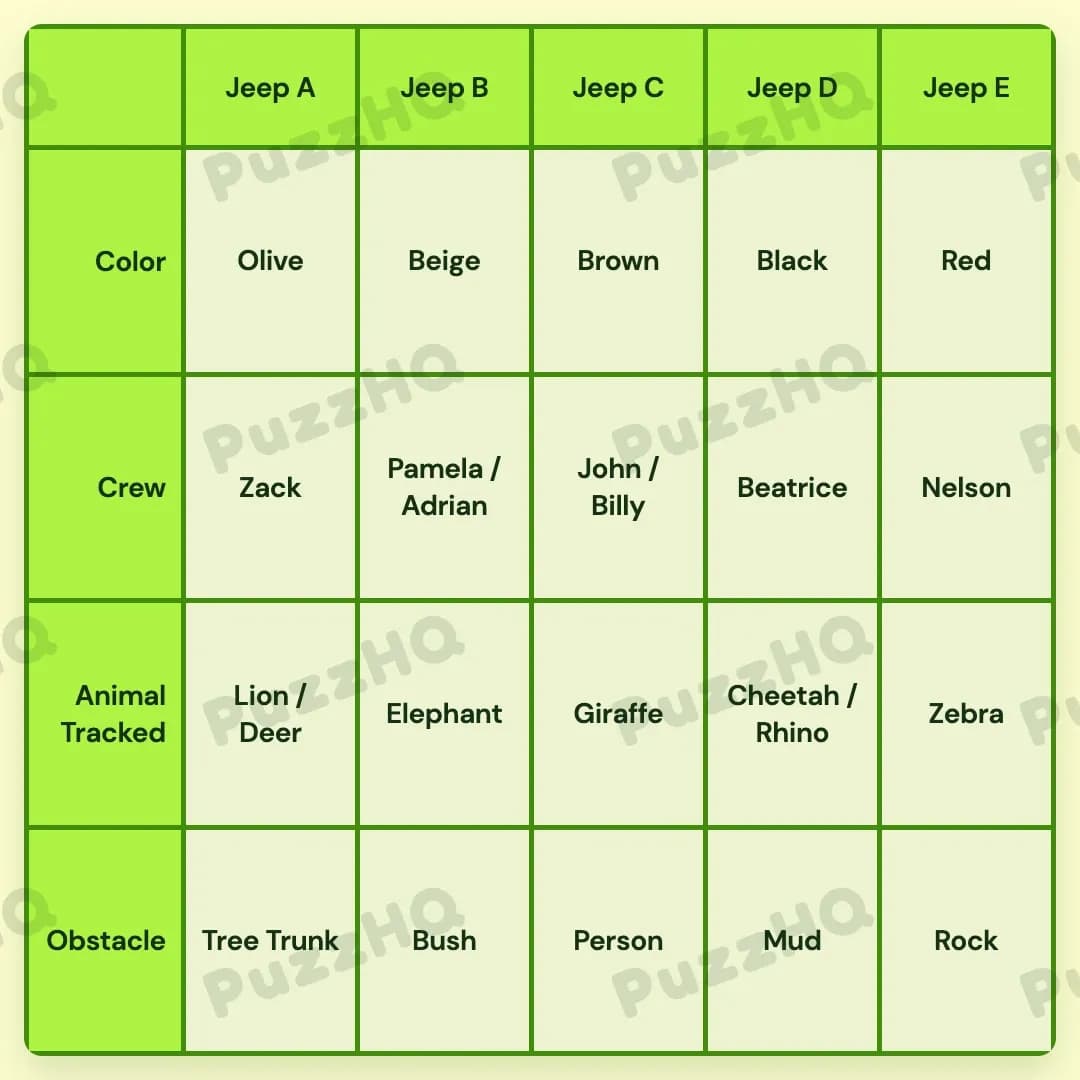
The expedition organizes across five columns from Jeep A on the far left to Jeep E on the far right.
| Trait | Jeep A | Jeep B | Jeep C | Jeep D | Jeep E |
|---|---|---|---|---|---|
| Color | Olive | Beige | Brown | Black | Red |
| Crew | Zack | Pamela / Adrian | John / Billy | Beatrice | Nelson |
| Animal Tracked | Lion / Deer | Elephant | Giraffe | Cheetah / Rhino | Zebra |
| Obstacle | Tree Trunk | Bush | Person | Mud | Rock |
How To Think Through Profile Perfect Level 398
The most useful solving habit for this level is anchoring fixed positions first, then using directional boundaries to lock down endpoints before filling the middle columns.
Start With Direct Matching: Anchor The Middle And Exterior Jeeps
Direct statements give you immediate placements without needing cross-reference work. You should always scan the clues for explicit assignments to start building solid anchors.
Clue 2 tells you directly that Jeep A is Olive. Clue 3 states that John is stationed in the middle jeep, which is Jeep C. Clue 5 adds another direct fact by revealing that John drives the Brown jeep, making Jeep C both Brown and crewed by John.
Establishing these anchors immediately limits where other traits can go. Once you know Jeep A is Olive and Jeep C is Brown, you have eliminated two entire columns from any clue discussing vehicle colors or driver placement.
Use Positional Spans: Lock Down The Left And Right Flanks
When a clue restricts subjects to specific ends of the grid, check the boundary conditions before looking at the center.
Clue 2 states that Olive Jeep A is led by either Zack or Nelson. Clue 8 clarifies that Nelson is to the right of the Black jeep. If Nelson were placed in Jeep A on the far left, there would be no room to put a Black jeep to his left. Therefore, Nelson cannot be in Jeep A. Zack must lead Jeep A.
Clue 10 reinforces this span by noting that eleven living beings stand between Zack and Nelson. With Zack on the far left in Jeep A, Nelson must sit on the far right in Jeep E. Clue 8 then tells you that the Black jeep is somewhere to the left of Nelson. Since Jeep A is Olive and Jeep C is Brown, Jeep D must be Black.
This leaves only two vehicle colors to resolve: Beige and Red. Clue 1 links a boulder or rock obstruction directly to the Red jeep. Clue 4 states that the Rock is more than two columns away from the Bush. If the Red jeep were in Jeep B, the Rock could not be more than two columns away from anything else on the board. Therefore, the Red jeep must be Jeep E on the far right, and the Rock obstacle belongs to Jeep E. Jeep B takes the final remaining color, Beige.
Combine Multi-Trait Clues: Connect Obstacles And Roles
Multi-trait clues reveal how items from different categories bundle together. You can link these bundles into your established columns.
You know Jeep E holds the Rock obstacle. Clue 4 requires the Bush to be more than two columns away from the Rock. Because the Rock sits in Jeep E in column 5, the Bush must sit in either column 1 or column 2.
Look at Clue 12, which tells you that the Tree Trunk is a toy for the king of the savannah. The king of the savannah refers to the Lion. Clue 14 notes that the animal beside the Lion does not neighbor the Mud, placing the Lion on an edge jeep where it has only one neighbor. Placing the Lion in Jeep A pairs it with the Tree Trunk obstacle in Jeep A.
With Jeep A holding the Tree Trunk and Jeep E holding the Rock, the Bush must go into Jeep B to satisfy the distance requirement from the Rock. Clue 9 says that Mud and a living obstacle are next to each other. With the Bush in Jeep B, Jeep C must take the living obstacle, Person, and Jeep D must take the Mud.
Apply Distance And Neighbor Logic: Track The Animals
Distance clues between specific targets allow you to place items by counting step intervals across your existing grid layout.
Clue 6 states that two animals and one jeep stand between the Giraffe and the Zebra. This structure means an entire jeep column holding two animals sits directly between the Giraffe and the Zebra. Jeep C holds the Giraffe, Jeep D holds a dual animal pair, and Jeep E holds the Zebra.
Clue 15 confirms this placement by noting that the Giraffe in Jeep C is between two gray-colored animals. Jeep B holds the Elephant, and Jeep D holds a pair that includes the gray Rhino.
Clue 11 notes that a cat that cannot roar is seen alongside a herbivore. A cheetah cannot roar, which pairs the Cheetah with the herbivore Rhino in Jeep D. Clue 13 mentions that the animal targeted by Nelson is not as tall as an Elephant, which fits the Zebra in Jeep E. To finish the animals, the Lion in Jeep A pairs with the Deer.
Eliminate Already Used Values: Complete The Crew Roster
Once the larger trait structures are locked in, complete the remaining empty slots by checking multi-person crew requirements.
Clue 7 shows Pamela actively checking the baby Elephant in Jeep B. Clue 16 adds that Adrian focuses on the parents, putting Pamela and Adrian together in Jeep B.
Clue 5 states that Beatrice does not accompany John in his Brown jeep. With John and his partner Billy occupying Jeep C, Beatrice must take the open driver seat in Jeep D. Every driver and passenger is now placed without contradiction.
What This Level Teaches You
- Test boundary conditions against directional clues. Clue 2 offered two options for the far-left jeep, but Clue 8 required one of those candidates to sit to the right of another vehicle. Testing whether a candidate can physically fit on an edge eliminates invalid options instantly.
- Use span clues to determine exact column spacing. Clue 6 specified that two animals and one jeep sit between the Giraffe and the Zebra. Recognizing that a single intermediate column containing a two-animal cell fulfills that description lets you position both animals correctly.
- Connect multi-person crew descriptions to multi-animal targets. Clues 7 and 16 split crew responsibilities across baby and parent elephants, showing that multiple characters belong in the exact same vehicle cell.
Final Thoughts
Solving this level smoothly relies on using edge constraints to eliminate options early. When you place your far-left and far-right anchors first, spacing clues for obstacles and animals naturally fall into place.
Comments