
Profile Perfect Level 414 Answer
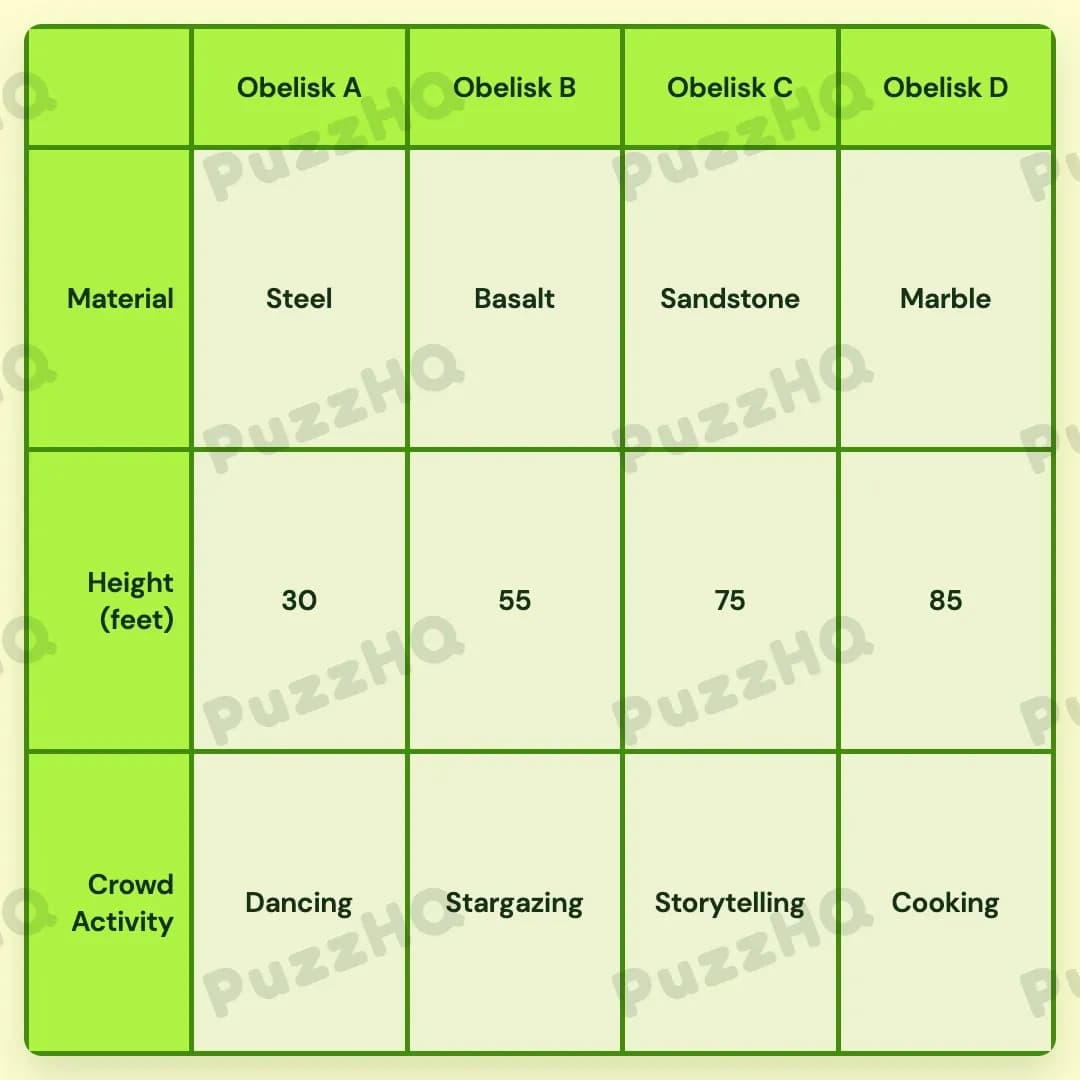
Here is the complete solution for the four monuments standing in a line from Obelisk A on the far left to Obelisk D on the far right.
| Trait | Obelisk A | Obelisk B | Obelisk C | Obelisk D |
|---|---|---|---|---|
| Material | Steel | Basalt | Sandstone | Marble |
| Height (feet) | 30 | 55 | 75 | 85 |
| Crowd Activity | Dancing | Stargazing | Storytelling | Cooking |
The Logic Behind Profile Perfect Level 414
The entire puzzle hinges on how the physical layout of the four monuments controls both their heights and materials. Because the four obelisks stand in an ordered line, any condition regarding neighbor counts immediately divides the board into the outer boundary posts and the sheltered interior positions. Once you realize that the extremes of height must occupy matching positional profiles, the sequence of the remaining values falls into place with remarkable clarity.
The Boundary Posts Establish The Scale
A four-item lineup offers only two types of positions when counted by neighbors. The two outer slots at Obelisk A and Obelisk D each have exactly one neighboring monument, while the inner slots at Obelisk B and Obelisk C each share borders with two. We are told that the shortest obelisk has the same neighbor count as the tallest. This means both extremes must sit together either in the interior or at the outer ends.
Looking at the height options of thirty, fifty-five, seventy-five, and eighty-five feet, the steel obelisk has a much lower height than all the others, designating it firmly as the thirty-foot shortest monument. At the other end of the tape, the eighty-five-foot monument stands as the tallest.
A positional clue clarifies that the obelisk made of marble sits to the right of the seventy-five-foot monument. That directional requirement eliminates Obelisk A from being the marble monument and prevents seventy-five feet from occupying the far right at Obelisk D. Furthermore, sandstone sits directly next to the eighty-five-foot monument, and feasts are held at the marble obelisk, while the tallest monument cannot sit adjacent to stargazing.
If the shortest and tallest were both in the middle at positions B and C, they would border one another. But we know the fifty-five-foot obelisk attracts people looking up at the night sky for stargazing, and the tallest monument cannot neighbor stargazing. Placing the thirty-foot and eighty-five-foot monuments at the exterior posts of Obelisk A and Obelisk D satisfies the neighbor count rule cleanly, placing thirty feet at Obelisk A on the left and eighty-five feet at Obelisk D on the far right.
Materials Line Up Across The Row
With Obelisk A locked at thirty feet and Obelisk D at eighty-five feet, the material clues quickly take charge. Steel corresponds to the lowest height, giving Obelisk A its material immediately.
Next, consider the marble monument. We know it sits to the right of the seventy-five-foot obelisk, and it is also the site where feasts take place. Because Obelisk D is the only available position to the right of the remaining middle slots that can satisfy this relationship, Obelisk D must be made of marble. This leaves Obelisk C as the seventy-five-foot monument sitting directly to its left.
The rule that sandstone is used next to the eighty-five-foot monument points straight to Obelisk C, since Obelisk C is the sole neighbor of Obelisk D. With steel at A, sandstone at C, and marble at D, only basalt remains for Obelisk B.
The middle height of fifty-five feet naturally slots into Obelisk B, completing an ascending height progression of thirty, fifty-five, seventy-five, and eighty-five feet from left to right across the row.
Activities Settle Into Their Positions
Assigning the crowd activities relies on translating the thematic descriptions into their listed names. The leftmost monument hosts full-body workouts, which associates dancing with Obelisk A.
We already noted that people gather at night looking up near the fifty-five-foot obelisk. That links stargazing directly to the fifty-five-foot height at Obelisk B. This placement also agrees with our earlier structural rule, as the stargazing at Obelisk B is separated from the eighty-five-foot tallest monument at Obelisk D by Obelisk C.
The marble monument at Obelisk D hosts frequent feasts, assigning cooking to the far right. That leaves storytelling as the final remaining activity, which neatly fills the open trait slot at Obelisk C alongside sandstone and seventy-five feet.
The Clue I Would Read Twice
The pivotal clue in this solve is the statement that the shortest obelisk has the same neighbor count as the tallest.
In a casual read, it is easy to assume this simply compares two objects without providing location data. However, in a four-subject linear puzzle, neighbor count is entirely an issue of geography. Outer ends have one neighbor, while inner positions have two. By pairing the thirty-foot and eighty-five-foot monuments into the same structural category, the clue forces a choice between the outer pair and the inner pair. Combined with the requirement that the eighty-five-foot monument cannot touch the stargazing group at fifty-five feet, this single clue dictates the geometry of the entire solve.
Final Thoughts
What makes Level 414 memorable is the neat harmony between its physical dimensions and its spatial layout. The heights happen to arrange themselves in a perfectly clean ascending order from left to right, but reaching that realization requires untangling subtle neighborhood constraints first. It is a satisfying exercise in using outer borders to bring stability to the middle.
Comments