
Profile Perfect Level 416 Answer
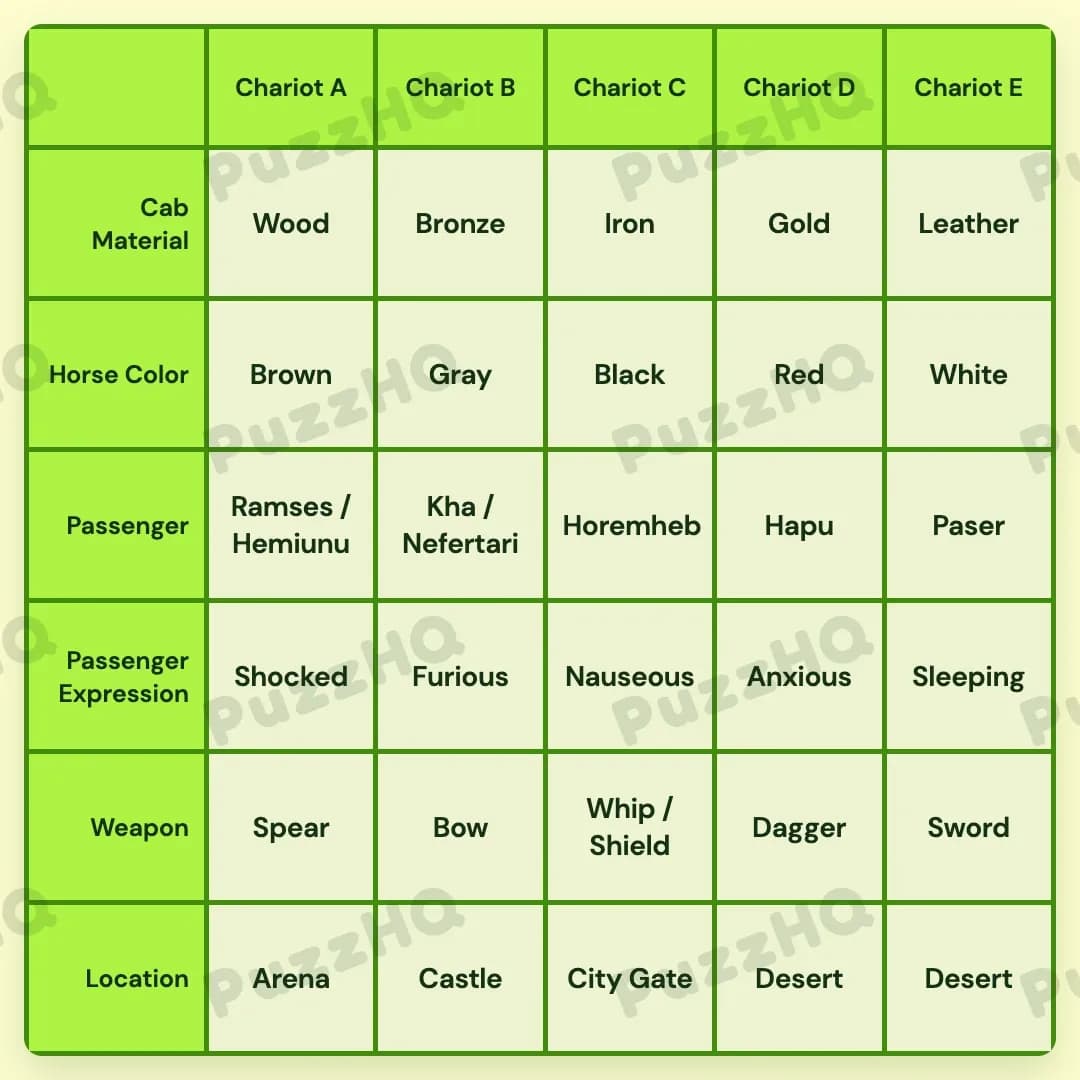
Every chariot can be fully reconstructed by anchoring the leftmost chariot with the Brown horse and Wooden cab, then calculating exact column and passenger distances across the row.
| Trait | Chariot A | Chariot B | Chariot C | Chariot D | Chariot E |
|---|---|---|---|---|---|
| Cab Material | Wood | Bronze | Iron | Gold | Leather |
| Horse Color | Brown | Gray | Black | Red | White |
| Passenger | Ramses / Hemiunu | Kha / Nefertari | Horemheb | Hapu | Paser |
| Passenger Expression | Shocked | Furious | Nauseous | Anxious | Sleeping |
| Weapon | Spear | Bow | Whip / Shield | Dagger | Sword |
| Location | Arena | Castle | City Gate | Desert | Desert |
How To Think Through Profile Perfect Level 416
The most productive habit on this level is treating fixed positional clues as anchors while carefully distinguishing between chariot spacing and passenger counts. Several chariots carry pairs rather than single riders, so distance clues must be interpreted based on whether they count columns, people, or individual weapons.
Anchor The Edge: The Brown Horse And Wooden Cab Fix Chariot A
Begin by scanning for clues that establish absolute board positions. Absolute placements immediately eliminate ambiguity and serve as reference points for every relative clue that follows.
- Clue 3 confirms that the Brown horse pulls the leftmost chariot, fixing Brown in Chariot A.
- Clue 6 notes that the Wooden chariot is pulled by the chestnut horse, which equates to the Brown horse. This places Wood in Chariot A.
- Clue 11 mentions that the audience cheers at the chariot made from planks. Since Wood is in Chariot A, its location must be the Arena.
- Clue 12 states that the Spear is brought by the person to the left of the Bronze cab. Because Chariot A is the leftmost slot, Chariot A must carry the Spear, and Chariot B must be made of Bronze.
With Chariot A fully initiated, you have a solid edge anchor that unlocks several adjacent relationships.
Count Carefully: Spacing Clues Determine Weapons And Passengers
Once Chariot A holds the Wood cab, look for clues that measure distance away from that anchor.
- Clue 13 states there are 3 people between the Dagger and Wood. Because Chariot B carries two passengers and Chariot C carries one passenger, the three people between them occupy Chariots B and C. This places the Dagger in Chariot D.
- Clue 5 tells you that someone in the wilderness keeps their Dagger ready. This assigns the Desert location to Chariot D.
- Clue 22 states that Paser is farthest from the Gray horse. To be the maximum possible distance from any internal chariot, Paser must be on the opposite edge at Chariot E, which also means the Gray horse belongs in Chariot B.
Use Relative Neighbors: Gray And Red Horses Position The Middle
With Chariots A, B, D, and E partially filled, focus on neighbor clues that connect adjacent columns.
- Clue 17 states that to the right of the Gray horse is the passenger that brought the Whip. Since Gray is in Chariot B, the Whip belongs in Chariot C.
- Clue 2 matches the long flexible weapon (the Whip) to the passenger at the City Gate. This sets Chariot C's location to City Gate.
- Clue 10 restricts Red and Black horses to Chariot C and Chariot D.
- Clue 20 clarifies that the passenger on the left of the Red horse is sick from all the rocking. That forces the Red horse into Chariot D so that Chariot C can be the passenger who is Nauseous.
- Consequently, Chariot C takes the Black horse by elimination, leaving White for Chariot E.
Resolve Multi-Passenger Duos And Weapons
Several clues mention passengers riding together or holding multiple items. Tracking headcount avoids confusion when placing individual names.
- Clue 7 notes that multiple people ride in the Bronze cab (Chariot B).
- Clue 19 states that the sharpshooter accompanies Nefertari, meaning Chariot B holds Nefertari and uses the Bow.
- Clue 15 states Nefertari's partner is not Hemiunu, but he sits next to her. Looking at the remaining names, Kha is Nefertari's partner in Chariot B, while Hemiunu sits in Chariot A alongside Ramses.
- Clue 4 states Horemheb embarks to war alone next to the duo, placing Horemheb in Chariot C.
- Clue 8 places the Leather chariot 2 columns away from Horemheb in Chariot C, which lands Leather in Chariot E. This leaves Iron for Chariot C and Gold for Chariot D.
- Clue 16 mentions that Paser and Hapu might meet along the way. Since Paser is in Chariot E in the Desert, Hapu must be in Chariot D, also in the Desert.
Match The Final Expressions And Weapons By Elimination
With the layout nearly complete, direct constraints quickly lock the remaining slots.
- Clue 14 notes that 3 weapons separate the Sleeping and Furious passengers. Chariot C carries two weapons (Whip and Shield) and Chariot D carries one (Dagger), creating a total separation of 3 weapons between Chariot B (Furious) and Chariot E (Sleeping).
- Clue 1 notes that it should not be possible for him to still hold the Sword, which aligns with the Sleeping passenger in Chariot E holding the Sword.
- Clue 9 places the Castle to the right of the Shocked passenger. This puts Shocked in Chariot A and Castle in Chariot B.
- Clue 18 states the passenger in the Iron cab (Chariot C) is not Anxious. This leaves Anxious for Chariot D, completing the grid.
What This Level Teaches You
Distinguish Between Column Distance And Item Count
When a clue specifies an offset, check whether the unit of measurement is chariots, passengers, or weapons. In this puzzle, Chariot B contains two riders and Chariot C contains two weapons. Reading "3 people between" as "3 columns between" would lead to misplacing the Dagger. Always verify what entity is being counted.
Pair Complementary Binary Constraints
Clue 10 narrowed the Red and Black horses down to a two-chariot subset (Chariot C and Chariot D). Rather than guessing, waiting for Clue 20 immediately resolved the orientation by defining the passenger to the left of the Red horse. Grouping clues that address the same small pool of candidates prevents premature branching.
Final Thoughts
Success in this level relies on anchoring the outer boundaries first and taking multi-occupant cells into account during distance calculations. Once the leftmost chariot and rider counts are established, the remaining traits lock into place through straightforward neighbor deductions.
Comments