
Profile Perfect Level 450 Answer
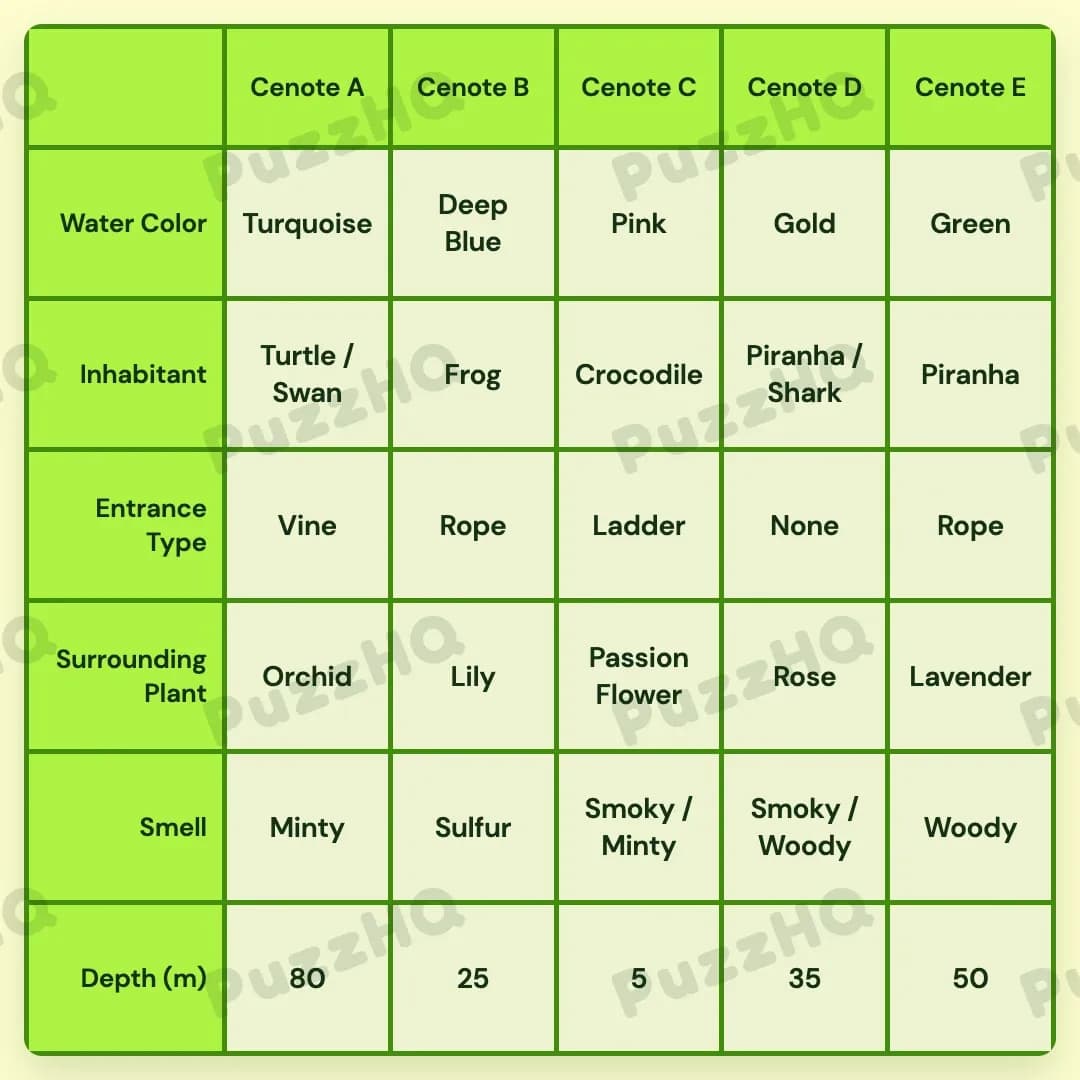
Before diving into the logic, here is the complete solution for the five subterranean chambers, mapping every color, depth, and resident across the cavern system.
| Trait | Cenote A | Cenote B | Cenote C | Cenote D | Cenote E |\n| --- | --- | --- | --- | --- | --- |\n| Water Color | Turquoise | Deep Blue | Pink | Gold | Green |\n| Inhabitant | Turtle / Swan | Frog | Crocodile | Piranha / Shark | Piranha |\n| Entrance Type | Vine | Rope | Ladder | None | Rope |\n| Surrounding Plant | Orchid | Lily | Passion Flower | Rose | Lavender |\n| Smell | Minty | Sulfur | Smoky / Minty | Smoky / Woody | Woody |\n| Depth (m) | 80 | 25 | 5 | 35 | 50 |
The Logic Behind Profile Perfect Level 450
Solving this puzzle comes down to reading the row of caverns as a physical landscape rather than a collection of isolated facts. Cenotes line up sequentially from A through E, and the spatial relationships established by the flora and physical access points dictate almost everything else. Once you pin down how the depths align with the cavern entrances, the biological traits follow in rapid succession.
Geography And Depth Establish The Perimeter
The outer bounds of the grid settle quickly if you look at the landscape cues. We learn that the rightmost pool is kept free of insects by its flora, which points toward lavender, known naturally for warding off pests. That puts lavender squarely at Cenote E.
From there, distance becomes your best diagnostic tool. The clue noting that lavender sits farthest from the solitary frog prince means the frog cannot be tucked into the middle. It must sit at Cenote B, leaving Cenote A open while maximizing the distance from the far right edge.
At the same time, depth begins to govern the horizontal order. A rose grows to the left of the second deepest cavern, which is explicitly fifty meters deep. Because Cenote E is already occupied by lavender on the far right, the fifty meter pool has to be Cenote E itself, immediately placing the rose at Cenote D.
Now the entrance types come into focus. Two cenotes rely on ropes, with one dropping twice as far as the other. Because Cenote E is fifty meters deep, the matching rope cenote must measure twenty-five meters. Cenote B claims that twenty-five meter depth and the first rope entrance, while Cenote E takes the second rope entrance.
The remaining depths fall into place through simple constraints. A thirty-five meter cenote possesses a completely hidden entrance with no conventional access. Because Cenote D is already adjacent to Cenote E and lacks an assigned entrance, it takes the thirty-five meter depth and the hidden entrance. The vine entrance cannot sit next to this hidden entrance, which eliminates Cenote C and pushes the vines all the way to Cenote A. That leaves Cenote C with the ladder entrance.
With fifty, thirty-five, and twenty-five meters accounted for, the two remaining depths are five meters and eighty meters. The sulfuric water is described as the second shallowest depth in the network. That leaves five meters as the absolute shallowest, which belongs to Cenote C beneath the ladder. Cenote A becomes the deepest chasm at eighty meters, neatly accommodating the sea turtle capable of diving the height of the Taj Mahal.
Botany Colors The Water
With the physical structure settled, the pool colors and their accompanying scents weave through the remaining gaps. Cenote B holds sulfuric water, matching our earlier twenty-five meter measurement and introducing a distinct sulfur scent.
Looking at the botanical clues, the ladder cenote features a bloom named for a sacred event. Passion flower fits the description perfectly and lands at Cenote C. Deep blue water is surrounded by flowers that sprout from bulbs, a hallmark of lilies, which places both the deep blue pool and the lily at Cenote B. By elimination among the flora, the orchid belongs to Cenote A.
Water colors fill in smoothly behind the plants. Turquoise water carries a fresh, toothpaste-like mint aroma. Since Cenote B is deep blue, Cenote C has the ladder, and Cenote E holds lavender, Cenote A is the only viable home for turquoise water and its minty freshness.
The pink pool carries neither a sulfur nor a woody smell. Cenote C is the natural home for pink water, especially since we are told that gold water belongs to either C or D. Gold water therefore claims Cenote D, leaving green water for Cenote E on the far right.
Wildlife Finds Its Territory
The final phase populates each cavern according to environmental temperament. Cenote C, resting beneath the ladder, is claimed by the solitary crocodile that refuses to share its space with any rival species.
Green water at Cenote E is noted as being infested with a school of dangerous Amazonian animals, making piranhas the clear occupant. Cenote D hosts the shark, an apex predator that competes with another meat-eater, sharing the pool alongside piranhas.
That leaves Cenote A for the remaining fauna. Vines serve as the primary diet for the swan, while the deep eighty-meter pool gives the diving turtle room to maneuver. Both animals settle comfortably into the turquoise water of Cenote A.
A lingering smoky scent helps distinguish the final sensory details between the eastern pools. Cenote D and Cenote E split woody and smoky qualities, with Cenote D holding both smoky and woody notes while Cenote E settles on woody alone. Cenote C rounds out the olfactory profile by pairing its clean freshness with a smoky trace alongside its minty note.
The Clue I Would Read Twice
"Rose is to the left of the 2nd deepest cenote, 50m deep" is the quiet pivot of the entire solve.
At first glance, it reads like a simple positional hint between two adjacent columns. But when you cross-reference it with the clue establishing that one rope cenote is twice as deep as the other, it suddenly does massive structural work. By identifying fifty meters as the second deepest mark, it locks down both the identity of the deeper rope entrance and forces the rose into Cenote D. Without recognizing how those two clues hinge on each other, the depth assignments can easily stall out.
Final Thoughts
What makes this level stand out is how gracefully it balances spatial reasoning with natural history trivia. You are not merely balancing abstract variables in a grid; you are picturing the canopy above, the depth of the drop, and the exact species that would thrive in each sunlight-starved pocket of water. Once the rope and vine entrances find their proper anchors, the rest of the subterranean world settles into place.
Comments