
Profile Perfect Level 456 Answer
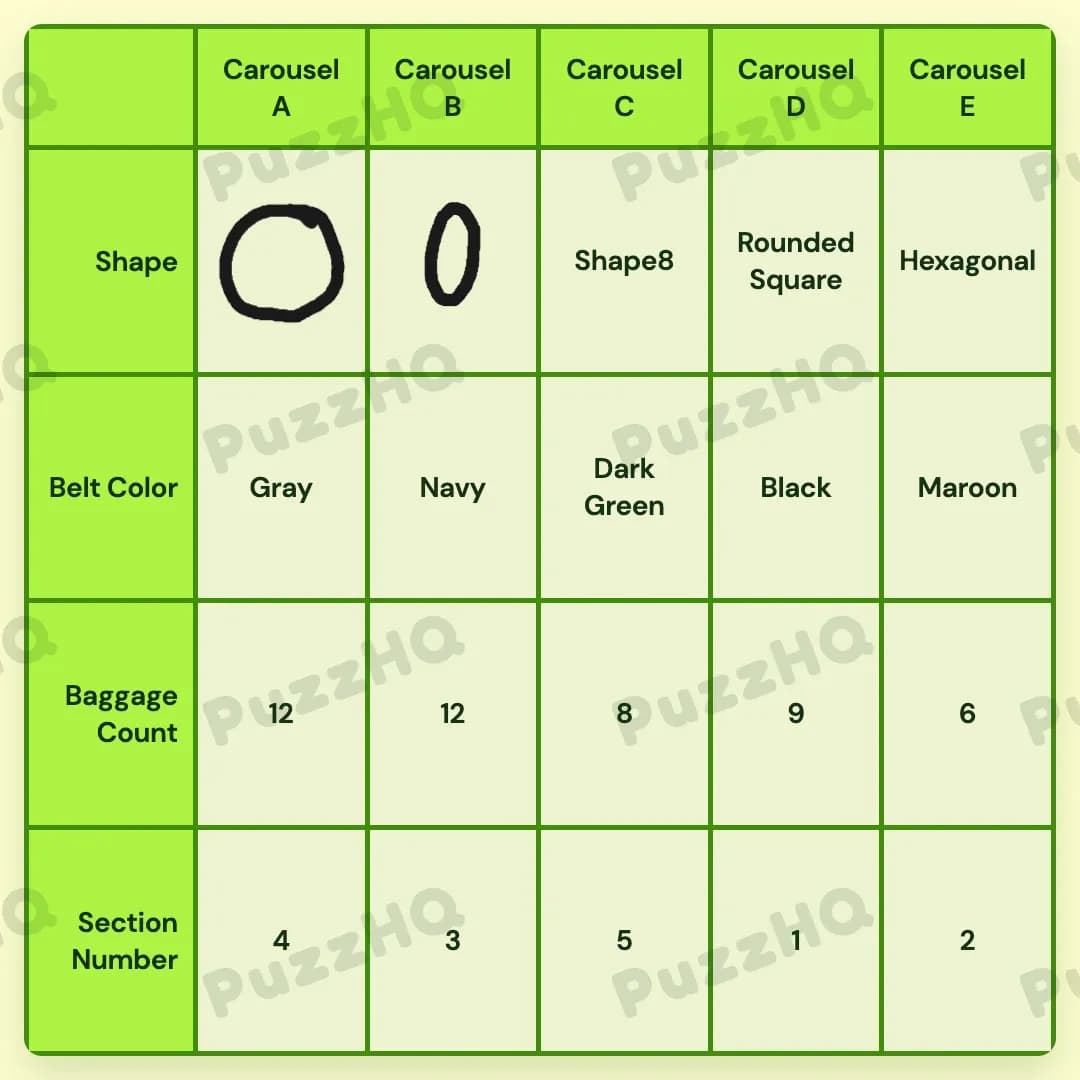
Before diving into the belt lines and section assignments, here is the full layout for every carousel across the terminal.
| Trait | Carousel A | Carousel B | Carousel C | Carousel D | Carousel E |
|---|---|---|---|---|---|
| Shape | ShapeO | Shape0 | Shape8 | Rounded Square | Hexagonal |
| Belt Color | Gray | Navy | Dark Green | Black | Maroon |
| Baggage Count | 12 | 12 | 8 | 9 | 6 |
| Section Number | 4 | 3 | 5 | 1 | 2 |
The Logic Behind Profile Perfect Level 456
Geometry anchors this puzzle long before the baggage counts or section numbers settle into place. While baggage numbers and belt colors appear tangled at first glance, the terminal layout relies on distinctive silhouettes that quickly pin down the center and edges of the board. Once the physical shapes claim their positions, spatial relationships between neighboring belts handle the rest of the sorting.
Geometric Forms Anchor The Columns
The most dependable starting point sits right in the middle column. Carousel C is explicitly described as having the only shape with two holes. Scanning the available forms, Shape8 is the singular candidate fitting that description, giving Carousel C an immediate visual identity.
From there, numerical associations between geometry and baggage counts begin to narrow the field. We are told that the hexagonal carousel carries as many pieces of baggage as it has edges. A hexagon naturally possesses six edges, which fixes a baggage count of 6 directly to the Hexagonal shape. Furthermore, two carousels share identical baggage counts alongside similar shapes. The twin circular profiles, ShapeO and Shape0, neatly pair up with matching loads of 12 baggages apiece, leaving the remaining baggage totals of 8 and 9 to distribute among the rest of the board.
Because the Dark Green carousel cannot carry a baggage count exceeding its shape, pairing it with Shape8 creates an exact ceiling: 8 pieces of baggage for Carousel C. This leaves the baggage count of 9 to land on the Rounded Square, while the Hexagonal carousel claims the 6 baggage count at Carousel E. With the circular twins restricted from section 2, and knowing their twin baggage load of 12, Carousel A and Carousel B comfortably take ShapeO and Shape0. Carousel D claims the Rounded Square by elimination.
Belt Colors Fall Into Alignment
With the shapes and several baggage totals established, the belt colors form an orderly chain across the board. Dark Green belongs to Carousel C, right at the center. The clues dictate that Dark Green sits directly between the Navy belt and section 1. Looking at the neighboring columns, Carousel B must take the Navy belt, while the carousel in section 1 must lie on the other side at Carousel D.
We also know that the carousel carrying 9 baggages holds the smallest section number. Since Carousel D holds the 9 baggage count, it naturally becomes section 1, fully validating the alignment with the Dark Green belt in Carousel C.
The neighboring requirements continue to tighten the remaining colors. The Black carousel borders a neighbor carrying 6 baggages. Carousel E holds the 6 baggage load, which means Carousel D must be the Black carousel. Carousel A, sitting far to the left, claims the Gray belt, which lost its intended silver shine, leaving Maroon to complete Carousel E.
Spatial Spacing Closes The Sections
Resolving the section numbers becomes a straightforward exercise in column counting. The clue governing the Gray belt notes that the highest section number sits exactly two columns away. With Gray firmly stationed at Carousel A in the first column, counting two columns to the right lands square on Carousel C in the third column. This designates Carousel C as section 5, the maximum section value on the board.
That placement leaves only sections 2, 3, and 4 undecided across Carousels A, B, and E. The circular twins are barred from section 2. Carousel A and Carousel B hold those circular profiles, which immediately rules them out of section 2 and pushes section 2 into Carousel E.
With section 2 assigned to Carousel E, only sections 3 and 4 remain for the first two columns. The spacing requirement between carousels puts two units between one of the carousels and section 4, settling section 4 cleanly into Carousel A. Carousel B takes the final open value, section 3, completing the entire terminal grid without a single contradictory note.
The Clue I Would Read Twice
The clue stating that the Dark Green carousel has a baggage count that does not exceed its shape sounds delightfully cryptic on a casual read. In many logic puzzles, comparing a baggage count to a shape feels like comparing apples to geometry. Here, the phrasing demands that you interpret the visual silhouette as a numerical boundary.
Once you recognize that Carousel C is Shape8, the shape name itself provides the upper limit. It is not asking for an abstract edge count or interior angles; it is pointing directly to the numeral 8 embedded in the shape's designation. Seeing that connection turns an otherwise puzzling comparison into an absolute lock, pinning the 8 baggage count directly to the center column and unlocking the remaining baggage distribution across the board.
Final Thoughts
What makes this level stand out is how gracefully it blends literal geometry with column arithmetic. Instead of relying purely on standard comparative statements, the grid asks you to look at shapes as physical objects with holes, edges, and digits built right into their names. It is a satisfying solve that rewards players who pay close attention to how everyday visual descriptions can double as concrete mathematical limits.
Comments