
Profile Perfect Level 452 Answer
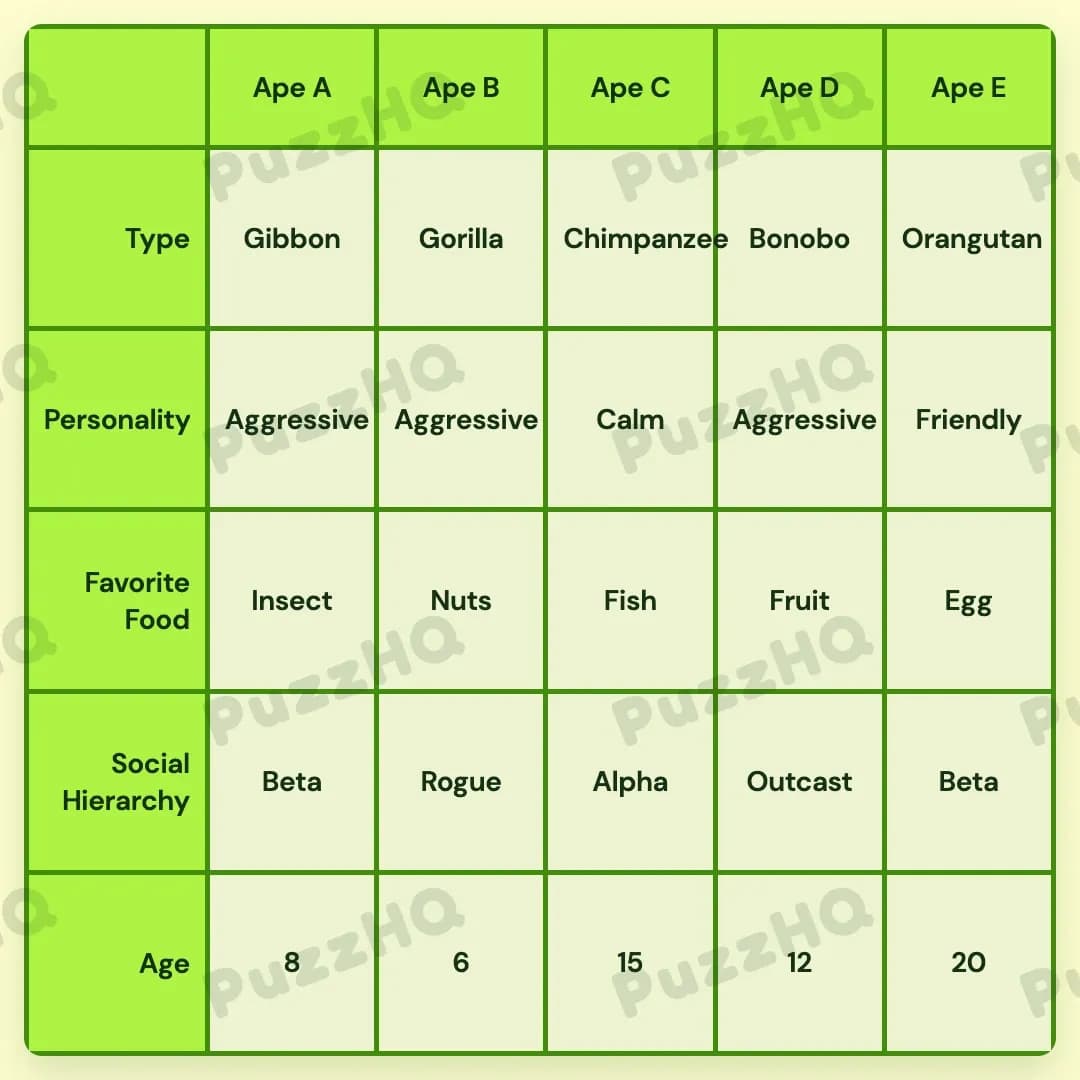
The jungle primates find their proper order across five traits once you link social hierarchy and dietary preferences to establish fixed anchor points on the line.
| Trait | Ape A | Ape B | Ape C | Ape D | Ape E |
|---|---|---|---|---|---|
| Type | Gibbon | Gorilla | Chimpanzee | Bonobo | Orangutan |
| Personality | Aggressive | Aggressive | Calm | Aggressive | Friendly |
| Favorite Food | Insect | Nuts | Fish | Fruit | Egg |
| Social Hierarchy | Beta | Rogue | Alpha | Outcast | Beta |
| Age | 8 | 6 | 15 | 12 | 20 |
Building The Grid By Trait
Starting with Favorite Food and Social Hierarchy provides an immediate physical anchor on the line, because specific positional statements quickly narrow down where each ape sits.
Favorite Food And Social Hierarchy Establish The Line Ends
The easiest foothold comes from looking at the dietary habits alongside the social rank of the perimeter apes. The rightmost primate, Ape E, loves Egg and exhibits a Friendly personality. Right beside Ape E sits the primate banished for taking the leader's food, which pinpoints Ape D as the Outcast.
Because Chimpanzee serves as the jungle's sole Alpha, that leadership title belongs to one individual, while two other apes hold the Beta rank to serve under him. With Ape E already marked as Friendly, Ape E must be one of the subordinates serving under the Alpha, making Ape E a Beta. That leaves the remaining Beta status to either Ape A or Ape B. However, the rule stating that no Beta primate can sit directly beside the Insect eater restricts placements. The Insect eater cannot be in the middle of two Betas, and Fruit and Insect eaters cannot be adjacent neighbors. When you place the Insect lover at Ape A, Ape B cannot be a Beta, leaving Ape B as the Rogue and cementing Ape A as the other Beta.
The food row quickly falls into place next. Ape C must be the Fish lover to allow the Nuts lover to sit directly beside him at Ape B. That leaves Fruit for Ape D, safely separated from the Insect eater over at Ape A.
Social Hierarchy Locks In Ape Types Across The Middle
With the hierarchy and diets plotted out, primate species naturally align with the established roles. The Chimpanzee is explicitly identified as the solitary Alpha, which fixes Chimpanzee squarely in Ape C's column.
Next comes the Gorilla. We know the Gorilla must be either the youngest or the oldest member of the troop, and an ape that hunts near the river sits to the Gorilla's right. Because Ape E is already confirmed as the Orangutan, Ape B becomes the Gorilla. This keeps Ape B to the left of the river hunter and allows the Gorilla to claim the youngest spot among the group.
The Outcast position at Ape D receives the Bonobo label, which leaves only the Gibbon and Orangutan. The Orangutan is older than the Gibbon, and with Ape E already placed at the far right, Ape E takes Orangutan while Ape A becomes the Gibbon.
Age Values Resolve Through Numeric Ratios And Adjacency Rules
The Age row uses a web of relational math that depends on the types and roles we just anchored. The Outcast at Ape D is exactly twice the age of another primate. Looking at the available age options (6, 8, 12, 15, and 20), Ape D must be 12 years old, making him twice the age of the 6-year-old primate.
Because the Gorilla at Ape B must be either the youngest or the oldest primate, Ape B cannot be 20 if Ape D is twice someone else's age. Ape B takes the youngest slot at 6 years old, cleanly satisfying the ratio for Ape D.
Ape A is specifically identified as the 8-year-old ape, situated directly to the left of the Nuts eater at Ape B. The remaining numbers are 15 and 20. The Orangutan at Ape E is older than the Gibbon at Ape A, and the second oldest primate cannot sit beside the Gibbon. Since the second oldest ape is 15 years old, that primate cannot be Ape B. Ape C takes the 15-year-old slot, while the oldest primate at 20 years old belongs to Ape E, who is wise and frequently consulted for advice.
Personality Completes The Final Profiles
With the line completely structured across four categories, the Personality row wraps up swiftly. We already know from the starting conditions that Ape E is Friendly.
The Alpha structure dictates that one Friendly ape and one Aggressive ape both serve under the Alpha as Betas. Because Ape E is the Friendly Beta, the other Beta at Ape A must be Aggressive. Ape C, holding the quiet dignity of the Alpha Chimpanzee, takes the Calm demeanor. The remaining roles for Ape B and Ape D take Aggressive dispositions, completing every profile across the troop without contradiction.
Where The Trait Rows Intersect
Social Hierarchy Bridges Diet To Primate Type
The banishment clue does not merely identify a status; it bridges what an ape eats with who rules the group. When the clue mentions that the ape beside the Egg eater was banished for eating the Alpha's food, it instantly fixes both the food item at Ape E and the Outcast status at Ape D. From there, knowing that the Chimpanzee is the Alpha creates a direct bridge to Ape C. Tracking how social rank controls geographic layout proves far more effective than trying to guess species locations in isolation.
Age Ratios Rely On The Gorilla's Extremes
The mathematical clue dictating that the Outcast is twice as old as another primate could theoretically apply to several number pairings. However, intersecting this clue with the trait rule for the Gorilla unlocks the whole sequence. Because the Gorilla must occupy an extreme end of the age scale (youngest or oldest), and Ape D is twice someone's age, the only viable anchor for the bottom number is 6. This simultaneously solves the Gorilla's exact age at Ape B and determines Ape D's age at 12 without testing multiple dead-end permutations.
Beta Restrictions Dictate Diet Distribution
The negative condition stating that no Beta ape can sit beside the Insect eater creates an essential cross check between Social Hierarchy and Favorite Food. Since Ape E is established as a Beta, Ape D cannot eat insects. Furthermore, the separation between Fruit and Insect lovers prevents Ape D from having insects on either flank. This forces the Insect preference to the far left at Ape A, simultaneously determining that Ape B cannot be a Beta and solidifying Ape B as the Rogue.
Final Grid Check
Every row now locks tightly into its neighbors. The physical positions from Ape A to Ape E reflect every dietary separation, the Alpha Chimpanzee remains flanked by his subordinates and rivals, the age ratios check out mathematically with the Gorilla as the youngest, and the personality traits align with their respective ranks. The puzzle resolves as a cohesive unit where each trait category validates the next.
Comments