
Profile Perfect Level 463 Answer
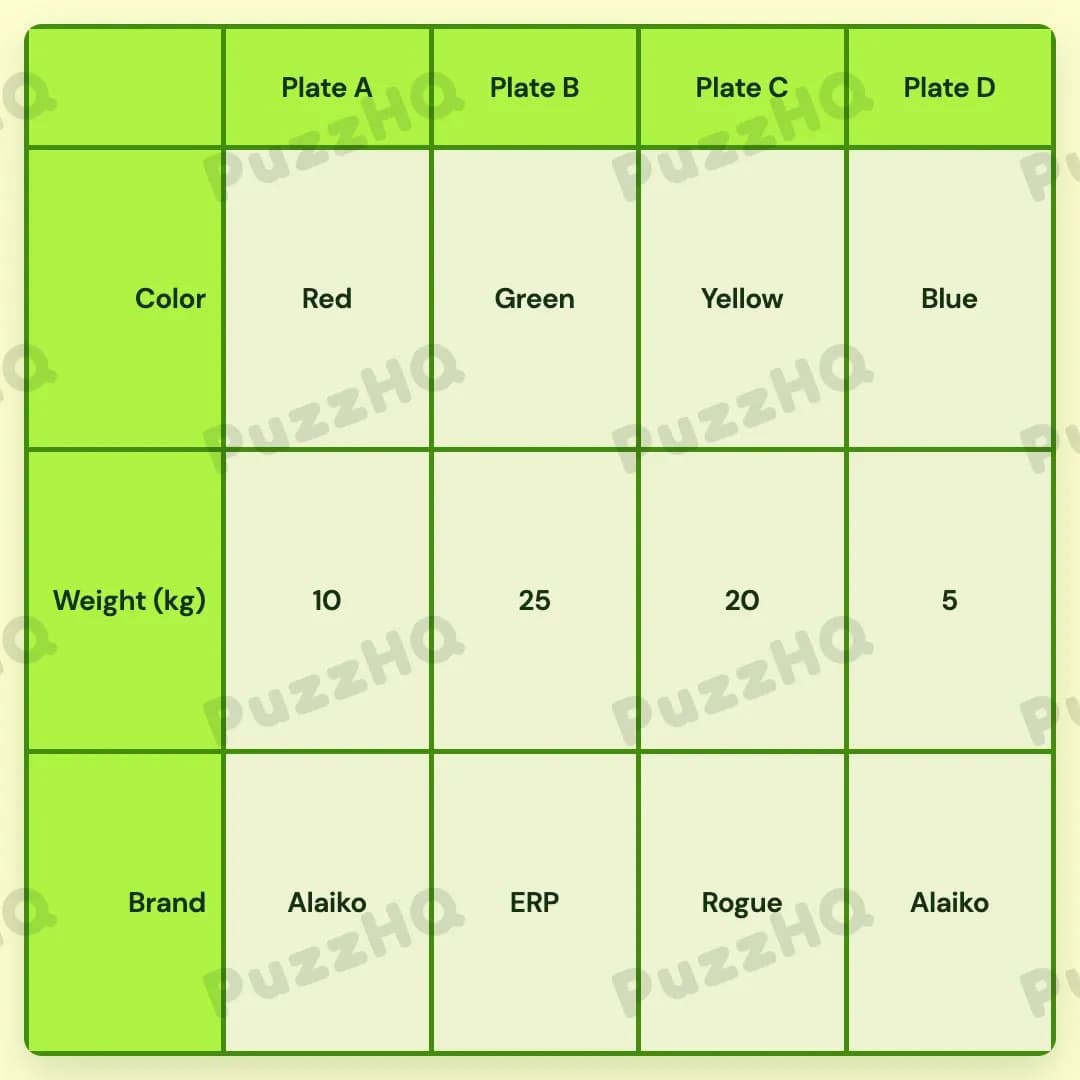
Plate A is Red, weighs 10 kg, and belongs to Alaiko, while Plate B is Green, weighs 25 kg, and is made by ERP; Plate C is Yellow, weighs 20 kg, and comes from Rogue, leaving Plate D as Blue, weighing 5 kg, and also manufactured by Alaiko.
| Trait | Plate A | Plate B | Plate C | Plate D |
|---|---|---|---|---|
| Color | Red | Green | Yellow | Blue |
| Weight (kg) | 10 | 25 | 20 | 5 |
| Brand | Alaiko | ERP | Rogue | Alaiko |
Building The Grid By Trait
Starting with Color and Weight provides the most stable foundation because several clues establish exact physical placements across the plates before brand names ever come into play.
Color Anchors The Middle And Defines The Edges
Looking across the row of plates from left to right, we have Plate A, Plate B, Plate C, and Plate D. A direct clue tells us immediately that Plate B is Green. This establishes a fixed anchor right away.
Next, we look at the placement restriction for Yellow. The clues state that the Yellow plate cannot sit on an edge of the grid. Because the edges are Plate A on the far left and Plate D on the far right, Yellow must sit on one of the inner two spots. With Plate B already locked down as Green, the only internal spot remaining is Plate C. Therefore, Plate C must be Yellow.
At this stage, two colors remain to be placed: Red and Blue. We know from our clues that two plates share the same brand, and between those two plates of the same brand, the leftmost one is Red. Furthermore, a later clue ties the Red plate to a relative weight calculation involving Yellow. As we examine the remaining open spots for Color, Plate A and Plate D, we can see how Color immediately connects to the Weight row.
Weight Values Lock In Through Half Grids And Proportions
The Weight row contains four distinct values: 5 kg, 10 kg, 20 kg, and 25 kg. We are given specific clues about how these weights are distributed across the plates.
First, consider the clue stating that the rightmost plate weighs 11 pounds. In standard conversions, 11 pounds corresponds directly to 5 kg. Because Plate D is the rightmost plate, Plate D must weigh 5 kg. With Plate D taking the value of 5 kg, we have established the lightest plate in the set.
Second, consider the clue stating that the heaviest plate and the second lightest plate both sit on the left half of the grid. The left half consists solely of Plate A and Plate B. The four weights available in the puzzle are 5, 10, 20, and 25 kg. Ranking them from lightest to heaviest gives 5 kg as the lightest, 10 kg as the second lightest, 20 kg as the second heaviest, and 25 kg as the heaviest.
Since the heaviest (25 kg) and the second lightest (10 kg) must occupy Plate A and Plate B, the remaining two plates on the right half (Plate C and Plate D) must contain the other two weights: 5 kg and 20 kg. We already discovered that Plate D holds 5 kg. That means Plate C must be assigned 20 kg.
Now we can resolve the color and weight link. A clue states that the Red plate weighs half as much as the Yellow plate. Since Plate C is Yellow and weighs 20 kg, the Red plate must weigh exactly 10 kg. Looking back at the left half of the grid, the two available weights are 10 kg and 25 kg. Therefore, the plate weighing 10 kg is the Red plate, which leaves 25 kg for the other slot.
Because Plate B is already known to be Green, Plate B cannot be the Red plate. Plate A must therefore be Red and weigh 10 kg. Consequently, Plate B must take the heaviest weight of 25 kg.
With Plate A being Red, Plate B Green, and Plate C Yellow, the only remaining color for Plate D is Blue. The entire Color row and Weight row are now fully resolved across all four plates.
Brand Assignments Follow Name Length And Total Weight
With the colors and weights firmly positioned, the Brand row can be solved using clues that depend on name characteristics and weight comparisons.
One clue states that the Green Plate B has the shortest brand name. Looking at the three brands featured in the puzzle (Alaiko, ERP, and Rogue), ERP contains three letters, Rogue contains five letters, and Alaiko contains six letters. Because ERP is unquestionably the shortest name, Plate B belongs to ERP.
Next, we look at the clue regarding the duplicate brand. It notes that among the plates sharing the same brand, the leftmost one is Red. Plate A is Red, so Plate A must be one of the two plates sharing a brand. Because Plate B is ERP and Plate C is already known to be distinct, the duplicate brand must span Plate A and Plate D.
We must decide whether Alaiko or Rogue is the repeated brand. The final clue provides the test: Rogue's total weight must be greater than Alaiko's total weight.
Let us test both possibilities:
If Rogue were the duplicate brand on Plate A and Plate D, Rogue's total weight would be the weight of Plate A (10 kg) plus Plate D (5 kg), equaling 15 kg. That would leave Alaiko on Plate C with a weight of 20 kg. But under that arrangement, Rogue (15 kg) would be lighter than Alaiko (20 kg), which directly contradicts the clue.
If Alaiko is the duplicate brand on Plate A and Plate D, Alaiko's total weight is 10 kg plus 5 kg, which equals 15 kg. Plate C then receives Rogue, giving Rogue a total weight of 20 kg. Here, Rogue's weight of 20 kg is strictly greater than Alaiko's weight of 15 kg. This satisfies the clue completely.
Thus, Plate A is Alaiko, Plate C is Rogue, and Plate D is Alaiko.
Where The Trait Rows Intersect
The Ratio That Binds Color To Weight
The connection between the Red plate and the Yellow plate is the central pivot of the puzzle. The clue states that the Red plate weighs half as much as the Yellow plate. Without placing Yellow on Plate C first through negative edge clues, this mathematical ratio would float freely. Once Plate C takes the Yellow trait and is forced into the 20 kg slot by the left half distribution rule, the color Red is permanently locked to 10 kg. This instantly sorts the left side of the board between Plate A and Plate B.
Brand Names Constrained By Weight Totals
The decision between which brand appears twice depends entirely on summing the solved weights. Knowing that the duplicate brand occupies Plate A and Plate D means the shared brand possesses a combined weight of 15 kg. Because Rogue must outweigh Alaiko, Rogue cannot be the split brand. Plate C's standalone 20 kg provides the exact margin needed to make Rogue heavier than Alaiko. This interaction shows how the numerical Weight row directly dictates the categorical Brand row.
Final Grid Check
Every row in the completed grid harmonizes with the clues provided. Plate B is Green and carries the shortest brand name, ERP. The duplicate brand, Alaiko, appears on Plate A and Plate D, with the leftmost plate being Red. Plate D on the far right weighs 11 pounds (5 kg), leaving the heaviest plate (Plate B at 25 kg) and the second lightest plate (Plate A at 10 kg) on the left half. Yellow sits comfortably in the middle on Plate C weighing 20 kg, which is exactly double Red's 10 kg. Finally, Rogue's 20 kg successfully surpasses Alaiko's 15 kg total, confirming that all traits align without any contradictions.
Comments