
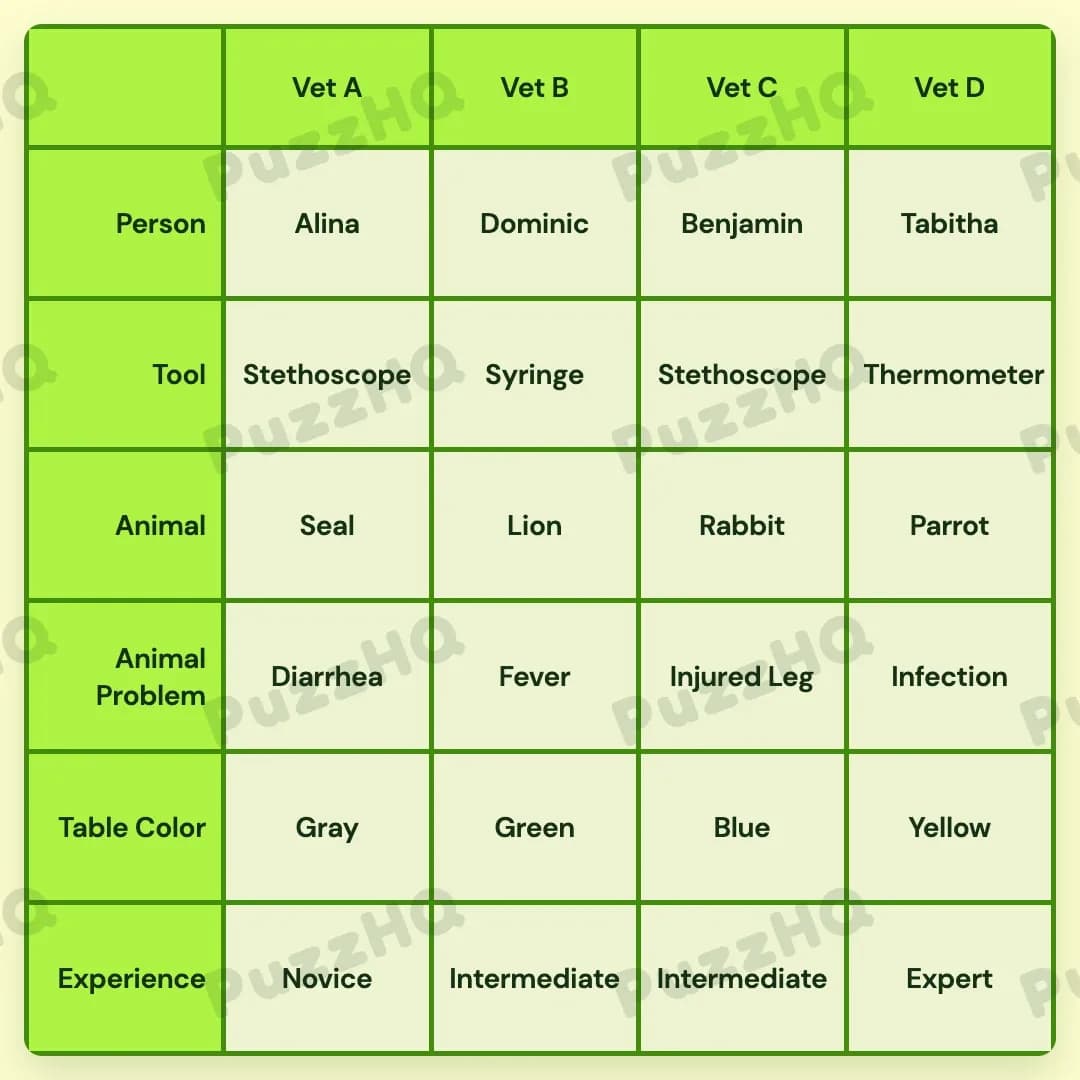
Profile Perfect Level 476 Answer
The four veterinary stations are staffed from left to right by Alina, Dominic, Benjamin, and Tabitha.
| Trait | Vet A | Vet B | Vet C | Vet D |
|---|---|---|---|---|
| Person | Alina | Dominic | Benjamin | Tabitha |
| Tool | Stethoscope | Syringe | Stethoscope | Thermometer |
| Animal | Seal | Lion | Rabbit | Parrot |
| Animal Problem | Diarrhea | Fever | Injured Leg | Infection |
| Table Color | Gray | Green | Blue | Yellow |
| Experience | Novice | Intermediate | Intermediate | Expert |
How To Think Through Profile Perfect Level 476
The key habit for solving this puzzle is recognizing structural constraints before trying to assign specific traits. While some clues describe tools or medical conditions, the most powerful clues define exact board positions based on neighbor counts and fixed spacing. By anchoring the physical setup first, you create reliable landing spots for every subsequent clue.
Use Structural Limits: Neighbor Counts Narrow Down The Middle
Direct location clues give immediate reference points. In this puzzle, you have four veterinary stations arranged in a line from left to right: Vet A, Vet B, Vet C, and Vet D.
One clue notes that the leftmost vet is handling a digestive problem. This establishes immediately that Vet A is dealing with Diarrhea, because Vet A is the only leftmost station.
Another clue states that both Dominic and Benjamin have two neighbors. In a four-column lineup, only the two interior positions have two neighbors. The edge stations, Vet A and Vet D, have only one neighbor each. Therefore, Dominic and Benjamin must occupy Vet B and Vet C in some order.
This deduction instantly locks the outer positions. Vet A and Vet D cannot belong to Dominic or Benjamin. When combined with the clue stating that Tabitha is to the right of Benjamin, you can pin down their exact names. Tabitha cannot be on the far left, and Benjamin must have room to his right for her. If Benjamin were placed at Vet B and Dominic at Vet C, Tabitha would have to be Vet D. However, Benjamin sitting at Vet C places Tabitha squarely at Vet D, leaving Vet B for Dominic. Because Dominic, Benjamin, and Tabitha now fill Vet B, Vet C, and Vet D, the only remaining name for Vet A is Alina.
Combine Multiple Trait Clues: Match The Newbie To The Aquatic Animal
Once the people are locked into their positions, look for clues that connect multiple categories without giving a column letter.
One clue mentions that it is a vet's first time handling an aquatic animal. A first-time worker corresponds to the Novice experience level, and the only aquatic animal in the pool of choices is the Seal. This bundles three details together: Novice, first-time status, and the Seal.
Now look at the clue stating that a vet sits between the newbie and the animal with an injured leg. Because Vet B sits between Vet A and Vet C, and Vet C sits between Vet B and Vet D, the term "between" requires a three-station sequence. If the newbie were at Vet B, the injured leg would have to be at Vet D with Vet C in the middle, or at Vet A. But we know the newbie is the Novice with the Seal.
Look at the clue stating that Novice and Expert vets are not neighbors. If the Novice were at Vet B, the Expert could only sit at Vet D, leaving no valid way to satisfy the relative experience and position constraints. Placing the Novice at Vet A cleanly satisfies the spacing clue: Vet B is between the newbie at Vet A and the animal with the Injured Leg at Vet C. This gives Alina at Vet A the Novice status and the Seal, while establishing that Vet C is treating an Injured Leg.
Use Column Spacing: Separate The Tables By Fixed Distances
Spacing clues allow you to lock down rows that still have multiple open slots.
Consider the clue stating that the Blue table is two columns away from the Gray one. In a four-column layout, two columns away means there is exactly one station in between. The only pairs that fit this gap are Vet A with Vet C, or Vet B with Vet D.
Now bring in the clue connecting the Lion, the Green table, and a vaccination. A vaccination requires a syringe, so the Lion, Green table, and Syringe belong to the same station. Because this bundle requires a table color, it cannot go to whichever stations claim Blue and Gray.
Since Vet A already has Diarrhea and Alina, and Vet C has the Injured Leg, look at the table colors. If Vet B has the Green table with the Lion and Syringe, the Blue and Gray pair must occupy Vet A and Vet C. Because Vet A is on the far left and cannot take Green, Vet A takes the Gray table, making Vet C the Blue table. This leaves the Yellow table for the final open position at Vet D.
Apply Adjacency Rules: Spot The Rabbit And The Thermometer
With several stations partially filled, narrow down the remaining animals and tools using directional neighbor clues.
One clue specifies that the animal to the right of the Rabbit is being checked with a Thermometer. Since the animal to the right must exist, the Rabbit cannot be at Vet D. The Seal is already at Vet A, and the Lion is on the Green table at Vet B. That leaves only Vet C for the Rabbit.
Because the Rabbit is at Vet C, the animal immediately to the right is at Vet D. That animal must be checked with a Thermometer. The only animal left for Vet D is the Parrot.
Now check the clue stating that the vet is sure the Parrot does not have Fever. Vet D has the Parrot, so Vet D cannot have Fever. Vet A has Diarrhea and Vet C has the Injured Leg. Therefore, Fever must belong to Vet B. This leaves Infection as the only remaining animal problem, which belongs to Vet D.
Resolve The Final Traits: Finish By Process Of Elimination
At this stage, only a few traits remain unassigned: two experience levels and two tools.
The clues already established that Alina at Vet A is the Novice. We also know that Novice and Expert vets are not neighbors. Because Vet B is directly adjacent to Vet A, Vet B cannot be the Expert. The Expert must therefore be Tabitha at Vet D.
This leaves the Intermediate experience level for both interior stations, Vet B and Vet C.
For the tools, Vet B has the Syringe from the vaccination clue, and Vet D has the Thermometer from the neighbor clue. The remaining two stations, Vet A and Vet C, both receive the final remaining tool, the Stethoscope. The entire board is now complete and internally consistent.
What This Level Teaches You
Interior Positions Have Unique Neighbor Math
When a clue mentions that two individuals each have two neighbors in a four-item lineup, you do not need to guess their positions. Only the two center columns can ever have two neighbors. Recognizing this mathematical reality lets you eliminate the outer edges immediately and focus solely on ordering the two interior slots.
Spacing Clues Dictate Board Geometry
A clue that describes one item sitting between two others always defines an odd-numbered span of three consecutive slots. By identifying which stations can physically support a middle position, you can link separate traits like the Novice experience level and the Injured Leg condition without needing explicit column names.
Final Thoughts
Success on this level depends on spotting structural rules before matching medical items. By translating neighbor counts and column gaps into fixed grid coordinates, you turn a complex web of clues into a calm, orderly progression.
Comments