
Profile Perfect Level 482 Answer
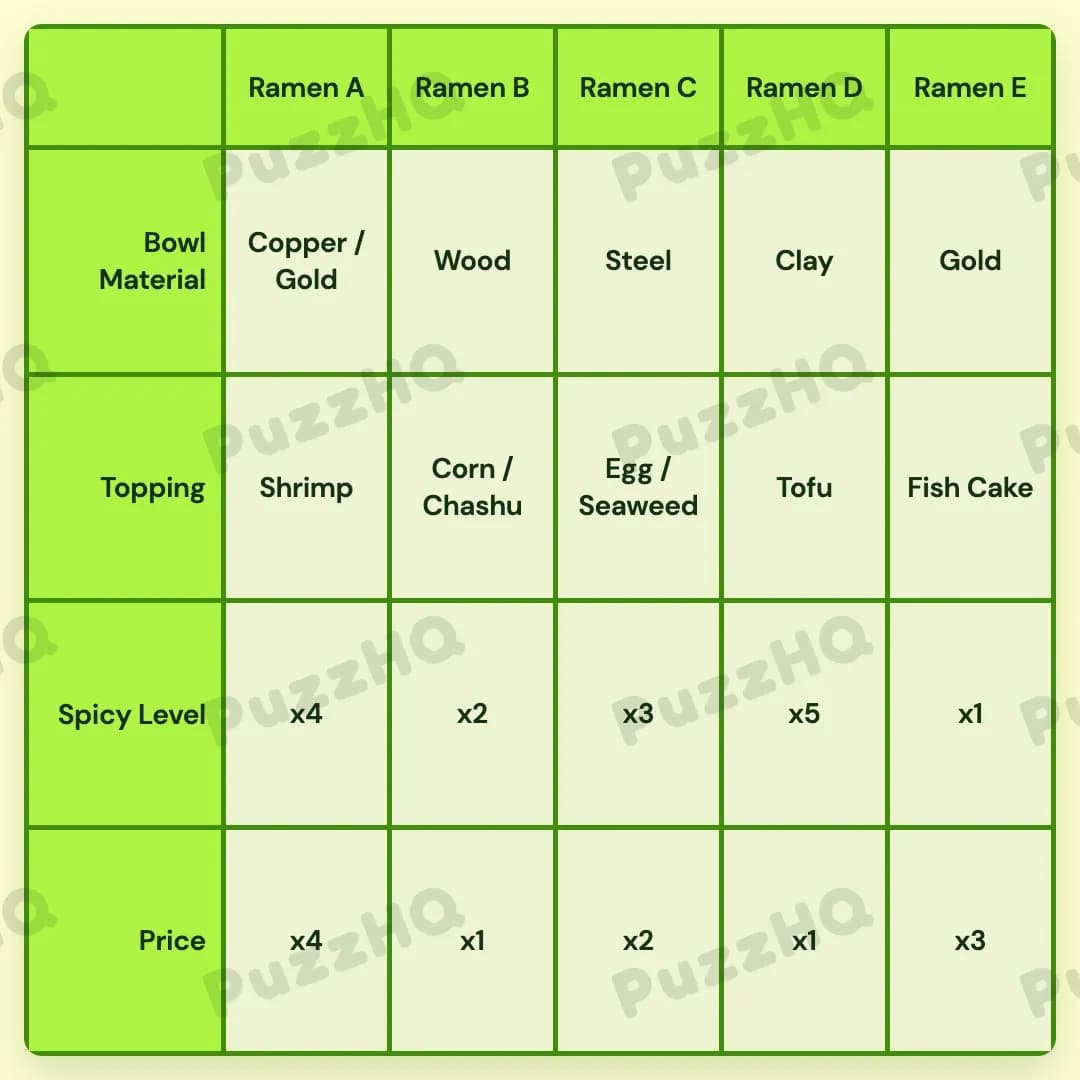
By anchoring the extreme price in Ramen A and resolving the neighborhood relationships around the wooden bowl, every trait falls into place across the row.
| Trait | Ramen A | Ramen B | Ramen C | Ramen D | Ramen E |
|---|---|---|---|---|---|
| Bowl Material | Copper / Gold | Wood | Steel | Clay | Gold |
| Topping | Shrimp | Corn / Chashu | Egg / Seaweed | Tofu | Fish Cake |
| Spicy Level | x4 | x2 | x3 | x5 | x1 |
| Price | x4 | x1 | x2 | x1 | x3 |
How To Think Through Profile Perfect Level 482
The most productive habit on this puzzle is to use positional clues and direct rankings before touching loose descriptive traits. When a puzzle gives you relationships that rely on arithmetic, neighbor counts, or scale rankings, those clues act as solid anchors. Starting with vague ingredient descriptions often leaves you guessing. Starting with strict ranks locks down entire columns at once.
Anchor Extreme Values First: Price In Ramen A
Direct extremes give you an immediate foothold without needing any prior board state. Look for clues that define the top or bottom of a numerical scale.
Here, one clue states that Ramen A is the hardest to afford. Looking at the price scale across the puzzle, the highest cost tier is x4. Because Ramen A holds the absolute maximum, you can write price x4 directly into Ramen A's column.
This single entry does more than solve one cell. It removes the highest price tier from the pool of possibilities for every other bowl. When you secure an extreme value immediately, any future clues comparing prices become much easier to evaluate.
Solve Relative Ranks: The Wooden Bowl And Spiciness
Once you place an extreme, look for clues that fix an item based on its relative rank along an ordered list.
The clue notes that only one ramen is less spicy than the one in the wooden bowl. In a spice scale ranging from x1 to x5, having exactly one value below means that the wooden bowl must sit at level x2. This guarantees that level x1 belongs to the sole bowl milder than it.
Next, combine this rank with the clue stating that the wooden bowl has three neighboring toppings. A single bowl position can border multiple toppings if its neighbors hold split toppings. Ramen B sits directly between Ramen A, which holds one topping, and Ramen C, which holds two toppings. Together, those immediate neighbors contain three toppings in total.
This places the wooden bowl firmly at Ramen B. You can now assign Ramen B both the wood material and spicy level x2.
Use Arithmetic Neighbors: Ramen C Sets The Budget
Equations between neighbors are powerful because they link three different columns simultaneously.
The puzzle tells you that one bowl of Ramen C gets you both of its neighbors. This means the price of Ramen C equals the combined prices of Ramen B and Ramen D. Another clue states that the neighbors of the ramen with mid-level spiciness have the same price.
On a five-step spice ladder, mid-level spiciness is level x3. Ramen C takes this central spice level of x3. Because Ramen C sits at mid-level spiciness, its neighbors Ramen B and Ramen D must share an identical price.
Now combine that with the purchasing equation. If Ramen B and Ramen D cost the same amount, and together they add up to the cost of Ramen C, then Ramen B and Ramen D must each cost x1, while Ramen C costs x2.
With prices x4, x1, x2, and x1 assigned to Ramen A, Ramen B, Ramen C, and Ramen D, only price x3 remains. That final price belongs to Ramen E. In just a few connected deductions, the entire price row is complete.
Connect Bowl Materials Through Pricing Tiers
When a clue bundles traits based on an already solved category, apply it right away to eliminate broad possibilities.
The clue states that the two priciest ramens are pricey because their bowls use precious metal. The two highest prices on the board are x4 at Ramen A and x3 at Ramen E. Therefore, Ramen A and Ramen E must hold the precious metal bowls: Copper / Gold and Gold. Ramen A takes Copper / Gold, and Ramen E takes Gold.
Only two bowl materials remain unassigned: Clay and Steel. Another clue notes that the topping in the clay bowl crumbles when lifted. Tofu is known for crumbling easily when handled, which pairs the clay bowl directly with tofu. Clue details also state that the steel bowl is not the farthest from the tofu topping. Placing the clay bowl and tofu in Ramen D keeps the steel bowl close by in Ramen C.
This completes the bowl material row:
- Ramen A has Copper / Gold
- Ramen B has Wood
- Ramen C has Steel
- Ramen D has Clay
- Ramen E has Gold
Distribute The Remaining Toppings And Heat Levels
With the grid mostly filled, use neighborhood conditions and simple elimination to resolve the final cells.
For spicy levels, levels x2, x3, and x4 are already locked into Ramen B, Ramen C, and Ramen A. The remaining levels are x1 and x5. Because we previously deduced that exactly one bowl is less spicy than Ramen B's level x2, that mildest rank of x1 must go to Ramen E. This leaves the hottest level of x5 for Ramen D.
Now turn to the remaining toppings: Shrimp, Corn / Chashu, Egg / Seaweed, and Fish Cake. Tofu is already fixed at Ramen D.
One clue mentions that both neighbors of a particular ramen have seafood toppings. Ramen D's neighbors are Ramen C and Ramen E. Assigning Egg / Seaweed to Ramen C and Fish Cake to Ramen E means both of Ramen D's neighbors feature seafood toppings.
This leaves Shrimp and Corn / Chashu. Placing Shrimp in Ramen A leaves Corn / Chashu for Ramen B, which also fulfills the vegetable neighbor condition with the tofu at Ramen D nearby. Every trait is now accounted for without a single guess.
What This Level Teaches You
Mathematical Neighbor Clues Solve Multiple Slots At Once
When a clue relates a center item to the sum of its neighbors, do not wait for separate clues to fill each spot. Pair the equation with symmetry clues, such as neighbors having equal values. This allows you to resolve three columns in one step.
Numerical Scales Yield Free Anchors
Phrases like the hardest to afford or only one item is lower give you exact values on a ranked ladder. Translate comparative language into hard numbers as early as possible so you can eliminate those tiers from the rest of the board.
Final Thoughts
The key habit on this level is building an early skeleton out of numerical ranks and neighborhood math. Once Ramen A's top price and Ramen B's wooden bowl were anchored, the remaining materials and ingredients could be placed by simple process of elimination.
Comments