
Profile Perfect Level 48 Answer
Spoiler warning: the complete breakdown for every instrument, material, player, and price tier is laid out below.
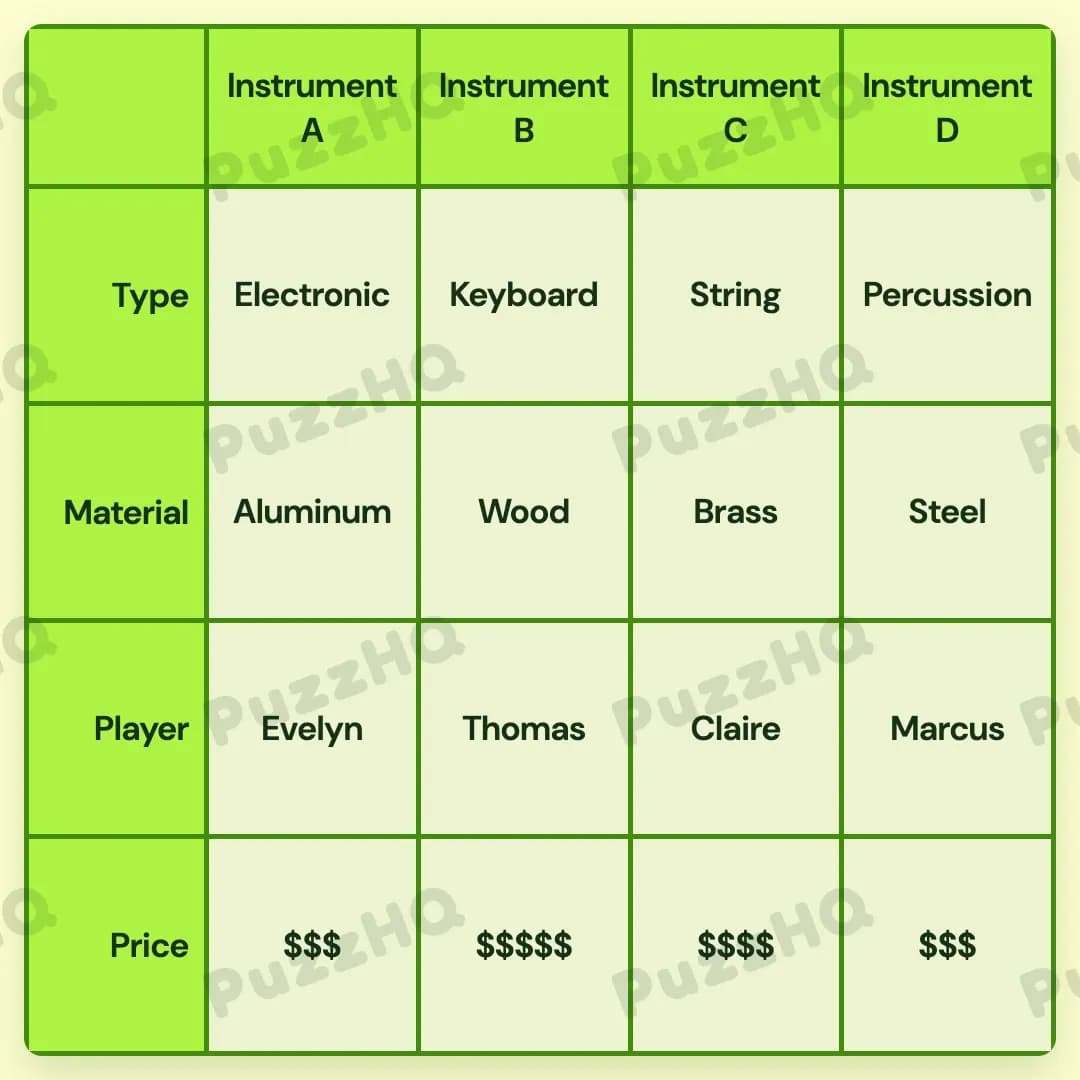
| Trait | Instrument A | Instrument B | Instrument C | Instrument D |
|---|---|---|---|---|
| Type | Electronic | Keyboard | String | Percussion |
| Material | Aluminum | Wood | Brass | Steel |
| Player | Evelyn | Thomas | Claire | Marcus |
| Price | $$$ | $$$$$ | $$$$ | $$$ |
The Logic Behind Profile Perfect Level 48
Solving this puzzle turns on how comfortably you manage instrument identities that span across categories. Several clues reference specific instruments like the piano, theremin, and harp, which do not exist as their own standalone trait row in the ledger. Instead, each specific instrument ties together a broader instrument type, a material, and an owner. Once you realize how these multi-trait packages fit against the physical layout of the four columns, the puzzle opens up quickly and the pricing tiers fall into line.
Multi-Trait Bundles Anchor the Roster
The most direct way into the board is to assemble the known bundles before worrying about absolute column positions. Claire plays a harp made out of brass, which immediately pairs her name with brass construction and the string family. We also learn that Evelyn plays the theremin, placing her in the electronic category. Marcus is tied directly to the steel instrument, while the piano is built from wood, naturally representing the keyboard family.
Because Claire, Evelyn, and Marcus each claim a distinct material and instrument, the fourth player, Thomas, has to take the remaining slot. The wood piano belongs to Thomas. Similarly, the aluminum material has no assigned player yet, which leaves it for Evelyn.
Now the materials are distributed cleanly across the quartet. Claire has brass, Evelyn has aluminum, Marcus has steel, and Thomas has wood. The instrument types match up just as cleanly: Claire plays string, Evelyn plays electronic, Thomas plays keyboard, and Marcus takes percussion.
Positional Constraints Place the Quartet
With the bundles formed, the puzzle shifts to column placement across Instrument A through Instrument D. The spatial clue tells us that the electronic instrument is not beside the string instrument.
Claire is our string player with brass, and Evelyn is our electronic player with aluminum. To keep electronic and string separated, they cannot occupy adjacent columns. Instrument A and Instrument C provide the necessary separation across the line. Placing Evelyn and her electronic aluminum setup at Instrument A, and Claire with her brass string harp at Instrument C, satisfies the requirement.
Marcus and his steel percussion kit settle comfortably into Instrument D, while Thomas and his wooden keyboard take Instrument B. This arrangement puts every player, material, and type into a firm, non-conflicting position across the board.
Pricing Structure Resolves the Remaining Tiers
All that remains is the price assigned to each instrument. The pricing structure relies on a few direct comparisons and an equality rule.
We know that the electronic instrument and the percussion instrument share the exact same price. Looking at our players, that means Evelyn and Marcus have identical price tags.
Next, the harp is strictly more expensive than the theremin. This means Claire at Instrument C must rank higher in cost than Evelyn at Instrument A. Since Evelyn shares her price tier with Marcus at Instrument D, both Evelyn and Marcus must sit at a lower tier than Claire.
Finally, we are told that the single most expensive instrument on the board does not belong to Claire. Since Claire is already higher than Evelyn and Marcus, the top tier has to belong to Thomas at Instrument B.
With four distinct price values across the board ($$$, $$$$, and $$$$$), Thomas takes the sole top spot at $$$$$. Claire sits just beneath him at $$$$. Evelyn and Marcus take the shared lower tier at $$$, neatly fulfilling the clue that links electronic and percussion together.
The Clue I Would Read Twice
The clue stating that instruments with the same price are electronic and percussion is the pivot that makes the entire pricing deduction work. On a quick first pass, it looks like a simple equivalence statement between two columns. However, when you read it alongside the fact that the harp costs more than the theremin and Claire does not own the most expensive piece, the clue turns into a ceiling constraint.
Because two of the four positions are locked together at the exact same value, there are only two independent tiers left for the other two instruments. Knowing that the harp is above the theremin instantly pushes the harp above the tied pair, and knowing the harp is not the absolute highest forces Thomas into the undisputed top position. It is a compact piece of logic that does a lot of heavy lifting in very few words.
Final Thoughts
What makes Level 48 memorable is the way specific musical instruments serve as an invisible translation layer. You are not just matching abstract properties to letters. You are recognizing that a theremin is an electronic device, a piano is a wooden keyboard, and a harp is a brass-strung instrument. Connecting those everyday identities to the formal traits makes the deduction feel intuitive from start to finish.
Comments