
Profile Perfect Level 512 Answer
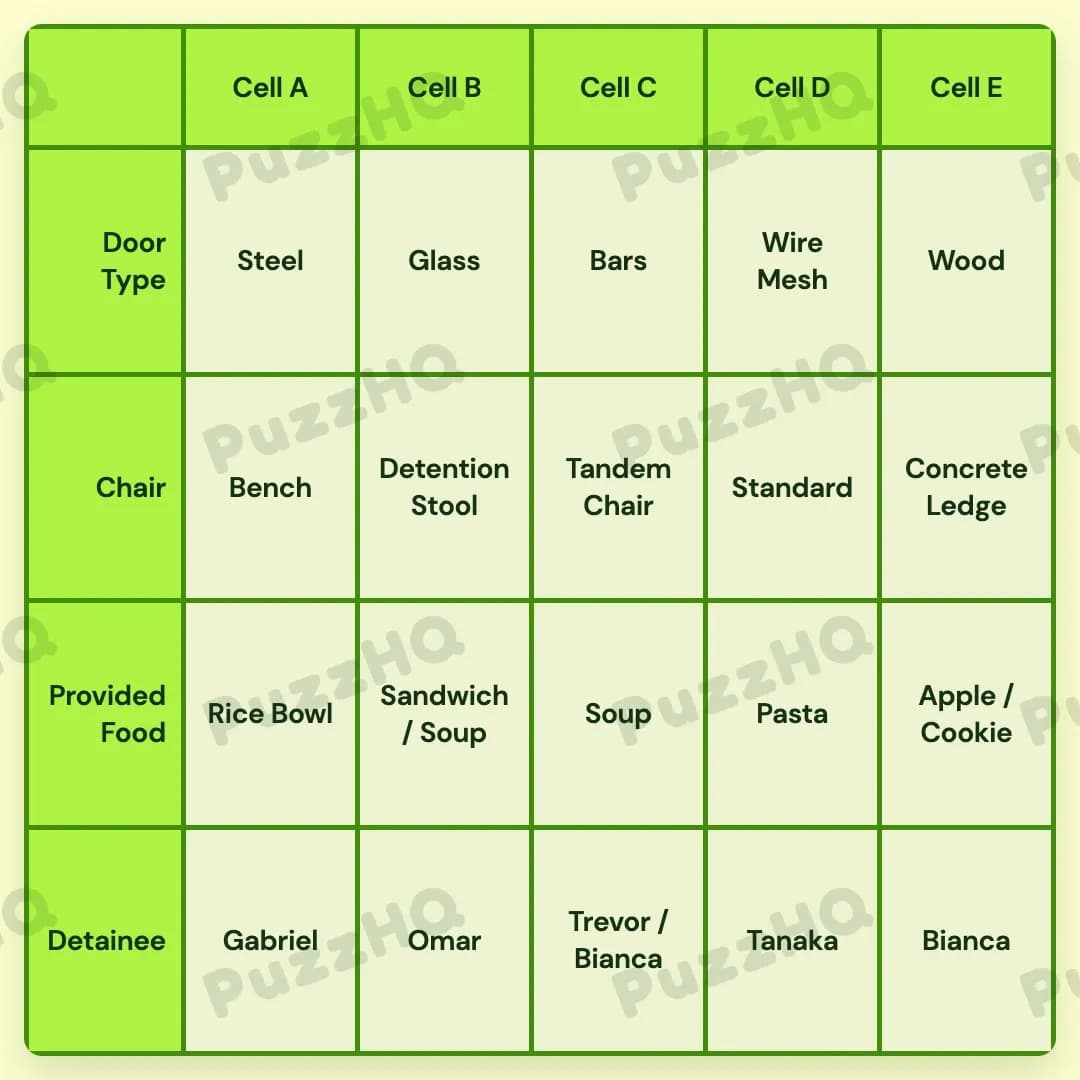
Every detainee, door type, chair, and food item locks into a single orderly row across Cells A through E once you identify the fixed doors and trace neighbor distances.
| Trait | Cell A | Cell B | Cell C | Cell D | Cell E |
|---|---|---|---|---|---|
| Door Type | Steel | Glass | Bars | Wire Mesh | Wood |
| Chair | Bench | Detention Stool | Tandem Chair | Standard | Concrete Ledge |
| Provided Food | Rice Bowl | Sandwich / Soup | Soup | Pasta | Apple / Cookie |
| Detainee | Gabriel | Omar | Trevor / Bianca | Tanaka | Bianca |
How To Think Through Profile Perfect Level 512
The most productive habit on this level is anchoring fixed positions before attempting relative spacing. While several clues describe distances or neighbor relationships, those clues cannot guide your placements until you fix reliable reference points along the row of cells.
Start With Direct Placements: Lock Down The First Anchor
Direct clues give you concrete facts that do not depend on any other cell. Finding one immediately turns an open grid into a structured board.
The clue stating that Cell B's door was laminated to make it shatterproof tells you that Cell B has the Glass door. Because shatterproof laminate is typical for safety glass, this assigns the Glass door directly to Cell B.
This single placement is crucial. Cell B is near the left edge of the five cell block, bordered only by Cell A on the left and Cell C on the right. Once Cell B is established as the Glass door, any clue that references the neighbors of the Glass door now has known coordinates.
Neighbor Reasoning: Resolving Cells Around The Anchor
A neighbor clue is powerful only when the central subject is already pinned down. Clue four states that the food in the cells next to the Glass door are Rice Bowl and Soup.
Because the Glass door sits in Cell B, its only possible neighbors are Cell A and Cell C. That means Rice Bowl and Soup belong exclusively to Cells A and C. Notice how this narrows down possibilities without guessing:
- Rice Bowl is in either Cell A or Cell C.
- Soup is in the other of the two cells.
- Neither Rice Bowl nor Soup can appear as the primary meal for Cell D or Cell E.
At the same time, clue seven notes that to the left of the room with Bars, the detainee is given classic picnic food. A sandwich is classic picnic food. If the room to the left receives a sandwich, then the room with Bars cannot be Cell A. If Cell C has Bars, the room to its left is Cell B, which receives Sandwich / Soup. This aligns Cell C with the Bars door and Cell B with Sandwich food.
Now check the food neighbor condition again. Since Cell C is next to Cell B, and Cell C receives Soup, Cell A must receive the Rice Bowl. Clue six confirms that Rice Bowl is not served in the cell with different kinds of food, which fits Cell A perfectly because Cell A receives only a single clean serving of Rice Bowl.
Positional Spacing: Using Distances To Place Detainees
Once physical traits start filling the grid, you can use exact spacing clues to lock in detainees.
Clue twelve mentions that Trevor prefers the Bench two columns away from him instead. This clue carries two requirements:
- The Bench must be located two columns away from Trevor.
- Trevor and the Bench must both fit within the five columns of the row.
Look at where a two column gap can exist. If the Bench is in Cell A, two columns to the right is Cell C. If the Bench were in Cell B, two columns away would be Cell D. However, clue ten states that Gabriel is completely locked behind the max security door. The max security door is the Steel door, located in Cell A. Gabriel occupies Cell A.
Since Gabriel is in Cell A behind the Steel door, and Trevor prefers the Bench two columns away, Trevor must sit in Cell C, while the Bench itself is situated in Cell A. That satisfies the distance of two columns between Cell A and Cell C.
Multi Trait Matching: Pairing Tanaka And His Preferences
When a clue pairs a person with a specific trait, search for the cell that can satisfy both identity and environmental restrictions.
Clue two states that Tanaka quite likes the Italian food given to him. Italian food means Pasta. Therefore, Tanaka and Pasta must occupy the same cell. Look at the remaining cells that do not yet have assigned food:
- Cell A has Rice Bowl.
- Cell B has Sandwich / Soup.
- Cell C has Soup.
- Cell D and Cell E remain open.
Clue eight adds that Tanaka has only two distinct detainee neighbors. If Tanaka were in Cell E, he would only have one neighbor column, not two distinct detainee neighbors. This requires Tanaka to sit in an interior cell. Cell D is the only interior cell still open for food and detainee assignments.
Placing Tanaka in Cell D instantly places Pasta into Cell D as well.
With Tanaka in Cell D, the detainees next to him are in Cell C and Cell E. Clue eleven mentions that the woman has been locked up for two different offenses, which explains why Bianca appears in multiple records across Cell C and Cell E. Tanaka's two neighbor columns are Cell C, occupied by Trevor and Bianca, and Cell E, occupied by Bianca.
Resolving The Remaining Traits: Doors And Chairs
With most of the puzzle locked in place, you can use remaining clues to eliminate empty options.
Clue three mentions chairs placed in the room left of the Wooden door. This means the Wooden door must have a cell to its left. That places the Wooden door in Cell E, making Cell D the room to its left. With Steel in Cell A, Glass in Cell B, Bars in Cell C, and Wood in Cell E, the only leftover door type for Cell D is Wire Mesh.
Now look at the chairs:
- The Bench is already in Cell A.
- Clue five states that Bianca has tried all long chairs, except the Bench. Long chairs refer to seating like the Tandem Chair and the Concrete Ledge. This assigns the Tandem Chair to Cell C and the Concrete Ledge to Cell E.
- The remaining chairs to place are the Detention Stool and Standard chair.
- Cell B takes the Detention Stool, leaving the Standard chair for Tanaka in Cell D.
Finally, the remaining food for Cell E is Apple / Cookie, which satisfies clue nine where the cell given a Cookie has the remaining chair assignment. The final detainee in Cell B is Omar, completing the grid without contradiction.
What This Level Teaches You
Anchor Points Make Neighbor Clues Actionable
Neighbor clues sound simple, but they are completely useless when both the target and the neighbor are floating. Identifying Cell B as the Glass door immediately turned the clue about Rice Bowl and Soup into a two cell choice between Cell A and Cell C. Always look for a fixed reference point before trying to evaluate neighbor conditions.
Exact Spacing Clues Narrow Down Positions Rapidly
When a clue specifies a distance like two columns away, count the possible slot pairs on the grid immediately. On a five cell board, a distance of two columns can only link Cell A with Cell C, Cell B with Cell D, or Cell C with Cell E. Combining this restriction with existing occupancy rules eliminates false branches immediately.
Final Thoughts
The key to mastering this level was refusing to guess between relative positions before establishing stable anchors. By identifying the Glass door in Cell B early, you gave every subsequent neighbor clue, distance measurement, and food preference a concrete framework to snap into place.
Comments