
Profile Perfect Level 517 Answer
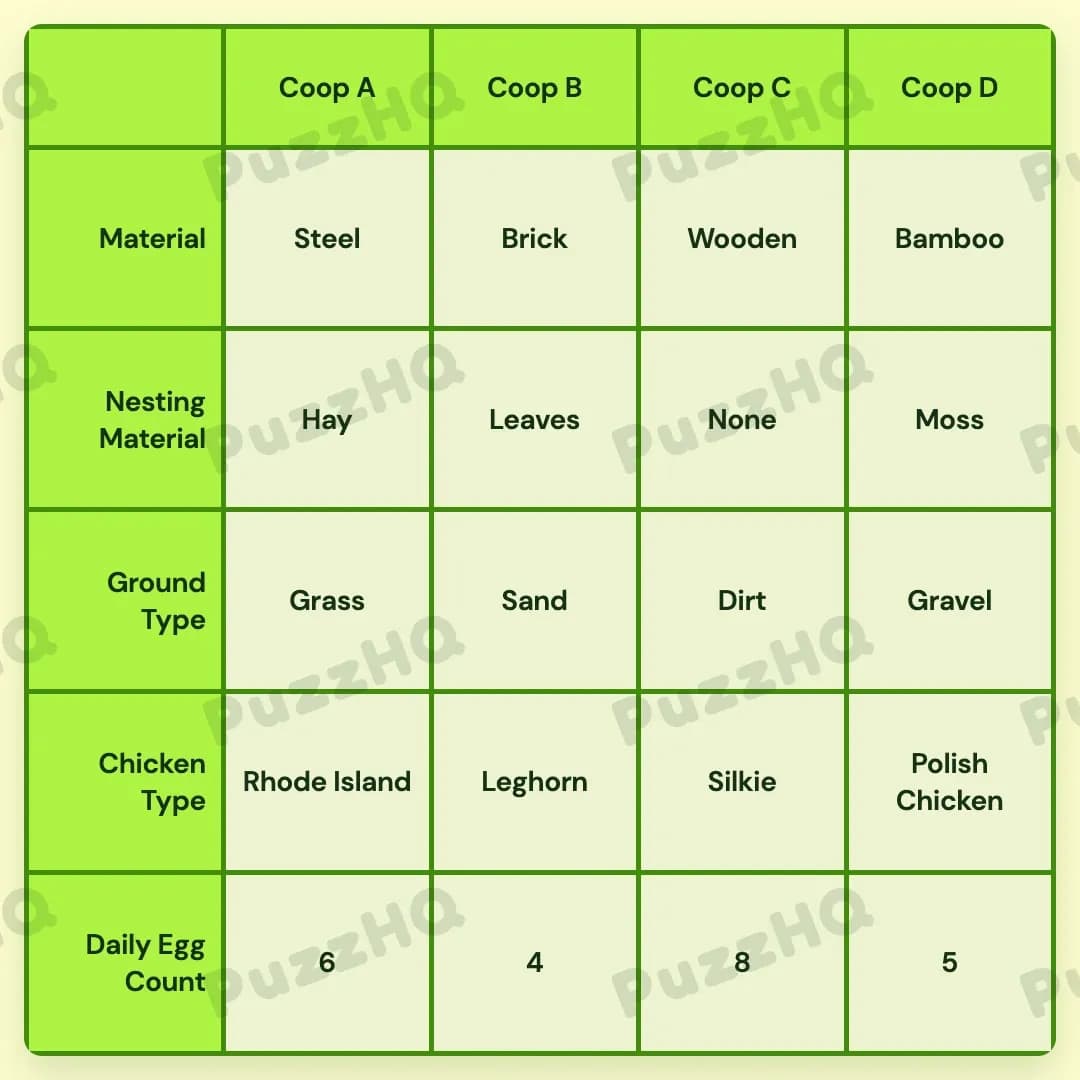
Every coop finds its exact balance once structural materials and nesting habits reveal which chickens occupy each space.
| Trait | Coop A | Coop B | Coop C | Coop D |
|---|---|---|---|---|
| Material | Steel | Brick | Wooden | Bamboo |
| Nesting Material | Hay | Leaves | None | Moss |
| Ground Type | Grass | Sand | Dirt | Gravel |
| Chicken Type | Rhode Island | Leghorn | Silkie | Polish Chicken |
| Daily Egg Count | 6 | 4 | 8 | 5 |
Building The Grid By Trait
Starting with the physical construction materials and the chicken breeds gives the clearest path forward because several direct associations establish the main structural identity of each coop before spatial clues lock down their columns.
Material And Chicken Type Establish The Primary Anchors
The puzzle provides several explicit partnerships between building material and chicken breed. First, the Silkie chicken resides inside the Wooden coop. Second, a chicken characterized by a messy, large crest belongs in the Bamboo coop, identifying that resident as the Polish chicken. We also learn that the coop with odd-numbered daily eggs is constructed from Bamboo, and that six eggs are laid daily inside the Steel coop.
Because steel is known to be the strongest structural building material despite poor insulation, the clue noting that the coop farthest to the left is the strongest places the Steel coop firmly into Coop A. This immediately fixes Coop A's material as Steel and attributes six daily eggs to Coop A.
Since Bamboo and Wooden belong to two distinct coops, and Brick remains the fourth material, the layout of materials begins to solidify. Coop D sits on the opposite end, matching the clue stating that the farthest coop has Moss growing in it. Because the Bamboo coop holds an odd number of daily eggs and five is the single odd value available (leaving four, six, and eight as even counts), Bamboo must be Coop D with its Polish chicken and Moss nesting. This leaves Coop B and Coop C for Brick and Wooden.
The Silkie belongs in the Wooden coop, and Rhode Island chicken must sit exactly two columns away from the Dirt ground. If Rhode Island is in Coop A, Dirt sits in Coop C, which directly accommodates the Wooden coop in Coop C and leaves Brick for Coop B. With Silkie in Coop C and Polish Chicken in Coop D, the Leghorn chicken must occupy Coop B, confirming Rhode Island in Coop A.
Nesting Material And Ground Type Define The Environments
Now that the chicken breeds and building materials are assigned to their respective columns, the surroundings and beddings fall into place around them. We know Moss occupies the far right end in Coop D. Another clue highlights that the Leghorn chicken sits adjacent to Hay. Since the Leghorn chicken is in Coop B, Hay could theoretically belong to Coop A or Coop C. However, the coop without any nest produces the most results, which must be eight eggs, and the Grass ground is not beside this nestless coop.
If Coop C is the nestless coop, it cannot be beside Grass, meaning Grass cannot be in Coop B or Coop D. Grass must therefore belong to Coop A. With Coop A having Grass, Hay naturally fits into Coop A as the bedding next to the Leghorn chicken in Coop B.
This leaves Leaves and None to distribute between Coop B and Coop C. Because the nestless coop is in Coop C, Coop C takes None for its nesting material, leaving Leaves for Coop B.
For the remaining ground surfaces, we know from earlier breed positioning that Dirt sits two columns away from the Rhode Island chicken in Coop A, confirming Dirt under Coop C. The coop at the beach contains the fewest eggs. Beach translates directly to Sand, meaning Sand holds four eggs. Coop B is open for Sand, leaving Gravel to take the final position under Coop D.
Daily Egg Count Completes The Yields
With the subjects anchored across materials, chickens, beddings, and ground types, distributing the production numbers becomes straightforward arithmetic. The values to assign are four, five, six, and eight.
Coop A is already established at six eggs through its Steel construction. Coop D, made of Bamboo, requires the odd-numbered count, securing five eggs for Coop D. The coop at the beach, which is Coop B with Sand, produces the fewest eggs, assigning it four eggs. The nestless coop in Coop C produces the highest total yield, which allocates eight eggs to Coop C. Every row across the four coops now aligns without contradiction.
Where The Trait Rows Intersect
Cross-trait clues provide the necessary leverage to jump between distinct rows without guessing.
Structural Strength Meets Output Requirements
The identification of the strongest coop links structural composition to horizontal positioning. Recognizing Steel as the strongest material immediately locks Coop A into place. That single deduction activates the egg yield rule, immediately giving Coop A a fixed count of six eggs. This pair of traits eliminates Coop A from being either the lowest producer or the highest producer, drastically narrowing where the nestless coop and the beach coop can reside.
Nesting Absence And Ground Adjacency
The rule stating that Grass is not beside the nestless coop connects nesting conditions to ground types across adjoining columns. Because Coop C has no nest to maximize its egg output, Coop B cannot be Grass. Since Coop D already has Gravel and Moss, Grass is forced into Coop A. This placement in turn confirms Hay in Coop A, because the Leghorn chicken in Coop B must be situated next to Hay. A single negative constraint regarding nest bedding thus resolves multiple ground and bedding assignments simultaneously.
Breed Anatomy And Odd Number Parity
The physical description of a chicken with a messy, large crest connects the Polish chicken to the Bamboo coop. Pairing this breed detail with the numerical requirement that the Bamboo coop yields an odd-numbered egg count immediately locks five eggs to the Polish chicken. It prevents any confusion between the even production totals of four, six, and eight, cementing the rightmost column's material, breed, and output in one cohesive move.
Final Grid Check
Every row neatly verifies the adjacent constraints. Coop A pairs Steel and Hay on Grass with a Rhode Island chicken laying six eggs. Coop B puts Brick and Leaves on Sand with a Leghorn chicken producing four eggs. Coop C uses Wooden framing and no nesting on Dirt with a Silkie laying eight eggs. Coop D combines Bamboo and Moss on Gravel with a Polish chicken producing five eggs. All eleven clue conditions are fully respected, proving the deduction solid across every category.
Comments