
Profile Perfect Level 521 Answer
The four farm animals and their feeding setups can be deduced cleanly by establishing the layout of the animals along the row of troughs first.
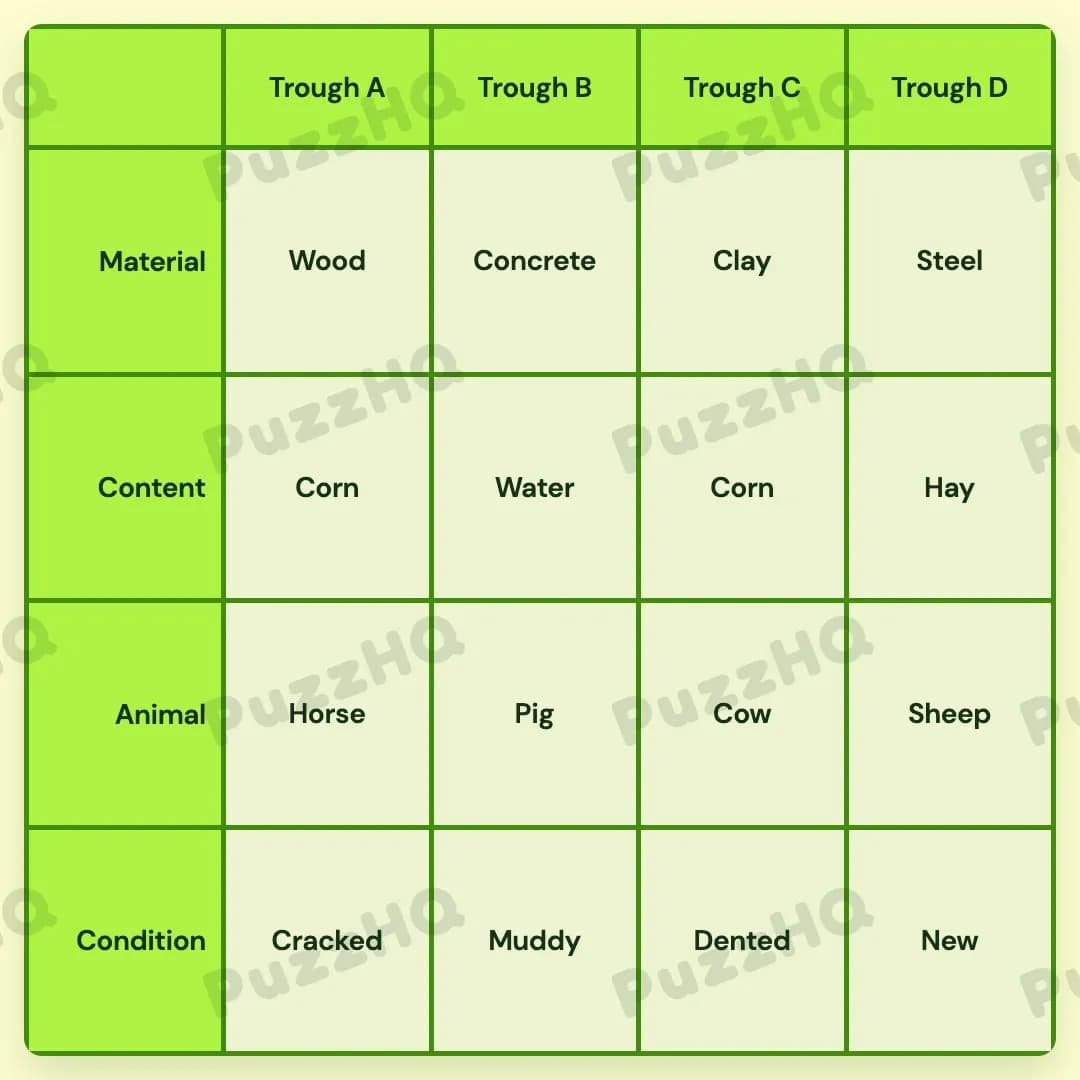
| Trait | Trough A | Trough B | Trough C | Trough D |\n| --- | --- | --- | --- | --- |\n| Material | Wood | Concrete | Clay | Steel |\n| Content | Corn | Water | Corn | Hay |\n| Animal | Horse | Pig | Cow | Sheep |\n| Condition | Cracked | Muddy | Dented | New |
How I Solved Profile Perfect Level 521
The first thing I noticed when reading through the clues was that two separate statements gave specific structural restrictions on where the animals stood. By combining the fact that one animal had only a single neighbor with the fact that another had to sit directly between two matching troughs, the physical order of the animals fell into place much faster than the materials or conditions.
The Horse And Pig Fixed The Left Side Of The Row
I began with the neighbor relationships. One clue mentioned that the Horse's only neighbor is the Pig. In a four-trough setup arranged from Trough A to Trough D, having only one neighbor means an animal must occupy an outer edge, either Trough A on the far left or Trough D on the far right. That forced the Pig directly next to the Horse, occupying either Trough B or Trough C.
Right beside that clue was another detail: the Pig is between the troughs with the same content. That meant the Pig could not be on the outside, and more importantly, whatever sat on either side of the Pig had to share identical feed.
At the same time, another clue stated that both the Clay and Wood troughs are filled with Corn. That gave me two troughs containing Corn, matching the requirement for identical content flanking the Pig. If the Pig were placed at Trough C, the two flanking troughs would be Trough B and Trough D. However, the clue about the left half notes that the Cracked and Muddy troughs are both in the left half, occupying Trough A and Trough B. Another clue pointed out that the troughs with Corn inside are not spotless, while the Hay trough's material makes it shiny.
Looking at the relationship between the Clay and Wood troughs, another clue noted that the animal eating from the Clay trough is not the Horse. When evaluating the two possible positions for the Horse, placing the Horse at Trough A put the Pig at Trough B. That positioned the two Corn troughs at Trough A and Trough C, neatly surrounding the Pig. Since the Horse at Trough A could not be eating from the Clay trough, Trough A had to be the Wood trough, leaving Clay for Trough C. This established the Horse at Trough A with Wood and Corn, and the Pig at Trough B.
Identifying The Cow And Sheep
Once Trough A and Trough B were anchored by the Horse and Pig, I only had two open slots for animals: Trough C and Trough D.
A clue noted that the Cow kicked the trough before, leaving it deformed. Looking at the condition categories, deformed clearly points to the Dented state. Because the left half of the grid was already reserved for the Cracked and Muddy troughs, the Dented trough had to belong to either Trough C or Trough D.
Since Trough C was already confirmed to contain Corn and be made of Clay, it remained eligible for the Dented condition. That assigned the Cow to Trough C, eating Corn from the Dented Clay trough.
By simple elimination among the animals, the Sheep had to go to the final available slot at Trough D.
Sorting The Materials And Conditions
With all four animal positions confirmed, I turned my attention to the remaining traits for Trough B and Trough D.
Trough D now belonged to the Sheep. One clue stated that the Hay trough's material makes it look shiny. Out of the available materials, Steel is the only one that fits a shiny appearance, and Hay was one of the two unused contents. That allowed me to assign Hay and Steel directly to Trough D.
That left only one unused content for the entire grid, which was Water. Because Trough A and Trough C held Corn, and Trough D held Hay, Water had to go into Trough B for the Pig.
Next, looking at the materials, Wood was at Trough A, Clay was at Trough C, and Steel was at Trough D. The only unused material trait was Concrete, which therefore belonged to Trough B.
Finally, I needed to resolve the conditions across the board. The clue stating that Cracked and Muddy troughs are in the left half meant that Trough A and Trough B held those two conditions in some order. Trough C was already identified as Dented from the Cow's kick, and the remaining condition, New, naturally went to Trough D. Because Trough A was the Wood trough containing Corn, and the opening condition clue specified the pair in the left half, assigning Cracked to Trough A and Muddy to Trough B completed the entire arrangement.
The Point Where I Nearly Went Wrong
The most deceptive moment came when trying to place the Pig and Horse purely from the statement that the Horse had only one neighbor. It was tempting to assume the Horse could just as easily go on the far right at Trough D, which would have put the Pig at Trough C.
If you tentatively place the Pig at Trough C, the two troughs with matching content would have to be Trough B and Trough D. But Trough D turns out to be the shiny Steel trough filled with Hay. If Trough D contains Hay, it cannot match Trough B, breaking the rule that the Pig is flanked by troughs with identical content. Remembering to cross-check the duplicate Corn requirement against the Pig's neighbors prevented me from committing to the wrong end of the board.
Looking Back At The Solution
The breakthrough in this puzzle came from linking the Pig's position between matching contents directly to the clue showing that Corn appeared twice. Once that pair of Corn troughs was locked into Trough A and Trough C, the Horse, Cow, and Sheep settled into place with very little resistance.
Comments