
Profile Perfect Level 552 Answer
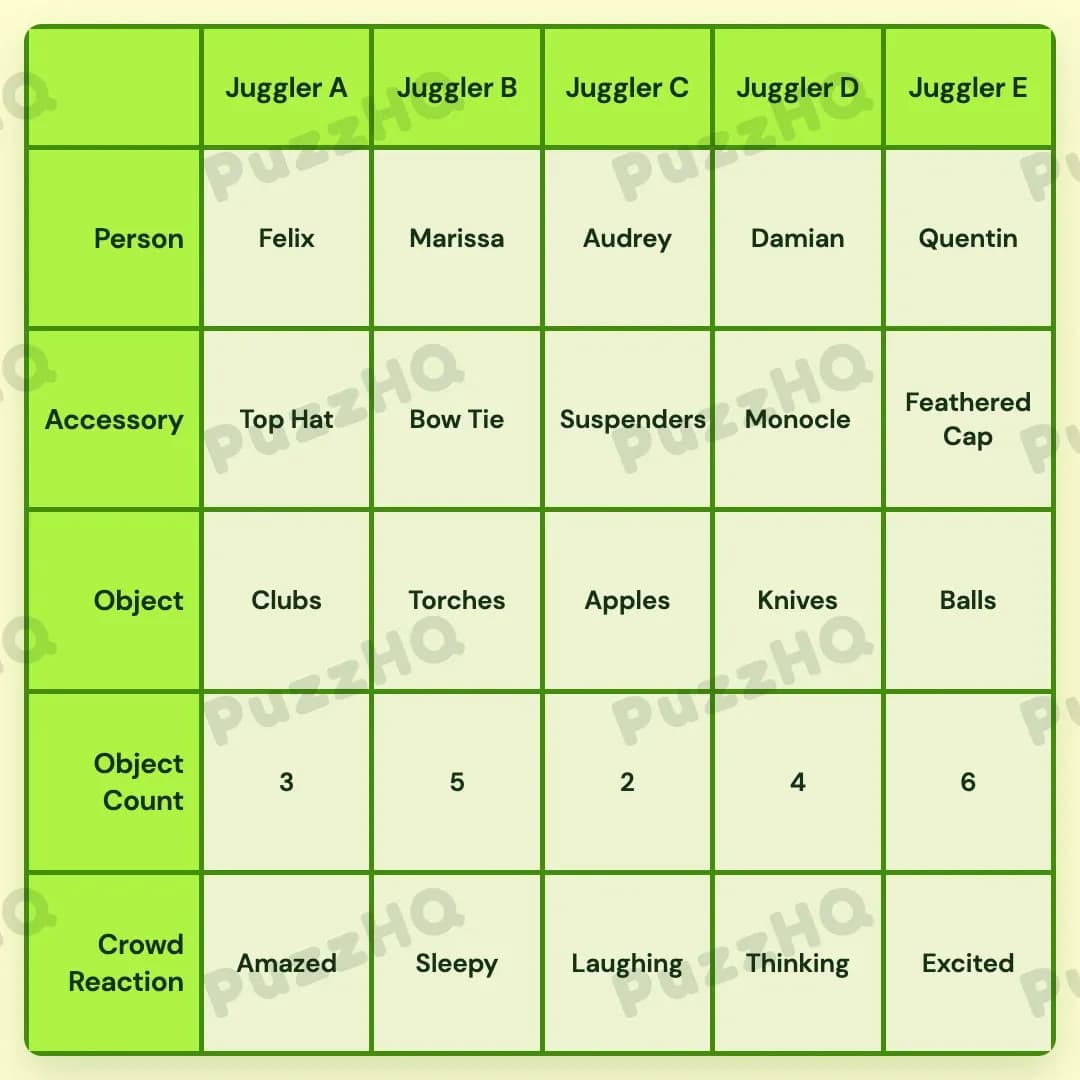
Before stepping into the sawdust ring, take a look at the full stage lineup across all five performers.
| Trait | Juggler A | Juggler B | Juggler C | Juggler D | Juggler E |
|---|---|---|---|---|---|
| Person | Felix | Marissa | Audrey | Damian | Quentin |
| Accessory | Top Hat | Bow Tie | Suspenders | Monocle | Feathered Cap |
| Object | Clubs | Torches | Apples | Knives | Balls |
| Object Count | 3 | 5 | 2 | 4 | 6 |
| Crowd Reaction | Amazed | Sleepy | Laughing | Thinking | Excited |
The Logic Behind Profile Perfect Level 552
Every stage act requires a focal point, and this puzzle builds its entire foundation right in the middle of the performance floor. Rather than giving you an easy scatter of independent character sketches, the clues quickly pin down the center stage before radiating outward through strict column spacing, arithmetic restrictions, and prop associations. Once the center holds, the rest of the troupe falls into place like well-timed toss juggling.
Center Stage Sets The Physical Boundaries
Everything starts with the performer in the middle column. When the middle performer suffers a wardrobe malfunction with snapping suspenders, the crowd breaks into laughter. That single mishap pins down two traits for Juggler C immediately: suspenders as the accessory and laughing as the crowd reaction.
Having a confirmed anchor in column C opens up the rest of the layout. We learn that both hats in the performance are positioned exactly two columns away from those suspenders. Two columns to the left lands on Juggler A, while two columns to the right lands on Juggler E. Between the available accessories, the two hats are the top hat and the feathered cap. That means Juggler A and Juggler E must share those hats between them, leaving the remaining accessories to the inner columns.
Directly following that spatial clue, we are told that the performer to the right of the laughing crowd works with dangerous items. Since the laughing crowd belongs to Juggler C, the juggler immediately to the right is Juggler D. Among the objects in the ring, knives are unmistakably the dangerous specialty here, securing knives for column D.
Balancing The Arithmetic Of Flying Objects
With the physical layout taking shape, the puzzle pivots into numbers. We know that the juggler playing with fire handles five items at a time, meaning torches automatically correspond to a count of five.
Next comes a sequence of comparative constraints that narrows down the available totals of two, three, four, five, and six. We learn that Damian has a neighbor who juggles more objects than Juggler B. Meanwhile, Audrey throws exactly half as many objects as her neighbor. Combined with the rule that Juggler A and Juggler C together throw no more objects than Juggler B, the arithmetic tightens rapidly.
Consider the counts. If Juggler B manages five torches, then the combined total of Jugglers A and C cannot exceed five. The only distinct counts that sum to five or less are two and three. Therefore, A and C must divide two and three between them.
Now look at Audrey. Because she manages half as many objects as her neighbor, she must hold an even number that can be doubled, meaning she either holds two (with a neighbor holding four) or three cannot work. Since column C must hold either two or three, Audrey slots neatly into column C with two objects. That immediately forces Juggler A to take the count of three to keep the sum at five.
Because Audrey throws half as many items as her neighbor, and Juggler B has five torches, Audrey's neighbor with the doubled count cannot be Juggler B. Her other neighbor is Juggler D, who must therefore hold four objects. With two, three, four, and five assigned, the remaining count of six belongs to Juggler E.
Returning to Damian, we know his neighbor juggles more objects than Juggler B. Since Juggler B has five, the only performer with a higher count is Juggler E with six. Because Juggler D is adjacent to Juggler E, Damian must be Juggler D.
Sorting The Troupes And Final Accessories
With the numbers resolved, identifying the remaining people and their props is a matter of following neighbors and personal clues. The crowd next to Quentin appears deep in thought. Since Quentin is neighbors with Juggler D, who sits beside the thinking audience, Quentin takes the spot at Juggler E, while Juggler D earns the thinking reaction.
This leaves two performer names unresolved: Felix and Marissa. Clues tell us that Felix commands an amazed crowd because his clubs weigh ten pounds each. That three-way link of Felix, clubs, and amazed crowd fits only in column A, which still has all three categories open. That leaves Marissa for column B, where she sports an accessory around her neck, specifically the bow tie.
By elimination, Juggler D takes the monocle, completing the accessory row once we distinguish the two hats at the ends. We are told the ball thrower wears a feathered cap, while newbies commonly juggle balls, and those beginner props are kept away from the torches at Juggler B. Juggler E holds the balls and wears the feathered cap, while Juggler A receives the top hat.
Finally, the crowd next to the apple juggler needs caffeine, pointing to a sleepy reaction in column B right next to Audrey's apples in column C. That leaves excited as the final crowd reaction for Quentin in column E.
The Clue I Would Read Twice
The clue stating that both hats are two columns away from the suspenders deserves a careful second look. In a casual reading, a solver might interpret "two columns away" as referring to two performers standing in either direction without realizing it strictly locks down the extreme wings of the grid. Because the suspenders occupy column C, moving exactly two columns left lands on column A, and two columns right lands on column E.
What makes the clue particularly elegant is that it does not tell you which hat belongs where. Instead, it holds both column A and column E in suspense until much later, when the ball thrower is matched to the feathered cap. It transforms what looks like a simple accessory note into a structural bookend for the entire grid.
Final Thoughts
What makes this particular stage arrangement enjoyable is how neatly the spatial layout cooperates with arithmetic limits. The snapping suspenders may create a brief moment of theatrical chaos for the audience in column C, but for the solver, that middle mishap is the precise point of order that keeps every flying club, torch, and apple under total control.
Comments