
Profile Perfect Level 562 Answer
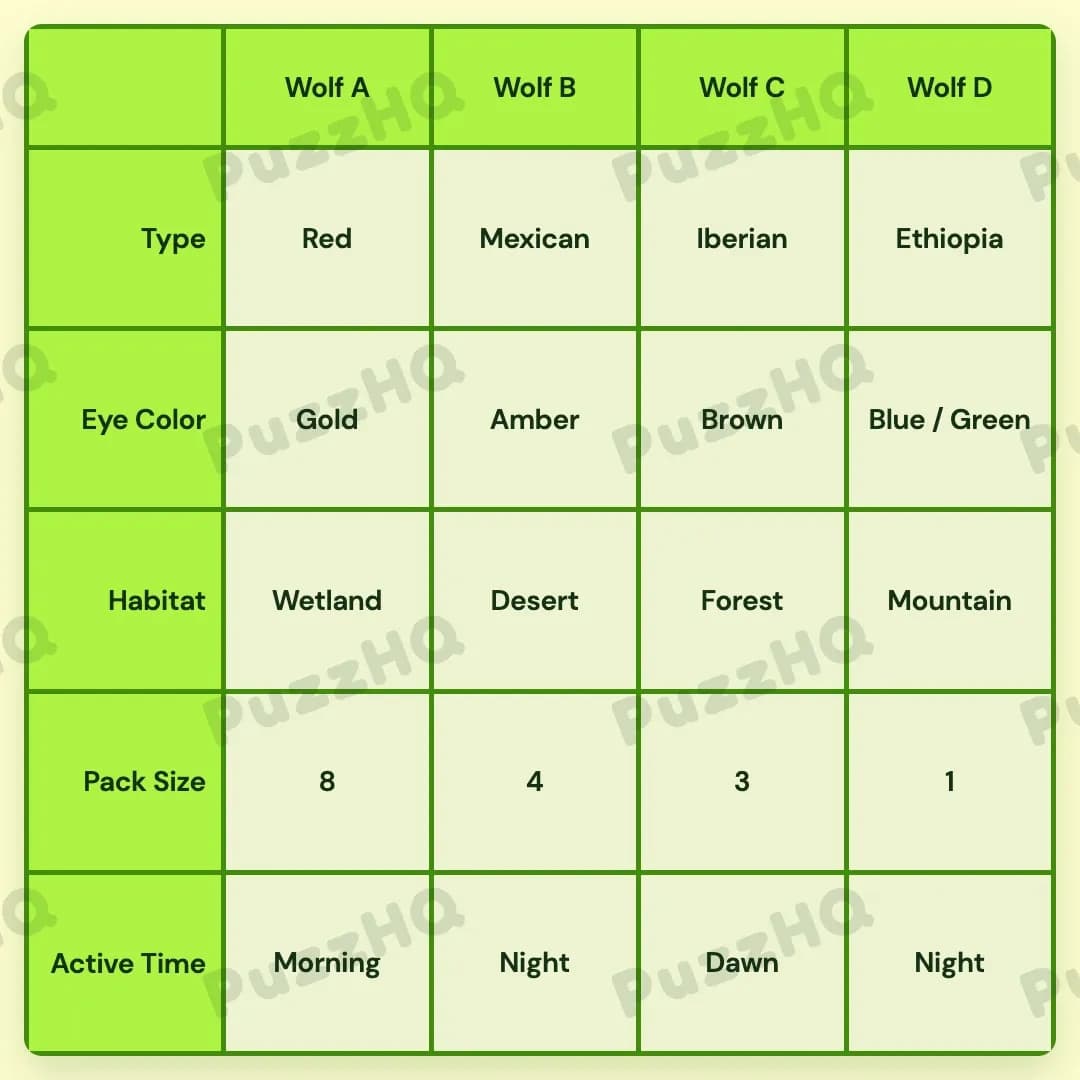
The four packs arrange neatly from left to right as the Red wolf in the wetlands, the Mexican wolf in the desert, the Iberian wolf in the forest, and the solitary Ethiopian wolf on the mountain.
| Trait | Wolf A | Wolf B | Wolf C | Wolf D |
|---|---|---|---|---|
| Type | Red | Mexican | Iberian | Ethiopia |
| Eye Color | Gold | Amber | Brown | Blue / Green |
| Habitat | Wetland | Desert | Forest | Mountain |
| Pack Size | 8 | 4 | 3 | 1 |
| Active Time | Morning | Night | Dawn | Night |
How I Solved Profile Perfect Level 562
Looking over the clues for the first time, what immediately caught my attention was how several statements tied specific wolf types to behavioral habits and physical locations. Between a solo hunter, a wolf sandwiched between two neighbors, and a pair of wolves sharing the largest pack sizes, there were distinct structural anchors that made it possible to reconstruct the board without guesswork.
Finding The Anchor For The Right Edge
The first thing I noticed was the description of the Ethiopia wolf. One clue mentioned that the Ethiopia wolf was found active at Night working in solitary. Right alongside that, another clue noted that the solo hunter usually roams around Mountain. This established a concrete profile for a wolf with a pack size of 1, an active time of Night, and a habitat in the Mountain.
At the same time, a positional clue caught my eye: the brown-eyed wolf sits between the Mexican wolf and the nocturnal wolf. Because a wolf can only sit between two others if it occupies one of the inner columns, the brown-eyed wolf had to be Wolf B or Wolf C.
If the brown-eyed wolf were Wolf B, it would need neighbors on both sides, which would force the nocturnal wolf and the Mexican wolf into Wolf A and Wolf C. However, we also had a clue stating that an Amber-eyed wolf in the left half lives around the Desert. If Wolf B had brown eyes, Wolf A would have to take the Amber eyes and the Desert. But another clue linked Red wolves directly to shining Golden eyes, leaving no comfortable room on the left side for the Mexican wolf while respecting the other matches.
Placing the brown-eyed wolf at Wolf C resolved this neatly. That positioned the Mexican wolf at Wolf B, and the nocturnal wolf at Wolf D. Because the Ethiopia wolf was already known to be nocturnal and solitary, Wolf D naturally took the Ethiopia type, the Mountain habitat, the Night active time, and a pack size of 1.
Identifying The Iberian Wolf And The Center Columns
With Wolf D confirmed as the solitary Ethiopia wolf and Wolf B established as the Mexican wolf, Wolf C was clearly the brown-eyed wolf between them.
Looking at the remaining types, we had the Iberian wolf and the Red wolf left to place. A direct clue told us that Iberian wolves live in the area of deep woods, which matched the Forest habitat option. Another clue mentioned that the Iberian wolf has an active time different from the others. Since Wolf B was already identified as Mexican, Wolf C was the only candidate left for the Iberian wolf.
That immediately locked in Wolf C as the Iberian wolf with Brown eyes living in the Forest.
Because Wolf C was Iberian, Wolf B was Mexican, and Wolf D was Ethiopia, only Wolf A remained for the Red wolf. As soon as Wolf A took the Red wolf label, the clue stating that Red wolves have shining Golden eyes became immediately actionable. That gave Wolf A its Gold eye color.
Sorting Habitats And Eye Colors Across The Left
Once Wolf A was locked as the Red wolf with Gold eyes, the eye color options simplified drastically. Only Amber and the remaining mix remained open.
The clue about the left half came into focus: a type of wolf with Amber eyes in the left half lives around Desert. The left half consists only of Wolf A and Wolf B. Since Wolf A already held Gold eyes, Wolf B was forced to take the Amber eyes along with the Desert habitat.
From there, habitat assignments were nearly complete. Wolf B was in the Desert, Wolf C was in the Forest, and Wolf D was in the Mountain. The only unassigned habitat was Wetland, which naturally fell to Wolf A.
Looking at eye colors, Wolf A had Gold, Wolf B had Amber, and Wolf C had Brown. The clue stating that the wolf active at Night has Green eyes applied directly to Wolf D, giving it the combined Blue / Green entry and confirming its nocturnal schedule.
Resolving Active Times And Pack Numbers
With habitats, types, and eye colors fully settled, active times and pack sizes were all that remained.
For active times, we knew the Iberian wolf at Wolf C had a schedule distinct from the others. Another clue noted that a pack of wolves is active right before sunrise, which corresponds to Dawn. Setting Wolf C to Dawn satisfied the condition of having an active time different from the rest. Because Wolf D was already confirmed as Night from its solitary Ethiopia clue, and Wolf C was Dawn, we had Morning and Night left to distribute between Wolf A and Wolf B.
The clue that placed the brown-eyed wolf between the Mexican and the nocturnal wolf reminded me that Wolf D was already nocturnal. Meanwhile, Mexican wolves also prowl after dark, so setting Wolf B to Night and Wolf A to Morning gave every column an active period that matched all constraints without contradiction.
Finally, the pack numbers fell into order through two related clues. One clue stated that the wolf types with the largest packs are next to each other. The available pack numbers were 8, 4, 3, and 1. The two largest packs, 8 and 4, had to occupy adjacent columns. The only adjacent pair with open pack sizes capable of holding both numbers was Wolf A and Wolf B.
Another clue specified that the biggest pack of wolves does not have Amber eyes. Because Wolf B possessed Amber eyes, the largest pack of 8 could not belong to Wolf B. It had to belong to Wolf A instead. That left 4 for Wolf B.
With pack size 1 already assigned to the solitary Ethiopia wolf at Wolf D, pack size 3 went cleanly into the last open slot at Wolf C. The entire board clicked together without a single gap.
The Point Where I Nearly Went Wrong
The easiest place to stumble in this puzzle involves the clue stating that the brown-eyed wolf is between the Mexican and the nocturnal wolf.
It is tempting to read "the nocturnal wolf" as an indication that there is only one wolf active at Night on the entire board. If you make that assumption, you might hesitate when both Wolf B and Wolf D end up with Night as their active time.
However, the phrasing functions purely as a reference point to distinguish the right-hand neighbor from the Mexican wolf on the left. Wolf D is specifically characterized as active at Night through its solitary Ethiopia clue, while Wolf B is identified by its type. The clue simply uses that trait to single out Wolf D without asserting that no other column could share a nighttime schedule. Recognizing that multiple wolves could hunt at night prevented me from discarding an otherwise seamless layout.
Looking Back At The Solution
The breakthrough for me came from combining the solitary Ethiopia hunter with the positional clue about the brown-eyed wolf. Once Wolf C was locked as the central bridge between the Mexican wolf and the nocturnal neighbor, the left and right halves of the puzzle separated cleanly, allowing habitats, pack sizes, and schedules to fall into place with steady momentum.
Comments