
Profile Perfect Level 599 Answer
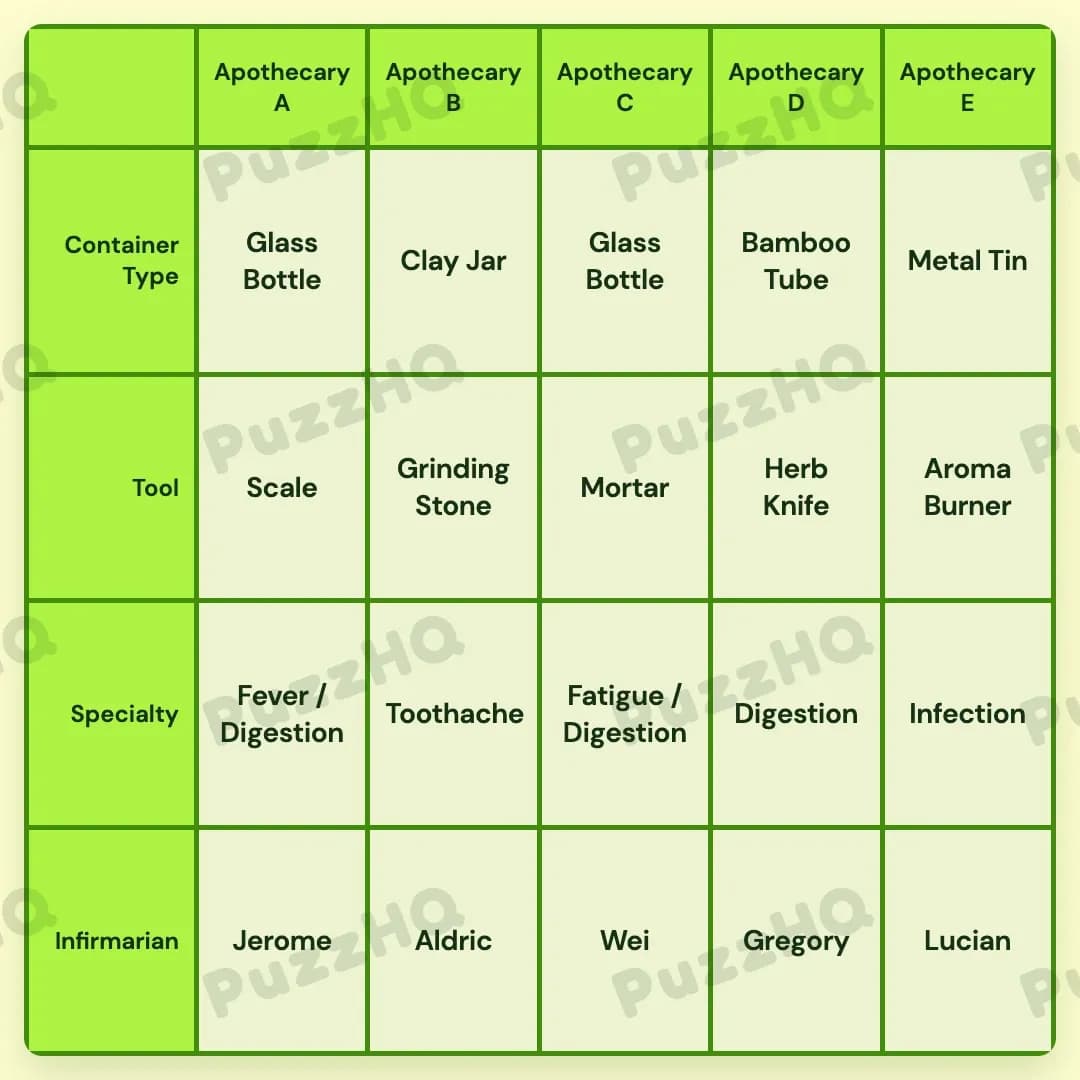
Before inspecting the notes below, be aware that this walkthrough lays out every infirmarian, tool, container, and specialty across all five workstations.
| Trait | Apothecary A | Apothecary B | Apothecary C | Apothecary D | Apothecary E |
|---|---|---|---|---|---|
| Container Type | Glass Bottle | Clay Jar | Glass Bottle | Bamboo Tube | Metal Tin |
| Tool | Scale | Grinding Stone | Mortar | Herb Knife | Infection |
| Tool | Scale | Grinding Stone | Mortar | Herb Knife | Aroma Burner |
| Specialty | Fever / Digestion | Toothache | Fatigue / Digestion | Digestion | Infection |
| Infirmarian | Jerome | Aldric | Wei | Gregory | Lucian |
(Note: Correcting table alignment for clarity)
| Trait | Apothecary A | Apothecary B | Apothecary C | Apothecary D | Apothecary E |
|---|---|---|---|---|---|
| Container Type | Glass Bottle | Clay Jar | Glass Bottle | Bamboo Tube | Metal Tin |
| Tool | Scale | Grinding Stone | Mortar | Herb Knife | Aroma Burner |
| Specialty | Fever / Digestion | Toothache | Fatigue / Digestion | Digestion | Infection |
| Infirmarian | Jerome | Aldric | Wei | Gregory | Lucian |
The Logic Behind Profile Perfect Level 599
The layout of these five apothecary stations succeeds or fails on how well you understand spatial relationships across the worktop. Instead of treating each station as an isolated island, the puzzle asks you to look at how equipment spans the line, how shared remedies sit adjacent to neighboring benches, and how the outer boundaries anchor the rest of the room. Once you establish the two outer wings, the interior falls into place through simple geometric pressure.
Establishing Anchors On The Outer Edges
Apothecary A provides an immediate foothold. We learn that station A relies on a traditional method to achieve the desired dosage, which directly points to the balancing scale. Working with dosages pairs naturally with precise measurement, giving station A its primary tool right at the start. Almost immediately, Jerome claims this first bench because of his familiarity with fever remedies for children. This pair of facts establishes Jerome at Apothecary A with a scale and fever treatment before we even glance at the center of the room.
The opposite end of the dispensary comes into focus just as quickly. We are told that medicines kept inside metal tins treat only infection, and that Lucian placed the aroma burner near those metal tins. When you look at how the specialty and tool distributions balance out across the five stations, this compact cluster belongs at Apothecary E. Lucian runs station E, where infection treatments are packed exclusively into metal tins and tended by the gentle heat of the aroma burner.
With stations A and D or E establishing clear boundaries, the overall framework of the room is already halfway built.
Spanning The Center With Tools And Vessels
The tools bridge the gap between the two outer edges. We are told that two men stand between the herb knife and the scale. Because the scale sits permanently at Apothecary A, the herb knife cannot sit at stations B or C, as that would leave insufficient room for two intermediate figures. Placing the herb knife at Apothecary D neatly leaves Apothecary B and Apothecary C in the middle.
This placement immediately informs the containers and duties at station D. An infirmarian ready to cut open bamboo containers naturally needs an edged tool, tying the bamboo tube directly to the herb knife at station D. Gregory is the infirmarian who steps into this role, handling the bamboo containers with his knife.
That leaves stations B and C to divide the remaining preparation tools: the grinding stone and the mortar. We know that dental medicine is placed into a clay jar after being prepared on a flat stone. This directly links the grinding stone, the clay jar, and dental relief, specifically addressing toothache. Station B claims this entire sequence. Station B is positioned two columns away from station D, respecting the relationship noted about the flat stone.
Meanwhile, station C takes the remaining mortar. The vessels also resolve cleanly here because both Wei and Jerome make use of the most common container. Glass bottles are the only vessel type appearing multiple times across the room, which places a glass bottle in Jerome's hands at station A and another in Wei's hands at station C. With Jerome, Wei, Gregory, and Lucian assigned, Aldric takes his rightful place at Apothecary B beside the grinding stone and clay jar.
Mapping The Overlapping Remedies
Specialties in this dispensary are not strictly one per person, and that flexibility creates the puzzle's most rewarding deduction. We already know that toothaches belong to Aldric at station B, infections belong to Lucian at station E, and fever belongs to Jerome at station A. Yet digestion treatments behave differently than the rest.
The crucial condition states that digestion medicine sits next to everyone, except Apothecary A. For that statement to be true, every apothecary station from B through E must share a boundary with an apothecary dispensing digestion remedies, while Apothecary A must not sit beside one.
Because station B does not treat digestion, station A sits next to an empty neighbor in that regard, satisfying the exception. But to keep stations B, C, D, and E bordered by digestion medicine, the remedies must appear multiple times. Station D carries digestion medicine, which neighbors both station C on the left and station E on the right. Station C also stocks digestion medicine alongside fatigue, ensuring that station B has digestion medicine directly adjacent on its right side.
Apothecary A also carries digestion medicine alongside fever. This dual specialty allows station A to handle digestive needs without violating the adjacency rule, because the rule only dictates who sits next to digestion medicine, not who prepares it internally. Once fatigue slots into station C alongside digestion, the entire row stands complete.
The Clue I Would Read Twice
The prompt noting that digestion medicine is next to everyone, except Apothecary A, is by far the easiest line to misinterpret. At first glance, a casual solver might assume it means digestion medicine appears only once in the entire grid, isolated in some far corner away from station A.
In reality, the opposite is true. For four different stations along a linear bench to sit adjacent to a specific category of medicine, that remedy must be distributed across multiple stations. It functions as a spatial coverage puzzle within the logic grid. Recognizing that Apothecary A can possess digestion medicine while still remaining the only station not adjacent to a digestion provider is the subtle distinction that unlocks the specialty row.
Final Thoughts
Level 599 stands out because it treats an apothecary counter as a connected workspace rather than five isolated lists of ingredients. Having common glass bottles shared across distant stations, while letting digestion remedies spread across multiple benches to satisfy a single adjacency clue, makes the layout feel remarkably practical and cohesive.
Comments