
Profile Perfect Level 606 Answer
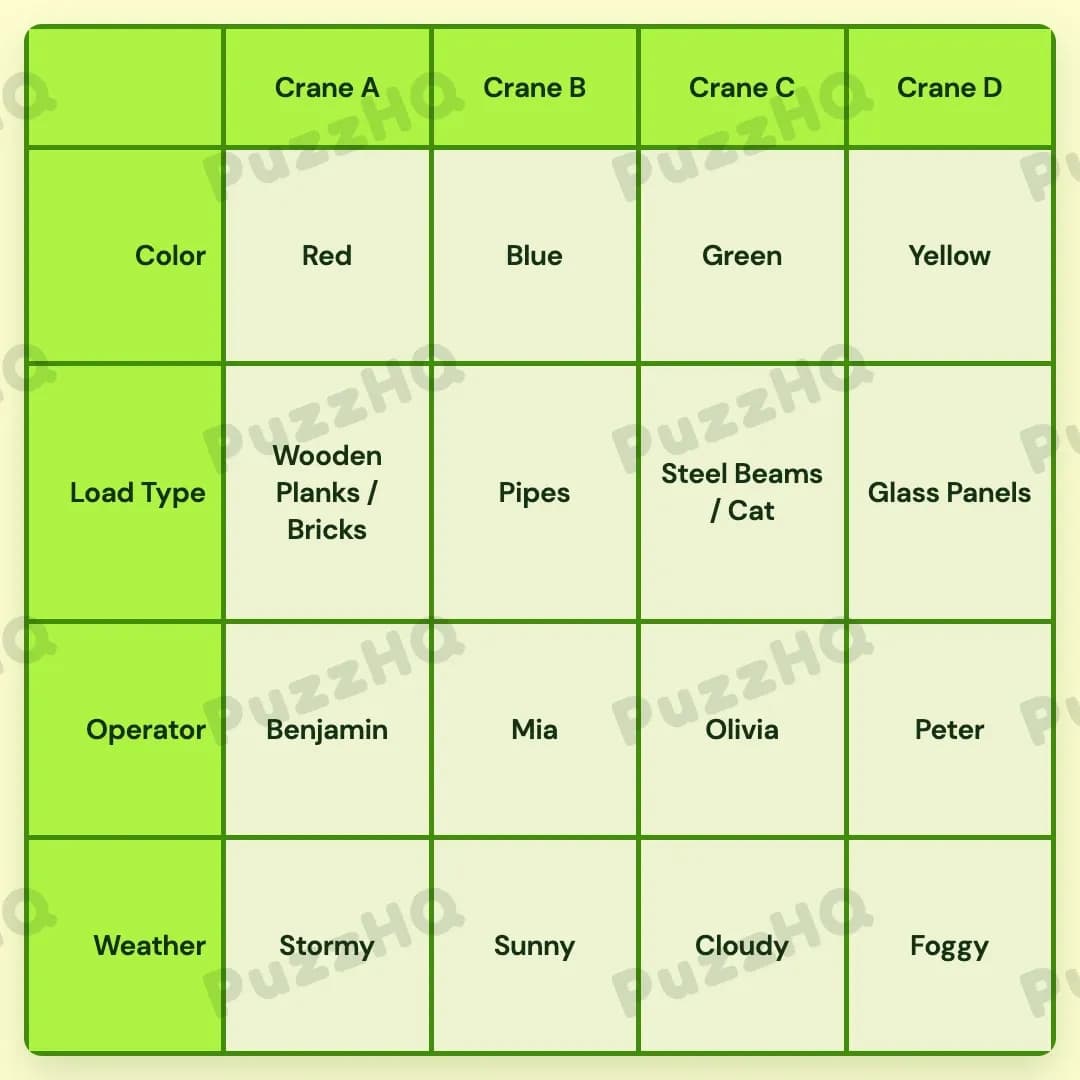
Before you look over the finished tally below, keep in mind that the cranes line up neatly from Crane A on the far left to Crane D on the right.
| Trait | Crane A | Crane B | Crane C | Crane D |
|---|---|---|---|---|
| Color | Red | Blue | Green | Yellow |
| Load Type | Wooden Planks / Bricks | Pipes | Steel Beams / Cat | Glass Panels |
| Operator | Benjamin | Mia | Olivia | Peter |
| Weather | Stormy | Sunny | Cloudy | Foggy |
The Logic Behind Profile Perfect Level 606
This grid finds its footing in spatial orientation. Rather than asking us to juggle an abstract soup of isolated pairings, the construction site behaves like a physical line of machinery stretching from left to right. Once you treat the four cranes as an ordered row where physical position restricts who can be adjacent to whom, the rest of the puzzle snaps into focus with surprising speed.
Laying Out The Loads From Left To Right
The easiest way to ground yourself is by looking directly at the crane deck and seeing what each rig is carrying. Right from the start, we learn that the leftmost crane carries the wooden planks. That immediately gives Crane A its cargo, pinning down our westernmost anchor on the board.
The remaining three loads fall into an unmistakable order thanks to a pair of clues describing how the materials are arranged. We are told that neither Crane A nor Crane B carries the glass or the beams. Because Crane A is already holding wooden planks and neither of the heavy structural materials can touch Crane B, the glass and the beams must belong to the remaining two spots, Crane C and Crane D.
From there, geometry finishes the job. The crane carrying the beams sits directly between the glass and the pipes. If the beams sit between two other loads, they cannot sit on an outside edge like Crane D. That forces the steel beams onto Crane C. By necessity, the glass panels must occupy Crane D on the far right, while the pipes take up Crane B in the middle. With that single sequence resolved, every cargo slot across the entire line of cranes is firmly identified.
Reading The Skies Above The Cabins
With the equipment locked in place, the weather patterns begin to dictate the machine colors and cabin locations. A couple of these connections show up almost casually. We are told that the person inside Green Crane C cannot see the sun despite otherwise pleasant conditions, which points squarely to cloudy skies over Crane C while simultaneously locking in green as its paint job.
Meanwhile, the operator inside the blue crane wishes they had brought their sunglasses. That strong hint of blinding light puts sunny skies directly overhead for the blue machine. We also know that Peter works in the yellow crane.
The decisive spatial link comes from the weather clue noting that two types of loads sit between the sunny and foggy weather. Looking at our row of cranes, Crane B is sunny. Right next to it sits Crane C, which holds two distinct types of cargo: steel beams and a small stowaway. Because those two loads sit nestled right in Crane C, the foggy weather has to belong to the crane just beyond it, which is Crane D.
That leaves only stormy weather unaccounted for, which naturally settles over Crane A at the far end of the yard. At the same time, we know Peter runs the yellow crane. Because Crane C is green and Crane B is blue, Peter and his yellow machine can only fit into Crane D. That leaves red as the sole remaining color for Crane A.
Matching Operators To Their Machines
Now that the yard is visually defined from paint to sky, the four crane drivers can take their seats. Some of these pairings hinge on understanding what is being lifted. Mia, for instance, lifts the item designed to circulate clear waters. Among our known payloads of timber, glass, steel beams, and plumbing hardware, pipes are the obvious conduit for running water. That places Mia in Crane B, operating the blue crane under the sun.
That leaves three operators to assign. Peter was already linked to the yellow cabin, which we found at Crane D. Benjamin is said to operate a crane with the color of his neighbor's hair, an eccentric detail that pairs him with the red machine at Crane A.
Olivia claims the remaining cabin at Crane C. Her assignment also explains the peculiar dual cargo listed for that rig. We are told an uninvited guest takes a ride on Olivia's crane. That surprise companion joins the steel beams, giving her machine the cat alongside the construction materials. The final operator falls into place, the line from Crane A to Crane D is fully staffed, and the whole yard stands complete.
The Clue I Would Read Twice
The clue stating that two types of loads sit between the sunny and foggy weather is easily the most fascinating piece of text in this solve.
On a first glance, many solvers naturally assume this means two entire crane stations must separate the sunny crane from the foggy one. If you read it that way, you might spend several minutes trying to stretch sunny and foggy across the extreme ends of the board at Crane A and Crane D.
The breakthrough comes when you look closely at how the cargo is actually cataloged. Crane C does not just carry a single item. It holds two distinct cargo types in one station because of the stray cat sharing the deck with the steel beams. Once you realize the clue is counting types of loads rather than physical crane towers, you realize Crane B and Crane D are the two weather posts framing Crane C. It is a wonderfully tight deduction that rewards anyone who pauses to read the exact wording.
Final Thoughts
What makes this level stand out is how neatly the thematic flavor supports the underlying deductions. From an unexpected stray cat hitching a ride on a beam to sunny glare reflecting off blue paint, every clue feels like an authentic glimpse of a busy workday rather than an arbitrary math problem. It is the kind of puzzle where paying attention to the scene itself makes the grid solve almost effortlessly.
Comments