
Profile Perfect Level 601 Answer
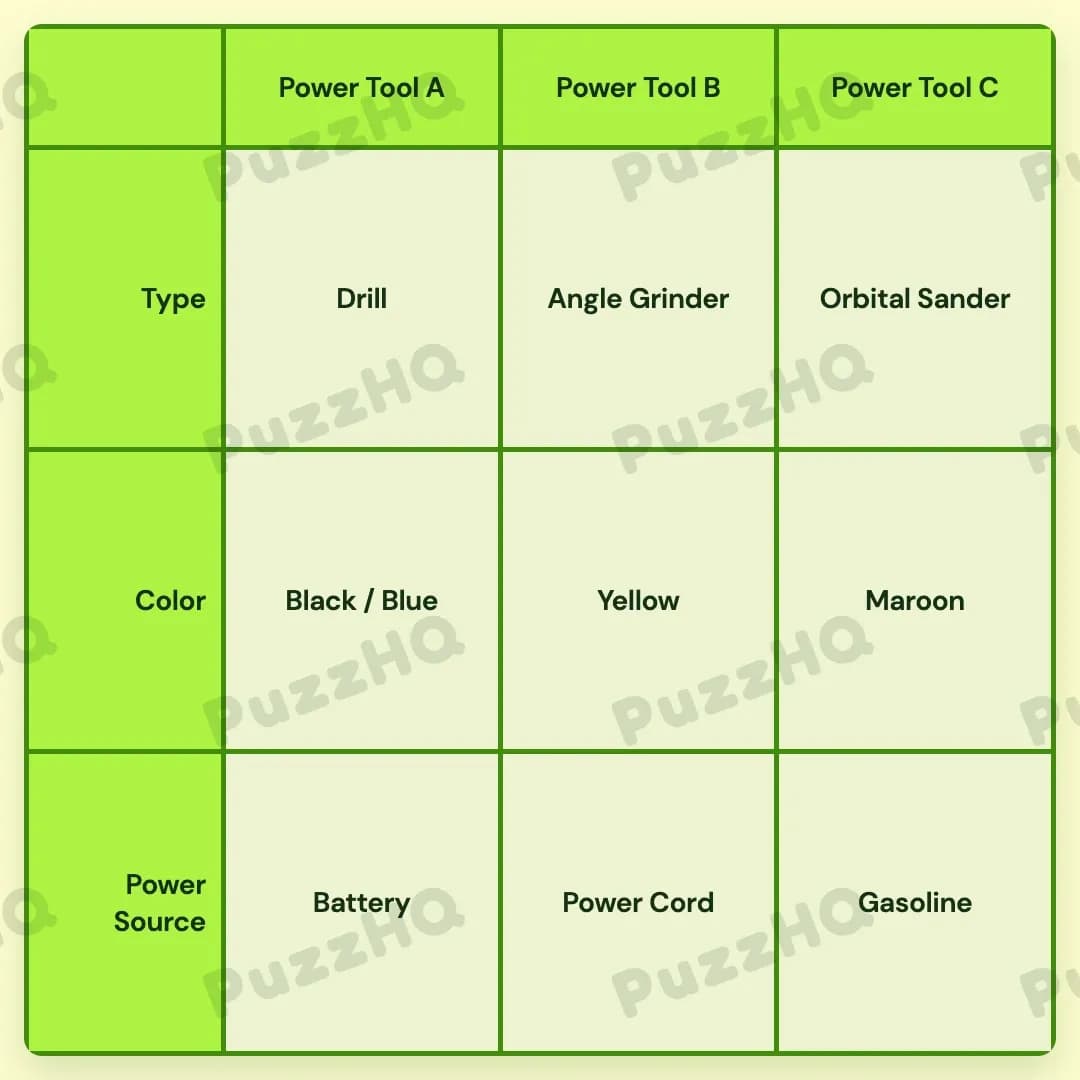
By aligning the structural requirements of tool types with their exterior colors, every power tool locks cleanly into its exact bench position and energy source.
| Trait | Power Tool A | Power Tool B | Power Tool C |
|---|---|---|---|
| Type | Drill | Angle Grinder | Orbital Sander |
| Color | Black / Blue | Yellow | Maroon |
| Power Source | Battery | Power Cord | Gasoline |
Building The Grid By Trait
Starting with isolated subjects can easily lead to unnecessary guesswork, but looking at how entire categories interact immediately reveals clear paths forward. In this puzzle, examining the Type and Color categories side by side yields the quickest breakthrough. Because positional clues and multi-color descriptions place tight boundaries on where equipment can sit, these two traits establish a sturdy frame that makes the remaining power choices simple to deduce.
Type And Color Establish The Physical Baseline
The Type row features the Drill, the Angle Grinder, and the Orbital Sander. The Color row introduces Yellow, Maroon, and a mixed Black and Blue finish. Solving these two categories together is far more productive than treating them as separate lists, because multiple statements bridge tool identities with their finishes and relative positions.
First, consider the relative horizontal arrangement. The clue stating that the Angle Grinder is situated to the right of the Drill immediately restricts the possible slots for these two devices. The Drill can never occupy the far right slot at Power Tool C, because there would be no available bench space to its right for the Angle Grinder. By that same logic, the Angle Grinder can never occupy the far left slot at Power Tool A.
Next, observe how the color information interacts with these positions. We learn that the Sander is fully coated in Maroon, and another rule reinforces that the Orbital Sander is not multi-colored. Meanwhile, another tool sports a split Black and Blue design. Because the Orbital Sander is confirmed to have a uniform Maroon exterior, it cannot possibly be the tool featuring the Black and Blue paint scheme.
The clue governing electrical needs notes that the tool next to the Blue one must be plugged into the wall. This relationship requires the Blue tool to have an adjacent neighbor. If the mixed Black and Blue color belongs to Power Tool A, its immediate neighbor is Power Tool B. Placing Black and Blue at Power Tool A assigns the Drill to that very same slot, cleanly accommodating the rule that the Angle Grinder rests to its right.
With Power Tool A established as the Drill with the Black and Blue color, the remaining tool types fall neatly into place. The Angle Grinder occupies Power Tool B, satisfying the requirement that it rests to the right of the Drill. That leaves Power Tool C as the only possible home for the Orbital Sander. Since the Sander is fully coated in Maroon, Power Tool C receives Maroon as its permanent trait. Finally, with Black and Blue assigned to Power Tool A and Maroon assigned to Power Tool C, the remaining color of Yellow naturally claims the center spot at Power Tool B. Both the Type and Color rows are now fully determined.
Power Source Resolves Across Neighboring Slots
With the tools and their color schemes firmly pinned across all three positions, the Power Source row becomes straightforward to solve. The available options in this category are Battery, Power Cord, and Gasoline.
The placement of the power cord follows directly from our earlier work with the colors. The rule states that the tool next to the Blue one needs to be plugged into the wall. Because Power Tool A carries the Black and Blue finish, its only adjacent neighbor is Power Tool B. Therefore, Power Tool B must be the tool that requires a wall outlet, granting it the Power Cord designation.
Only two options remain for the outer positions: Battery and Gasoline. The clue regarding engine mechanics notes that the Drill does not run on liquid fuel. Since Power Tool A is known to be the Drill, it cannot use Gasoline. Consequently, Power Tool A must rely on a Battery.
By elimination, the final remaining fuel choice of Gasoline belongs to Power Tool C. The entire Power Source row is now fully populated, completing the logic grid without requiring any trial and error.
Where The Trait Rows Intersect
Solving logic puzzles efficiently comes down to identifying statements that act as bridges between separate rows. In this bench layout, two specific intersections unlock the entire solution.
The Blue Color Trait Dictates The Wall Outlet Requirement
The statement specifying that the tool next to the Blue one needs to be plugged into the wall serves as an essential bridge between the Color row and the Power Source row. Rather than describing an item's own power needs, it projects a requirement onto an adjacent neighbor based entirely on the exterior paint of the first tool.
Once the dual Black and Blue color is locked to Power Tool A, this clue instantly targets Power Tool B as the recipient of the wall plug. Without this cross-category link, the Power Source row would remain ambiguous between the three slots. Connecting an adjacent color identity directly to an electrical supply constraint removes all doubt and anchors the central power source immediately.
Drill Identification Eliminates Liquid Fuel At Tool A
The second crucial intersection connects the Type category to the Power Source category through the statement that the Drill does not run on liquid fuel. Once Power Tool A is identified as the Drill, this fuel restriction immediately rules out Gasoline for the first column.
Because the central slot is already claimed by the Power Cord, Power Tool A is left with only one viable option: the Battery. This single negative restriction prevents Gasoline from floating between the ends of the bench and immediately propels Gasoline into its final home at Power Tool C alongside the Orbital Sander.
Final Grid Check
Reviewing the finished layout confirms that every requirement is satisfied without conflict. The Drill sits at Power Tool A with a Black and Blue coat and runs on a Battery. Directly to its right, Power Tool B holds the Yellow Angle Grinder plugged into the wall with a Power Cord. At the far right, Power Tool C hosts the Maroon Orbital Sander powered by Gasoline. Every trait row reinforces the others, forming an airtight, fully verified solution.
Comments