
Profile Perfect Level 612 Answer
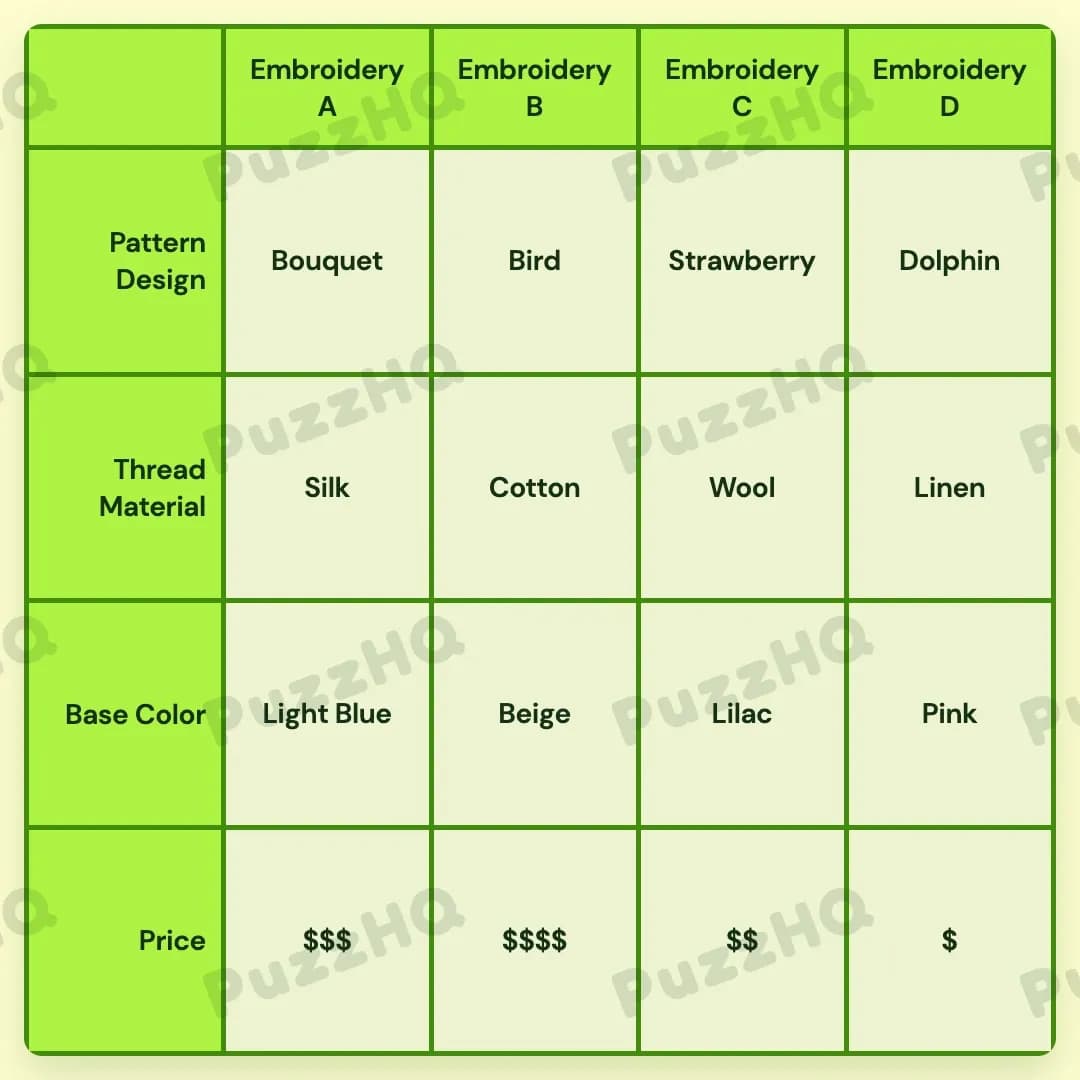
A careful balance between spatial edges and thread textures brings this gallery of needlework into sharp focus.
| Trait | Embroidery A | Embroidery B | Embroidery C | Embroidery D |
|---|---|---|---|---|
| Pattern Design | Bouquet | Bird | Strawberry | Dolphin |
| Thread Material | Silk | Cotton | Wool | Linen |
| Base Color | Light Blue | Beige | Lilac | Pink |
| Price | $$$ | $$$$ | $$ | $ |
The Logic Behind Profile Perfect Level 612
The heart of this puzzle rests on a tug between opposite ends of the display. Rather than gathering around a single dense focal point, the solve asks you to recognize how the boundaries define everything between them. Once the outer edges are pinned down through spatial alignment and price extremes, the middle pieces settle into place with surprising clarity.
Setting The Outer Boundaries
The grid immediately offers a firm starting position on the far left. We learn that beautiful flowers are embroidered onto the leftmost craft. That places the bouquet pattern directly into the first slot, Embroidery A.
From there, the eye naturally travels to the opposite side of the table. We are told that the cheapest craft sits at the far end from the piece with the Light Blue base. Because the four pieces run in a linear sequence from Embroidery A to Embroidery D, any pair sitting at the far end from one another must occupy the outer edges. If Light Blue were anywhere in the middle, no single piece could claim to sit at the far end from it.
Light Blue belongs at the leftmost position, sharing Embroidery A with the bouquet of flowers. That puts the cheapest craft all the way across the display at Embroidery D.
We can immediately identify that lowest price tier as the single dollar mark. Another observation connects this bargain price to its subject: the dolphin pattern was made by an amateur, which explains why it costs so little. The dolphin and the single dollar price tag land squarely on Embroidery D, anchoring the right side of the board as firmly as the bouquet anchors the left.
Sorting The Middle By Cost And Motif
With both extremities locked down, the puzzle turns inward to resolve the remaining values and patterns.
The relative pricing clues do most of the heavy lifting here. We are given an exact benchmark: the Lilac embroidery is cheaper than two other crafts. In a four item lineup with distinct price ranks, being cheaper than two items means exactly two crafts cost more. Lilac cannot be the cheapest piece, because the dolphin at Embroidery D already holds that rank, and it cannot be among the top two costs. That leaves Lilac sitting precisely at the two dollar tier.
Since Embroidery A already claims Light Blue and Embroidery D holds the single dollar dolphin, Lilac can only belong to Embroidery C.
The remaining price tiers quickly resolve themselves. Embroidery B must take the top price of four dollars, which leaves the three dollar mark for Embroidery A.
Pattern placement in the interior follows an equally tidy path. The bird pattern is placed right beside the leftmost craft, positioning it at Embroidery B. With the bouquet on Embroidery A, the bird on Embroidery B, and the dolphin on Embroidery D, the strawberry design has only one available position left. It drops into Embroidery C, resting on the Lilac base.
Matching Fluff, Gloss, And Pale Fabric
The final stage of the solve shifts from geometry and price tags to the physical character of the materials themselves.
One clue remarks that the red fruit somehow looks very fluffy. The only red fruit in the collection is the strawberry at Embroidery C. To achieve that raised, textured look, the stitcher used wool. Wool thread therefore pairs directly with the strawberry on the Lilac base.
Next comes the question of the fabric bases and their corresponding threads. Cotton thread is stitched into the pale base. Looking at the remaining color choices, beige is the only shade that fits the description of a pale fabric. That pairs cotton thread and beige together at Embroidery B, which leaves pink as the final available base color for the dolphin at Embroidery D.
All that remains is deciding where the silk and linen threads belong. A brief note informs us that the glossy thread is not stitched into the pink base. Silk provides that characteristic gloss, meaning it cannot sit on Embroidery D. Silk instead finds its home on Embroidery A alongside the bouquet and the Light Blue cloth. Linen takes the remaining spot on Embroidery D, completing the amateur dolphin piece.
The Clue I Would Read Twice
The clue that deserves a second glance is the quiet statement that the Lilac embroidery is cheaper than two other crafts.
It is easy to misinterpret comparative phrasing as a loose inequality, the sort of clue that requires you to wait for several other pieces to fall before taking action. Solvers often hold such clues in reserve, expecting to test multiple possibilities later.
In a set of four distinct tiers, however, saying an item is cheaper than two others does not create a range of options. It specifies an exact rank. Exactly two items are more expensive, and exactly one item is less expensive. Because the cheapest item was already identified at the far right edge, the Lilac piece had no choice but to settle into the two dollar position. Reading that clue with mathematical precision cuts through what might otherwise feel like an open ended middle game.
Final Thoughts
What makes this particular solve memorable is how neatly the tactile descriptions mirror the logic of the grid. Phrases about fluffy fruit, glossy sheen, and amateur stitchwork feel less like dry constraints and more like genuine notes taken while wandering through an artisan market. The structure never feels arbitrary when the visual details do so much work to guide your hand.
Comments