
Profile Perfect Level 614 Answer
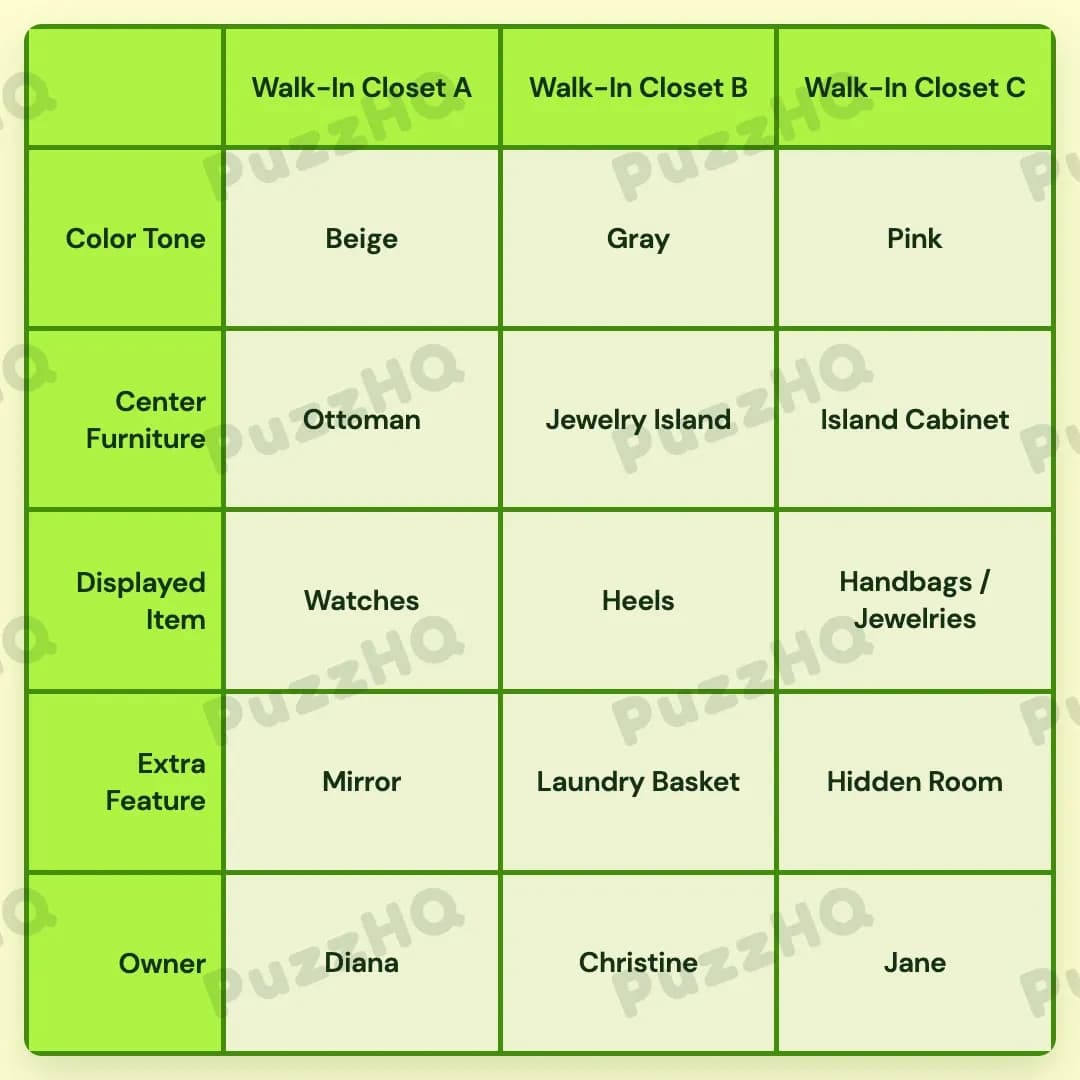
Walk-In Closet A belongs to Diana in beige with an ottoman, watches, and a mirror, Walk-In Closet B belongs to Christine in gray with a jewelry island, heels, and a laundry basket, and Walk-In Closet C belongs to Jane in pink with an island cabinet, handbags and jewelries, and a hidden room.
| Trait | Walk-In Closet A | Walk-In Closet B | Walk-In Closet C |
|---|---|---|---|
| Color Tone | Beige | Gray | Pink |
| Center Furniture | Ottoman | Jewelry Island | Island Cabinet |
| Displayed Item | Watches | Heels | Handbags / Jewelries |
| Extra Feature | Mirror | Laundry Basket | Hidden Room |
| Owner | Diana | Christine | Jane |
How To Think Through Profile Perfect Level 614
Solving this puzzle efficiently depends on finding fixed positional anchors before trying to resolve descriptive pairs. When a clue specifies a literal position like leftmost or middle, it provides an immovable reference point on the board. Once those anchor points exist, spacing clues that mention exact distances between subjects become simple elimination tools rather than guesswork.
Anchor Exact Positions First: Ottoman And Heels
Direct location clues should always be your opening move because they take zero guesswork to place.
In this puzzle, two clues give away fixed positions immediately:
- The leftmost closet's center furniture is designed for seating.
- The middle featured item tires its wearer the quickest.
Because Walk-In Closet A is the leftmost column, its center furniture must be designed for seating. Looking at the furniture choices, the ottoman is the only seat. You can place the ottoman directly into Walk-In Closet A under center furniture.
Next, look at the middle closet, which is Walk-In Closet B. The item that tires its wearer the quickest refers to high-heeled shoes. That means heels must be the displayed item in Walk-In Closet B.
Placing these two facts immediately locks down two columns. You now have established anchors in both Walk-In Closet A and Walk-In Closet B, which will help test and eliminate options in subsequent clues.
Use Column Distance To Constrain The Extremes: Mirror And Jane
Distance clues give you powerful structural boundaries, especially on a three-column grid.
One clue states that the big mirror is two columns away from Jane. On a board with only three columns (Walk-In Closet A, Walk-In Closet B, and Walk-In Closet C), a gap of two columns has only one geometric possibility: one item must be in Walk-In Closet A, and the other must be in Walk-In Closet C.
This leaves two possible arrangements:
- Option 1: The mirror is in Walk-In Closet A, and Jane owns Walk-In Closet C.
- Option 2: Jane owns Walk-In Closet A, and the mirror is in Walk-In Closet C.
To decide between these two arrangements, cross-reference this requirement with the clue mentioning Jane's closet furniture: Jane's feminine-themed closet includes a cabinet.
The available center furniture list contains the island cabinet. If Jane owns a cabinet, her closet must be able to hold the island cabinet. However, you already placed the ottoman into Walk-In Closet A during the very first step. Because Walk-In Closet A is already occupied by the ottoman, Jane cannot belong in Walk-In Closet A.
This single conflict collapses the options:
- Jane must be the owner of Walk-In Closet C.
- The mirror must be the extra feature in Walk-In Closet A.
- The island cabinet must be the center furniture in Walk-In Closet C.
Notice how the spacing clue narrowed the layout down to two opposite ends, and the previously anchored furniture instantly revealed which end was correct.
Layer Clues Onto Established Owners: Hidden Room And Diana
Once a subject has an assigned column, any clue referring to that subject applies to that column right away.
Now that Jane is confirmed as the owner of Walk-In Closet C, consider the clue stating that only Jane can access the extra feature in her closet. Among the available extra features (mirror, laundry basket, and hidden room), a feature restricted to a single person clearly describes the hidden room. You can immediately assign the hidden room to Walk-In Closet C as its extra feature.
Next, look at the vocabulary clue regarding Diana: Diana is a die-hard horologist who knows her craft well.
A horologist is someone who studies or collects timepieces, which links Diana directly to watches. This establishes an inseparable pair: Diana must share a closet with watches.
Look at where this pair can fit:
- Walk-In Closet C is already owned by Jane.
- Walk-In Closet B already has heels as its displayed item, so it cannot accommodate watches.
- Walk-In Closet A has an open owner slot and an open displayed item slot.
Therefore, Diana must own Walk-In Closet A, and her displayed item must be watches.
With Diana in Walk-In Closet A and Jane in Walk-In Closet C, only one owner remains unplaced. Christine must be the owner of Walk-In Closet B.
Complete Remaining Categories Through Neighbor Logic And Elimination
At this stage, most of the board is filled, leaving only a few empty cells across color tone, center furniture, displayed items, and extra features.
Begin with color tones using the neighbor clue: the gray closet is next to the pink one.
Earlier, a clue referred to Jane's closet as feminine-themed, which aligns with pink. If Walk-In Closet C is pink, the clue demands that gray sits directly next to it. That places gray into Walk-In Closet B. With gray and pink allocated, the only remaining color tone is beige, which fills Walk-In Closet A.
Now, finish the remaining single vacancies in each trait row:
- Center Furniture: Walk-In Closet A has the ottoman, and Walk-In Closet C has the island cabinet. The remaining furniture piece, the jewelry island, belongs to Walk-In Closet B.
- Extra Feature: Walk-In Closet A has the mirror, and Walk-In Closet C has the hidden room. The remaining feature, the laundry basket, belongs to Walk-In Closet B.
- Displayed Item: Walk-In Closet A displays watches, and Walk-In Closet B displays heels. The final displayed item choice, handbags and jewelries, belongs to Walk-In Closet C.
The entire grid is now completely solved without a single guess.
What This Level Teaches You
Fixed Positional Clues Outrank Free-Floating Pairs
Whenever a clue mentions an exact board position such as leftmost or middle, treat it as priority one. In this puzzle, identifying the ottoman in the leftmost spot and the heels in the middle spot established reliable boundary conditions. Free-floating pairs like Diana and watches are much easier to slot into place when two of the three columns already have occupied rows.
Maximum Distance Clues Pin Items To Outer Columns
On a three-column board, any clue requiring two items to be two columns apart automatically forces them into the first and third columns. You do not need to know which item goes on which side right away. Recognizing that the pair occupies the outer edges allows you to test both ends against already established items, just as the ottoman in Walk-In Closet A instantly ruled out Jane.
Descriptive Themes Resolve Remaining Neighbors
When an adjacency clue mentions two traits without stating which comes first, look for supporting descriptive keywords elsewhere. The neighbor clue stated that gray is next to pink, but did not specify their order. Connecting the earlier reference to Jane's feminine theme directly to pink assigned pink to Walk-In Closet C, which immediately pulled gray into Walk-In Closet B.
Final Thoughts
The defining habit for solving Level 614 is letting layout constraints do the heavy lifting. By placing literal position clues first, you transform wide-open spacing clues into definitive choices, making the remaining deductions smooth and inevitable.
Comments